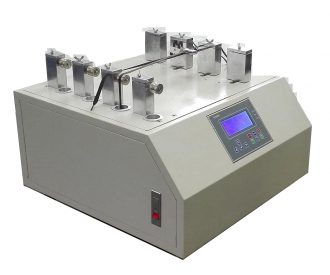
The shoelace abrasion testing machine is an indispensable piece of equipment in modern footwear manufacturing and testing. Its design and application play a crucial role in ensuring the quality and durability of shoelaces.
The shoelace abrasion tester simulates the reciprocating friction of shoelaces under specific tension to determine their lifespan. The test should continue until the sample breaks or reaches a preset number of cycles. Two shoelaces are placed horizontally and crossed in a movable clamp, rubbing against each other to measure their abrasion resistance. Four sets of samples can be tested simultaneously.
Shoelace abrasion resistance testing is a crucial part of evaluating shoelace quality. It simulates the friction and wear of shoelaces in actual use to test their wear resistance. Test methods include the double shoelace interlocking test and the shoelace friction test through eyelets held by fiberboard clamps.
In the daily use of footwear, shoelaces frequently rub against eyelets, hooks, and each other. This continuous friction can lead to:
Surface fraying and thread breakage: Affecting aesthetics and gradually weakening the shoelace strength.
Eventual breakage: Potentially causing the wearer to trip, posing safety risks in sports or specific work environments.
Decreased user experience: Worn shoelaces are harder to tie and look old.
Therefore, scientific and quantifiable abrasion resistance testing of shoelaces is an essential step in evaluating their quality level, verifying new materials, and improving production processes.
The working principle of the shoelace abrasion testing machine is based on simulating the wear and tear of shoelaces during actual use. The device uses specific clamps and a reciprocating motion mechanism to repeatedly rub the shoelace under a set tension, thereby evaluating its abrasion resistance. Specifically, one end of the shoelace is fixed to a movable clamp, while the other end is connected to a weight via a pulley, creating a certain tension. When the device is started, the movable clamp drives the shoelace in a reciprocating motion, causing friction with the shoelace or eyelet fixed at the other end, until the shoelace breaks or reaches the predetermined number of friction cycles.
The purpose of abrasion testing is to evaluate the abrasion resistance of materials or coatings to ensure their durability and service life in actual use. By simulating the wear process under actual use conditions, the test can provide information on the wear rate, wear mechanisms, and durability of the material under different wear mechanisms. This information is of great significance for material selection, product design, and performance optimization. Abrasion testing can also help engineers and researchers understand the wear rate, wear mechanisms, and durability of materials under different conditions, thus providing a scientific basis for material selection, product design, and performance optimization.
1. Take one or more shoelace samples for testing;
2. Leave the shoelace samples in a laboratory environment for more than 16 hours;
3. Hook the middle sections of two shoelace samples together;
4. Clamp the right end of the shoelace sample;
5. Clamp the left end of the shoelace sample;
6. Remove the sample guide;
7. Turn on the power switch and set the number of test cycles;
8. Press the test button to start the test;
9. After the test cycles are completed, remove the sample, observe the degree of friction on the sample, and make a judgment according to the standard requirements. If the shoelace breaks before reaching the set number of cycles, record the number of cycles at which it broke.
In industrial production and research and development processes, wear testing machines, as important experimental equipment, are widely used in the testing and evaluation of materials, mechanical parts, and other industries. To ensure their long-term efficient operation and accurate test data, daily maintenance is crucial. This article will discuss the key points of wear testing machine maintenance, analyze common maintenance methods, precautions, and maintenance strategies to help users maximize equipment performance and extend its service life.
Maintenance of wear testing machines should begin with cleaning and lubrication. Regularly cleaning the machine of dust and dirt not only prevents impurities from affecting test results but also effectively reduces component wear caused by dirt. For electrical systems, the connections of wires and circuits should be checked regularly to prevent failures caused by power fluctuations. Especially for wear testing machines operating in high-temperature environments, the replacement of lubricating oil is crucial. Choosing the appropriate lubricating oil and ensuring the smooth operation of the lubrication system is key to avoiding machine failures caused by friction.
Maintenance of wear testing machines should also include regular inspection of the wear of various components. Worn parts should be replaced promptly, especially critical components that directly affect test results, such as friction discs and friction materials. The measurement system should be calibrated during each maintenance procedure to ensure that its measurement accuracy meets standard requirements. The control system of the wear testing machine should be regularly upgraded and debugged to improve the automation and stability of the equipment.
Maintenance of wear testing machines requires professional technical support and meticulous operation. Only through systematic maintenance can equipment failures and loss of accuracy be effectively prevented, thus ensuring the reliability of test results.
In summary, the shoelace wear testing machine is of great significance in the field of footwear manufacturing and testing. Its scientific and reasonable testing methods and clear and precise testing steps provide strong support for accurately evaluating shoelace wear resistance. Meticulous maintenance is crucial to ensuring the long-term stable operation of the testing machine and the continuous output of accurate data. Only by paying attention to and doing well in these aspects can we continuously improve the quality of shoelaces and promote the footwear industry towards higher quality and greater reliability.


