The Reciprocating Abrasion Tester is a category of experimental equipment used to evaluate the performance of materials under friction and wear environments. In fields such as materials science, mechanical engineering, surface treatment, and lubricant research, friction and wear characteristics are critical indicators affecting product lifespan, reliability, and quality. Therefore, quantitatively assessing the wear resistance of materials through standardized testing methods is of great significance for R&D, quality control, and product benchmarking. The reciprocating abrasion tester is a primary tool designed to simulate the reciprocating friction and wear processes of materials under actual working conditions.
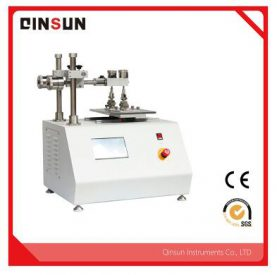
As the name suggests, a reciprocating abrasion tester is an instrument based on reciprocating motion to apply wear. Unlike rotary abrasion or rolling friction devices, it generates wear effects by moving a test specimen and an abradant (abrasive material) in a back-and-forth linear (or similar) motion under constant contact. Its primary objective is to simulate the wear behavior produced by reciprocating sliding or repetitive rubbing in practical applications and to provide a quantitative evaluation of wear performance based on specific parameters and standards.
These testers can feature various motion patterns, such as linear reciprocating, rotary reciprocating, or elliptical reciprocating modes, to adapt to different standards and testing requirements.
The core principle involves applying a specific load and causing the specimen and the abrasive material (such as friction pads, sandpaper, or abrading heads) to make repetitive contact under defined load and speed conditions. The basic operational steps include:
Specimen Fixation: The material sample is securely mounted on the test platform or sliding carriage.
Load Application: A specified load is applied to the specimen surface via weights, a force arm, or a loading device to simulate actual contact pressure.
Reciprocating Motion: The friction device (or specimen platform) moves at a preset stroke length and frequency, causing the abrading head to slide repeatedly across the sample surface.
Wear Action: During the process, wear, scratches, or surface damage are generated.
Evaluation: Wear resistance is typically evaluated through indicators such as weight loss, surface morphology, or wear scar depth.
Parameters such as frequency, stroke length, and load are adjustable to meet various standards, material types, and testing objectives. Many designs utilize a balanced arm or lever system to ensure the load is accurately transmitted to the surface, enhancing repeatability.
The technical specifications generally include:
Load Range: The magnitude of force applied to the specimen, usually measured in Newtons (N) or grams-force (gf).
Stroke Length: The distance of the back-and-forth motion, typically adjustable from a few millimeters to dozens of millimeters.
Reciprocating Frequency/Speed: The number of cycles per unit of time, used to simulate the impact of different friction velocities.
Abrasive Media: Various materials such as sandpaper, industrial fabrics, or steel balls used to simulate different wear conditions.
Specimen Size and Mounting: Fixtures must be adaptable to various sizes of flat or flexible samples.
Material Research: Evaluating the wear resistance of rubbers, plastics, coatings, metals, and composites to optimize material selection.
Lubricant and Grease Testing: Assessing the ability of lubricants to reduce wear and friction coefficients under reciprocating conditions.
Textiles and Fabrics: Simulating the repetitive rubbing of clothing or upholstery to determine durability.
Surface Treatments and Coatings: Comparing the scratch and wear resistance of different coating processes or surface hardening techniques.
Automotive and Aerospace: Predicting the durability of interior components, seals, and structural parts under daily or extreme conditions.
Testing Process and Evaluation
The standard procedure involves:
Preparation: Cutting, leveling, and cleaning the specimen; selecting the appropriate abradant.
Setup: Fixing the sample and setting the stroke, speed, and load.
Execution: Running the machine for a predetermined number of cycles.
Data Analysis: Using tools like analytical balances (for mass loss), microscopes, or 3D profilometers to perform quantitative analysis of the wear tracks.
Advantages: High controllability of test conditions, excellent repeatability, and broad applicability across different material hardness levels.
Limitations: While excellent for linear wear, it may not fully replicate complex multi-directional or rotational wear patterns found in certain mechanical joints.
The reciprocating abrasion tester is an indispensable tool in material evaluation and quality control. By precisely controlling motion, load, and media, it effectively simulates real-world wear environments. As measurement technologies and standardization continue to evolve, these testers will play an increasingly vital role across a wider range of industries.


