In the research and development and production of electronic products, automotive interiors, and home appliance casings, the abrasion resistance of material surfaces directly affects product lifespan and user experience. The RCA paper tape abrasion tester, as a standardized device for evaluating the abrasion resistance of surface coatings, films, and printed layers, has become an essential tool for quality control in the industry due to its ease of operation and reliable results.
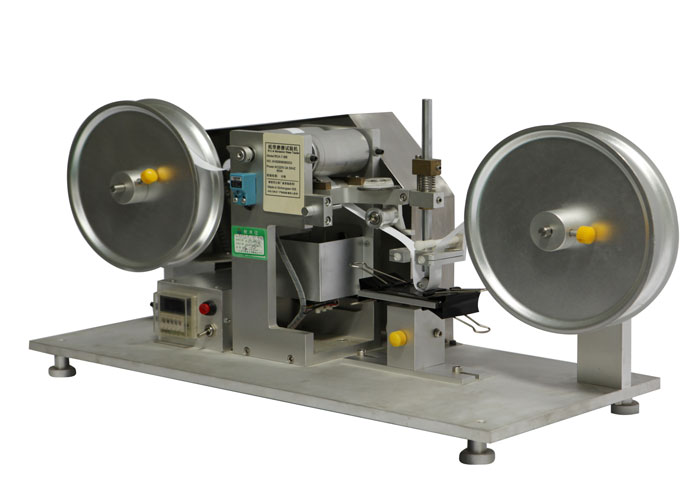
The RCA paper tape abrasion tester quantifies the abrasion resistance of material surfaces by simulating physical effects such as friction and scratching in daily use. Its core structure includes a drive system, a loading device, a paper tape transport system, and a counting module:
Drive System: A motor drives a rotating roller, propelling the paper tape to contact the sample surface at a constant speed. The rotation speed is typically adjustable from 157 mm to 2670 mm per minute to ensure consistent testing conditions.
Loading Device: Vertical pressure is applied via springs or weights. Standard test loads are available in three levels: 55g, 175g, and 275g, simulating different force scenarios such as light touch, pressing, and friction. For example, a 175g load is commonly used for testing mobile phone screen coatings, while a 275g load is used for testing the abrasion resistance of keyboard keyprints.
Paper Tape Transport System: Utilizes specialized abrasion-resistant paper tape (such as Norman Tools 7-IBB-CC standard paper tape), with a surface covered in alumina or silicon carbide microparticles. The uniform particle size distribution ensures stable friction. The paper tape is wound around the roller in single or double layers and automatically refreshes after each cycle, avoiding errors caused by repeated use.
Counting Module: A high-precision counter records the number of friction cycles, ranging from 0 to 99.999.999. It supports preset test termination conditions (such as automatic shutdown upon a fixed number of cycles or sample damage).
RCA testing methods have formed a multi-national standard system centered on the American Society for Testing and Materials (ASTM), with ASTM F2357-04. "Test Method for Abrasion Resistance of Inks and Coatings for Membrane Switches," being the most representative:
Sample Preparation: Samples must be at least 25mm × 25mm in size, with a smooth, defect-free surface. For curved samples (such as mobile phone casings), a special clamp must be used to ensure complete contact between the friction surface and the paper tape.
Test Parameters: The specified paper tape speed is 157 mm/min, the load is 175 g, and the number of abrasion cycles is set according to the material type (e.g., 500 cycles are typically used for coating tests).
Result Interpretation: Failure criteria include exposure of the substrate, scratches exceeding 10 micrometers in depth, or coating peeling. Some standards (such as ASTM F3152-16) also incorporate colorimeters to quantify color changes (ΔE value) before and after abrasion.
In addition to ASTM, the International Electrotechnical Commission (IEC) also uses the RCA test to evaluate the performance of materials under high-temperature friction in IEC 60695-10-2 "Glow wire test - auxiliary test method". Although the Chinese national standard GB/T 23988-2009 "Determination of abrasion resistance of coatings - rotating rubber wheel method" uses a different friction medium, the test logic is consistent with the RCA method.
RCA testing has penetrated multiple industries, becoming a crucial link in product quality control:
Consumer Electronics: Smartphone screen coatings must pass 500 cycles of 175g load abrasion testing to ensure no scratches during daily use; laptop keyboard lettering must withstand 2000 cycles of 275g load abrasion to ensure clear and legible characters. A flagship model of a certain brand suffered from substandard coating abrasion resistance, leading to numerous user complaints about easily scratched screens after its launch, ultimately resulting in a product recall and process improvements.
Automotive Interiors: Materials such as center console trim strips and seat leather must pass RCA testing to verify abrasion resistance. For example, one automaker requires interior coatings to withstand 1000 cycles of 175g load abrasion without exposing the substrate, to withstand scratches from hard objects such as keys and zippers.
Home Appliances: Surface coatings such as refrigerator panels and washing machine control screens must pass RCA testing to ensure a new appearance after long-term use. One home appliance brand improved its coating formula, increasing the number of abrasion resistance test passes from 300 to 800 cycles, resulting in a 60% decrease in product complaints.
Industrial Manufacturing: High-precision components such as medical device housings and aerospace instrument panels require extreme condition testing with a 275-gram load to ensure material stability under frequent operation.
With advancements in materials science, RCA testers are upgrading in the following directions:
Intelligent Control: Integrating touchscreens and USB interfaces to support automatic storage and export of test data; some high-end models are equipped with AI visual recognition systems that can monitor sample surface changes in real time and automatically terminate the test. For example, a new device uses deep learning algorithms to improve scratch detection accuracy to the 1-micron level.
Multi-Scenario Adaptability: Developing environmental simulation modules for low temperature (-20℃), high temperature (80℃), and humid (95%RH) conditions to evaluate the wear resistance of materials under extreme conditions. For example, one tester has added a salt spray corrosion + friction composite testing function to simulate the dual effects of the marine environment on the device housing.
Miniaturization Design: For miniaturized products such as wearable devices and AR glasses, portable RCA testers are being launched, reducing the size to 1/3 of traditional equipment while maintaining testing accuracy. A miniature device developed by a laboratory has been applied to the abrasion resistance testing of smartwatch straps, reducing the test time to one-fifth that of traditional methods.
From ASTM standard technical specifications to quality control in consumer electronics, from durability verification of automotive interiors to extreme condition testing in industrial manufacturing, the RCA paper tape abrasion tester has become the "gold standard" for evaluating material surface properties. With the integration of intelligent technologies and the driving force of multi-scenario needs, this device will continue to evolve, providing more precise support for the development of materials science and the improvement of product quality. In the future, the RCA tester may be deeply integrated with new technologies such as 3D printing and nano-coatings, propelling the field of abrasion-resistant materials to a higher level.


