In the fields of rubber, elastomers, and composite materials, abrasion resistance is a core indicator for measuring the service life and applicability of materials. Whether it's tires enduring long-term travel on complex road surfaces or industrial conveyor belts continuously operating in ore handling, the abrasion resistance of materials directly determines the reliability and economy of products. The DIN Abrasion Tester, as a globally standardized testing device, provides a scientific basis for material research and development, quality control, and industry standards by simulating friction and wear processes under actual working conditions. This article will comprehensively analyze the core value of this precision instrument from four dimensions: technical principles, testing standards, application scenarios, and development trends.
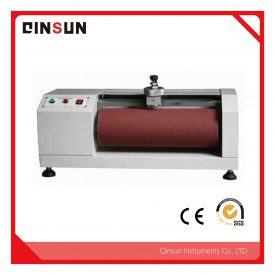
The design inspiration for the DIN Abrasion Tester comes from the abstract simulation of actual wear scenarios. Its core principle can be summarized as "dynamic friction between a fixed sample and a rotating abrasive":
Sample Fixing and Loading: The rubber or elastomer material to be tested is processed into a cylindrical specimen with a diameter of 16 mm and a height of 6-10 mm, and fixed on a sample holder using a special clamp. The tester can apply vertical pressure from 2.5 N to 20 N to simulate contact loads under different working conditions. For example, the contact pressure between a tire and the road surface is typically set at 10N, while the frictional pressure between an industrial conveyor belt and ore can reach as high as 20N.
Abrasive Rotation and Friction: The testing machine is equipped with a rotating drum with a diameter of 150 mm and a length of 460 mm, its surface covered with standard sandpaper or a special abrasive cloth. The drum rotates at a constant speed of 40 rpm, causing the abrasive to slide against the sample surface. The sample holder rotates in the opposite direction at a low speed of 0.9 rpm to ensure uniform wear distribution.
Wear Measurement: After a set number of revolutions (usually 500-2000 rpm), the sample mass loss is measured, and the wear volume (mm³/1.61 km) or mass loss (mg/1000 rpm) per unit revolution is calculated. For example, if a tire rubber sample loses 80 mg of mass after 1000 rpm, its wear resistance is superior to a control sample that loses 120 mg.
This process is like a meticulously choreographed mechanical dance: the contact angle, pressure distribution, and motion trajectory between the sample and the abrasive are all rigorously designed to ensure the repeatability and comparability of the test results.
The authority of the DIN rubber abrasion tester stems from its widely adopted international standards system. Core standards include:
DIN 53516: German industrial standard, defining the technical parameters, test methods, and result expression rules of the tester, considered a benchmark by the European materials science community.
ISO 4649: A globally applicable standard developed by the International Organization for Standardization (ISO), highly compatible with DIN 53516. ensuring data interoperability between multinational corporations and research institutions.
ASTM D5963: American Society for Testing and Materials (ASTM) standard, focusing on abrasion resistance testing of thermoplastic elastomers, supplementing the DIN standard's coverage in the field of new materials.
AS 1683.21: Australian standard, adding high-pressure (15-20N) and coarse abrasive (60-grit sandpaper) testing options for heavy-duty applications such as mining conveyor belts.
These standards not only standardize the hardware configuration of the tester (such as drum size and speed range) but also unify the testing procedures (such as sample preparation and speed setting) and result calculation methods. For example, all standards require the use of cylindrical samples with a diameter of 16 mm, and the samples must be kept at a constant temperature of 23°C and 50% humidity for 24 hours before testing to eliminate the interference of environmental factors on the results. This standardized system allows for direct comparison of data from different laboratories, providing a "common language" for materials research and development.
The DIN rubber abrasion tester covers all major areas of rubber and elastomer materials, and its test results directly guide product design, process optimization, and quality control:
Tire Industry: Tire abrasion resistance is one of the core indicators that consumers care about. Through DIN testing, manufacturers can screen for the optimal rubber formulation (such as the ratio of natural rubber to styrene-butadiene rubber), balancing abrasion resistance and grip. For example, a passenger car tire showed a wear rate of 120 mg/1000 rpm in the test, a 20% reduction compared to the previous generation, meaning its service life is extended to over 80.000 kilometers.
Industrial Conveyor Belts: In heavy-duty scenarios such as mines and ports, conveyor belts must withstand the continuous impact and friction of ores and coal. DIN testing can evaluate the abrasion resistance of different cover rubbers (such as neoprene and polyurethane), helping companies choose the optimal solution in terms of cost and lifespan. A steel company found through testing that conveyor belts using polyurethane cover rubber had a wear rate of only 0.5mm³/1.61km under 20N pressure, a 60% reduction compared to neoprene, resulting in annual maintenance cost savings of over one million yuan.
Footwear and Sports Equipment: The abrasion resistance of products such as shoe soles and yoga mats directly affects user experience. DIN testing can simulate the friction patterns of the human body during walking or exercise, guiding material selection and structural design. For example, a sports brand found through testing that using high-density carbon fiber reinforced rubber in key areas of the sole can improve abrasion resistance by 3 times while maintaining lightweight advantages.
Emerging Fields: With the development of new energy vehicles and aerospace technology, the application boundaries of DIN testing are constantly expanding. For example, testing the abrasion resistance of battery seals to ensure long-term sealing, or evaluating the resistance of spacecraft thermal insulation materials to micrometeorite impacts, both rely on the high-precision data from DIN testing machines.
Currently, DIN rubber abrasion testing machines are evolving towards intelligence and multi-functionality to adapt to the rapid development of materials science:
Automation and Data Integration: The new generation of testing machines is equipped with an automatic loading system and high-precision sensors, enabling real-time monitoring of pressure, speed, and wear, and generating visual reports through software. Some models also support integration with Laboratory Information Management Systems (LIMS) for automatic data upload and cloud analysis.
Multi-Factor Coupled Testing: Traditional DIN testing only simulates a single friction process, while actual working conditions often involve complex factors such as temperature, humidity, or chemical corrosion. Future testing machines will integrate environmental control modules, allowing simultaneous application of high temperatures (e.g., 80°C), high humidity (e.g., 90%RH), or corrosive gases (e.g., SO₂), more realistically reflecting material properties.
Miniaturization and Portability: Portable DIN testing machines are under development to meet the needs of rapid on-site testing. Their size is only 1/3 that of mainstream models, and they can be powered by batteries, making them suitable for production line sampling or field operations. For example, a research team has developed a handheld wear sensor that can complete a preliminary wear resistance assessment within one minute, providing support for immediate decision-making. Green Materials Testing: With increasingly stringent environmental regulations, the demand for new materials such as bio-based rubber and biodegradable elastomers is surging. The DIN testing machine will expand its testing scope to include indicators such as biodegradation rate and microplastic release, contributing to the research and development of sustainable materials.
From the long journeys of tires to the interstellar exploration of spacecraft, the DIN rubber abrasion tester, with its scientific design, stringent standards, and wide range of applications, has become the "gold standard" for measuring the abrasion resistance of materials. It not only safeguards product quality but also drives materials science towards higher performance and greater sustainability. In the future, with the integration of intelligent technologies, this classic instrument will continue to be revitalized, creating more durable and environmentally friendly material solutions for humanity.


