Throughout the entire process of leather products moving from the production workshop to consumers' lives, colorfastness remains a core indicator for measuring product quality. Whether it's maintaining the color of car seats over long-term use or keeping leather shoes looking clean after repeated walking, the precise testing of a leather rubbing fastness tester is indispensable. As a key piece of equipment for quality control in the leather industry, this instrument provides manufacturers with quantitative data support by simulating real friction scenarios, driving the industry towards higher standards.
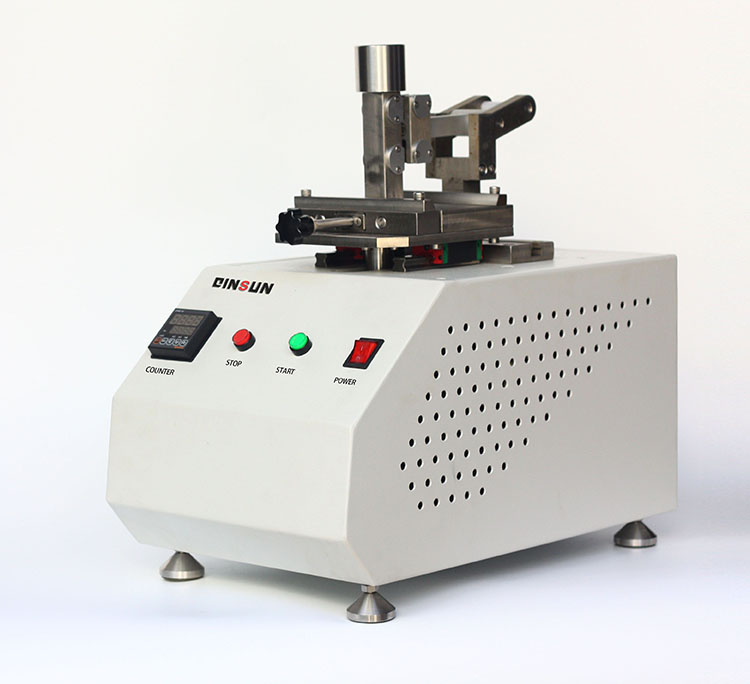
The core principle of the leather rubbing fastness tester is based on tribology. A standardized friction head applies controllable pressure and reciprocating motion to the leather sample, quantitatively assessing the degree of color fading. Its working system consists of five main modules:
Drive Module: A servo motor drives the friction head, achieving 0.1mm-level displacement accuracy control, ensuring the friction stroke remains stable within the range of 100±1mm.
Pressure Module: A 9N standard pressure is applied via a weight set or pneumatic device, simulating human contact pressure. Some high-end models can achieve 0.1N-level pressure fine-tuning.
Friction Module: Equipped with a 16mm diameter arc-shaped friction head covered with standard wool felt. The friction speed is adjustable from 30-60 times/minute, supporting both dry and wet testing modes.
Counting Module: Uses a photoelectric encoder to record the number of friction cycles, with an error rate of less than 0.01%, supporting freely set cycles from 1 to 9999.
Evaluation Module: Integrates a high-precision colorimeter, capable of real-time acquisition of sample color values before and after friction, automatically generating a grayscale rating report conforming to ISO 105-A02 standards.
Taking the testing of automotive interior leather as an example, after 500 friction cycles at a frequency of 40 times/minute, the colorimeter showed a ΔE value of 1.2. corresponding to an ISO rating of 4-5. indicating that the material can meet the colorfastness requirements of high-end vehicle models over a 5-year service life.
1. Raw Material Screening Stage
In the leather tanning process, the testing instrument can quickly identify the impact of different tanning agents on color fastness. A leather manufacturer, by comparing the friction data of chrome-tanned and vegetable-tanned leather, found that vegetable-tanned leather improved wet rubbing color fastness by 1.5 grades, but its dry rubbing durability decreased by 20%, providing key parameters for process optimization.
2. Finished Product Quality Control Stage
Footwear companies use multi-station testing systems that can simultaneously test uppers, linings, tongues, and other parts. Data from a sports brand showed that after adopting a new color-fixing process, the wet rubbing color fastness of the shoe upper improved from grade 3 to grade 4. and the return rate decreased by 37%.
3. Special Environment Simulation Stage
For automotive seat scenarios, the testing instrument can be loaded with simulated sweat liquid for specialized testing. A seat supplier improved the coating formula, enabling the material to improve its rubbing color fastness from grade 2 to grade 3 in simulated sweat containing 0.9% sodium chloride, successfully passing the stringent certification of OEMs.
4. R&D and Innovation Stage
A new materials laboratory used a testing instrument to verify the effect of nano-coatings. Data showed that the coating treatment could improve the colorfastness to rubbing of leather by two grades, while simultaneously increasing abrasion resistance by three times, providing data support for the development of functional leather.
1. Accelerated Standardization Process
The QB/T 4961-2016 industry standard, implemented in 2016. unified core parameters such as friction stroke (35mm), pressure (9N), and speed (40 times/minute), making test results from different manufacturers' equipment comparable. This standard also introduced an LCD counter and grayscale scale evaluation system, improving operational convenience by 40%.
2. Breakthrough in Intelligent Upgrades
The new generation of equipment integrates an IoT module, enabling real-time uploading of test data to a cloud platform. An intelligent system deployed by a testing institution analyzes historical data through machine learning algorithms, automatically identifying process defect patterns and reducing quality warning time from 72 hours to 2 hours.
3. Trend of Multifunctional Integration
Some models have integrated testing functions such as abrasion resistance, scratch resistance, and folding resistance. A certain composite testing instrument can automatically switch to the bending test module after completing 500 friction cycles, simulating the complex stress state of leather in the shoe upper area, improving testing efficiency by 60%.
4. Adaptability to Environmentally Friendly Materials For the testing needs of water-based coatings, equipment manufacturers have developed a dedicated friction head with a surface roughness Ra value controlled within 0.8μm, avoiding damage to flexible coatings caused by traditional metal heads. Tests by an environmentally friendly leather company show that the new friction head reduced the error rate of water-based coating color fastness testing from 15% to 3%.
1. Driving Technological Innovation: A leather tannery, through analyzing test data, discovered a problem with color floating in traditional dyeing processes. They switched to supercritical CO2 dyeing technology, improving colorfastness to rubbing by 1.5 grades while reducing dye usage by 30%.
2. Promoting Standardization: In the field of third-party testing, the widespread adoption of this instrument has reduced the difference in results between different laboratories from 25% to less than 5%, providing reliable quality certification for international trade. An export company successfully passed EU REACH certification using standardized testing reports.
3. Supporting Consumer Upgrading: As consumers' demands for quality increase, high-end brands are beginning to include colorfastness to rubbing in their product specifications. A luxury brand handbag explicitly states "dry rubbing grade 4-5. wet rubbing grade 3-4." becoming a key selling point for quality differentiation.
4. Contributing to Sustainable Development: Through precise testing, companies can optimize the amount of fixing agents used. A large tannery reduced its annual use of heavy metal fixing agents by 12 tons, lowering both production costs and environmental pollution.
With the integration of materials science and artificial intelligence, leather rubbing fastness testers are entering a new stage of development. It is projected that by 2030. the equipment will possess three core capabilities:
Microscopic Detection: Integrating an atomic force microscope module, it can analyze the damage mechanisms of nanoscale coatings.
Predictive Maintenance: Monitoring equipment operating status through vibration sensors, extending maintenance cycles from reactive inspection to proactive prevention.
Digital Twin: Establishing a virtual model of the leather rubbing process, enabling real-time optimization of process parameters.
From the laboratory to the production line, from quality control to R&D innovation, leather rubbing fastness testers consistently safeguard the quality lifeline of leather products through precise testing. Driven by both intelligent manufacturing and green development, this seemingly ordinary testing equipment is continuously writing a new chapter in the industry's quality upgrade.


