When buying clothes, we often wonder, "Will this pill after only two washes?" When choosing sofa covers, we worry, "Will it wear out after the kids jump on it a few times?" – In textile consumption, "durability and wear resistance" have always been the most practical demands. However, judging the durability of a fabric by touch and sight alone is unreliable; a quantitative answer requires professional equipment. The Schopper abrasion tester does just that. As a "hard currency" in textile physical performance testing, it uses scientific methods to score fabric durability, helping companies ensure quality and giving consumers greater peace of mind.
Simply put, the Schopper abrasion tester works by "simulating real-world wear and tear." For example, it can replicate the friction on the knees of jeans or the friction between backpack straps and clothing. It fixes the fabric sample in place and uses an abrasive material to repeatedly rub the fabric at a constant pressure and speed, either until the fabric tears or until a preset number of cycles is reached. The number of cycles the fabric withstands or the degree of wear is recorded, and this data is crucial for determining the fabric's abrasion resistance.
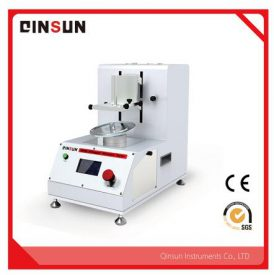
Its core capabilities are reflected in three details: First, "flexible adaptability," allowing adjustment of friction pressure and speed. For example, testing baby clothing fabric requires light pressure and slow abrasion, while testing workwear fabric requires increased pressure and speed. It can also comply with national and international standards such as GB/T 21196.2; second, "reliable data," automatic counting and damage detection are far more reliable than manual observation, eliminating errors caused by inattention; finally, "scenario correspondence," as cotton, linen, chemical fiber, and wool fabrics wear differently, the instrument can use different abrasive materials to simulate these different scenarios.
The T106 is a testing equipment independently developed and manufactured by Shanghai Qianshi Precision Electromechanical Technology Co., Ltd.
The T106 Schopper Abrasion Tester is used to test the abrasion resistance of fabrics, and is widely used in testing automotive interior materials. For fabrics, abrasion resistance is an important indicator of their performance and durability. During the test, friction is applied to the rotating sample in the tangential direction through a friction component to measure the abrasion resistance of the sample. The Schopper abrasion tester can be used to test the surface changes of the sample after friction or wear testing, effectively controlling production and verifying product performance.
For textile factories, this instrument is the "quality gatekeeper." For example, when developing new outdoor jackets, it's necessary to test the abrasion resistance of fabrics with different yarn ratios. Is 60% cotton + 40% nylon more durable, or is 50% cotton + 50% nylon better? Testing provides the answer. When producing batches of fabric, several rolls are sampled for testing. If the abrasion resistance doesn't meet the standards, it can be checked whether the temperature in the dyeing process was properly controlled, preventing a large batch of goods from being wasted. Work clothes worn by construction workers and the fabric of courier bags are all screened using this instrument to ensure qualified products; otherwise, they would wear out after only a few uses, which is neither practical nor safe.
For industry regulation, it is also a "standard enforcer." Many textiles now require labeling with abrasion resistance grades, and third-party testing agencies rely on the Schopper abrasion tester for sample inspection. For example, last year, a certain e-commerce platform sampled children's jeans and used this instrument to test their abrasion resistance, finding several products that pilled after less than 500 rubs, and directly ordered their removal from the shelves.
A circular sample is mounted on a rotating test head. The sample is subjected to friction against an abrasive material (sandpaper) in both clockwise and counterclockwise directions at a certain speed, pressure, and number of rotations. The abrasive material maintains linear contact with the sample, thus producing a tangential friction effect. The rotation direction is changed every 100 rotations (adjustable). The test results are evaluated based on mass loss and the formation of holes.
1. Mount the temperature and humidity-conditioned sample onto the sample holder using the accessories provided with the instrument, forming the rotating test head. Adjust the protrusion height of the test head using the arch height testing device according to relevant standards or other requirements, generally 5-8 mm;
2. Install the test head with the sample onto the test head mounting plate on the instrument's workbench. Secure the test head using the locating pins on the mounting plate and the corresponding locating holes on the underside of the test head;
3. Install the abrasive sandpaper onto the lower surface of the pressure plate using the abrasive material clamp located on the instrument's pressure plate. Tighten the clamp to ensure the sandpaper is securely and evenly installed;
4. Manually pull outward the pressure plate lifting lock located on the right side of the pressure plate to lower the pressure plate, bringing the sandpaper into contact with the sample surface on the test head;
5. Install the appropriate weight on the weight shaft above the pressure plate (the instrument is equipped with one each of 1500. 1000. 500. 250. 100. and 50g standard weights) to apply a certain pressure to the sample during friction. Select the required pressure value based on the weight per unit area of the sample.
1. The instrument must be placed on a stable surface before use;
2. Do not move the machine during operation;
3. Select the appropriate power supply voltage; do not use excessive voltage to avoid damaging components;
4. If the instrument malfunctions, please contact after-sales service for timely handling;
5. The machine must be operated in a well-ventilated environment;
6. Due to the heavy operating load on the mechanical components of the buttons, please lubricate the mechanical parts regularly;
7. After each test, clean the machine to keep it clean;
8. The control box should be wiped with a dry cloth, not a wet cloth.
Nowadays, consumers are increasingly focusing on "cost-effectiveness," and durability is one of the core aspects of cost-effectiveness. This forces textile companies to make abrasion resistance testing a standard procedure – after all, if a consumer buys a piece of clothing that wears out after only six months, they will certainly not buy that brand again. The widespread use of the Schopper abrasion tester is actually helping the entire industry move towards a "quality-oriented" direction. In the future, this instrument will become even smarter, for example, connecting to the internet to view test data in real time, automatically taking photos and archiving them when a certain degree of wear is reached, eliminating the need for constant human supervision, resulting in higher efficiency.
In the wave of continuous quality upgrades in the textile industry, the Schopper abrasion tester undoubtedly plays a crucial role. With its precise testing capabilities, it provides reliable assurance for the durability of textiles, driving the industry towards high quality and high standards. With the continuous advancement of technology, we have reason to believe that the Schopper abrasion tester will continue to iterate and upgrade, assisting textile companies in creating more high-quality products that can withstand the test of time, meeting the growing quality demands of consumers, and leading the textile industry to a more glorious future.


