Friction and wear testing machines, as key equipment for studying tribology, play an irreplaceable role in many fields such as materials science and mechanical engineering. By simulating various friction and wear conditions, they provide important experimental methods for a deeper understanding of the frictional characteristics, wear mechanisms, and lubricant performance of materials, powerfully promoting the progress and development of related technologies.
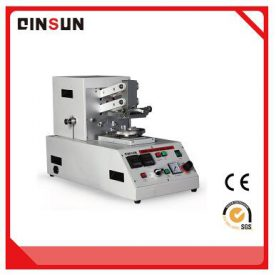
Friction and wear testing machines quantify the wear resistance and coefficient of friction of materials by simulating the frictional contact of materials under specific working conditions. Based on the testing principle and structure, they are mainly classified into the following categories:
Pin-disc type testing machine: Simulates sliding friction through the contact between a pin sample and a rotating disk sample;
Reciprocating type testing machine: Simulates frictional behavior under reciprocating motion, suitable for testing lubricant performance;
Ring-block type testing machine: Used to evaluate the wear resistance of ring-shaped components such as bearings and seals;
Multi-functional testing machine: Integrates multiple testing modes, suitable for tribological research under complex working conditions.
Akron Abrasion Tester: A specialized abrasion tester designed specifically for vulcanized rubber. A standard rubber sample wheel is pressed against the surface of a rotating abrasive wheel at a 15° angle and a load of 26.7N. The sample simultaneously revolves (around 320 rpm) and rotates on its own axis. The abrasion amount is calculated by the mass difference before and after wear, simulating the frictional wear of rubber in rolling contact, such as the friction between a tire and the ground.
Roller Abrasion Tester: Also known as the DIN abrasion tester, this is also for rubber materials. A rectangular rubber sample is pressed against the surface of a rotating abrasive roller. The sample reciprocates along the roller axis at a fixed speed. Abrasion resistance is characterized by the volume or mass loss of wear, focusing on simulating the "sliding + rolling" composite friction of rubber, such as the contact wear between a conveyor belt and a roller.
Rolling Abrasion Tester: This is a general-purpose rolling abrasion testing device, not a single model. The core technology involves subjecting the sample to pure rolling or a combination of rolling and sliding motion with a friction pair (metal rollers, rubber rollers, grinding wheels, etc.). The load, speed, and contact method are adjustable. Some models support simultaneous testing of multiple samples and are adaptable to simulating the rolling wear of various materials, including metals, rubber, and composite materials. It covers wear scenarios for bearings, gears, and rail transit wheels and rails.
The Akron abrasion tester is suitable for vulcanized rubber and rubber products. Its core testing parameters are a sample inclination angle of 15°, a load of 26.7 N, and a grinding wheel speed of 260 r/min. It complies with GB/T 1689-2014 and ASTM D1630 standards and is typically used for abrasion resistance testing of tire tread rubber, rubber shoe soles, and sealing rubber.
Roller abrasion tester: Suitable for vulcanized rubber and elastic composite materials. Core test parameters are sandpaper grit P60. sample load 10N, and roller speed 40r/min. Complies with DIN 53516 and GB/T 9867-2008 standards. Commonly used for abrasion resistance comparison of conveyor belt rubber, shock-absorbing rubber, and rubber seals.
Rolling abrasion tester: Suitable for metals, rubber, and composite materials. Core test parameters are adjustable load (0-500N), speed (0-1000r/min), and interchangeable friction pair types. Complies with GB/T 12444-2006 and ASTM G99 standards. Suitable for rolling abrasion testing of bearing steel, gear alloys, rail transit wheel and rail materials, and engineering plastics.
Key Differences:
Specialization vs. Versatility: The Akron abrasion tester and roller abrasion tester are specialized rubber-specific equipment with fixed testing procedures and parameters, offering strong targeting capabilities. The rolling abrasion tester, on the other hand, is a general-purpose platform, allowing for interchangeable friction pairs and adjusted operating conditions to adapt to complex rolling abrasion scenarios for various materials.
Friction Mode: The Akron abrasion tester primarily utilizes rolling friction, accompanied by slight sliding. The roller abrasion tester employs a combination of sliding and rolling friction, with a higher proportion of relative sliding between the sandpaper and the sample. The rolling abrasion tester can achieve diverse friction modes, including pure rolling and adjustable rolling-slip ratios, accurately simulating actual industrial conditions.
Emphasis on Testing Indicators: The first two types of equipment focus on mass/volume loss as the core indicator for classifying the abrasion resistance of rubber materials. The rolling abrasion tester can also monitor multi-dimensional data such as friction coefficient, wear depth, and contact fatigue life, making it suitable for research on material wear mechanisms and prediction of industrial component lifespan.
Materials R&D
Used to test the wear resistance of metals, ceramics, coatings, polymers, etc., and to optimize material formulations.
Automotive Industry
Evaluating the service life of critical components such as engine parts, brake pads, and tires.
Aerospace
Simulating the tribological performance of materials under extreme environments (high temperature, vacuum).
Energy Sector
Testing the wear resistance of equipment such as wind turbine gears and bearings to extend equipment life.
Case Study: An automaker successfully increased the lifespan of its braking system by 30% by optimizing brake pad material formulation using a tribological testing machine.
Equipment Maintenance and Usage Tips
Regularly clean the guide rails and sensors to prevent dust from affecting accuracy;
Calibrate the load and speed system every six months.
Testing Techniques:
Ensure proper alignment of the sample during installation to avoid data deviation due to off-center loading;
Before testing in complex environments, it is recommended to conduct preliminary experiments to adjust parameters.
Industry Development Trends
With the advancement of intelligent manufacturing, the next generation of friction and wear testing machines is developing in the following directions:
Intelligentization: AI algorithms automatically optimize test parameters and generate analysis reports;
Multi-dimensional Detection: Integrated 3D profilometer for real-time observation of microscopic changes on the worn surface;
High-throughput Testing: Supports parallel testing of multiple samples, improving R&D efficiency.
As a key tool in materials tribology research, the friction and wear testing machine, with its diverse types and precise testing capabilities, has played a significant role in numerous fields, powerfully promoting progress in materials research and development, industrial manufacturing, and other areas. From routine maintenance to testing techniques, and continuous upgrades to keep pace with industry development trends, it consistently advances in improving testing accuracy and efficiency. It is believed that in the future, with continuous technological innovation, friction and wear testing machines will bring innovative breakthroughs to more industries, helping various fields achieve high-quality development.


