In materials science, surface engineering, coating technology, industrial product development, and quality control, scratch testing is an essential experimental technique. It is primarily used to evaluate the resistance of materials and surface systems—such as coatings, films, plastics, and metals—against scratches, as well as to assess surface hardness, adhesion, and damage tolerance. Scratch testing is a fundamental method within surface performance evaluation systems.
This article provides a comprehensive overview of scratch testing, covering its concept, principles, experimental types, procedures, test indicators, practical applications, and distinctions from other testing methods, helping readers understand its significance and value in materials evaluation.
Scratch testing involves applying a controlled sliding scratch on the material surface using a hard indenter. The resulting damage is then analyzed to evaluate surface performance. It is mainly used to assess:
Scratch resistance of the surface material or coating;
Adhesion or bonding strength between the surface and substrate;
Material hardness and plastic deformation characteristics;
Failure modes and critical loads at which damage occurs.
In simple terms, scratch testing is “intentionally creating a scratch and observing the material’s response to evaluate performance.” Unlike casual visual scratches, it is a standardized, reproducible method with defined protocols and measurable data, widely used in research and product testing.
The core principle involves using a hard indenter to apply a controlled force—either constant or progressively increasing—while moving along a defined path on the sample surface. As the load increases, the scratch progresses from a minor surface mark to more severe damage such as cracking, chipping, or coating delamination. Recording the load and morphological characteristics at which these events occur allows quantitative analysis of scratch resistance.
Instrumented scratch testing uses computer-controlled systems to precisely regulate indenter load and speed, while recording load-displacement curves. Microscopes or profilometers are then used to analyze scratch morphology and obtain quantitative data.
Key factors in scratch testing include:
Load (normal force): Determines the severity of the scratch, which may be constant or progressively increasing;
Scratch speed and direction: Affects friction, heat generation, and test results;
Indenter geometry and radius: Different shapes produce different contact stress states, influencing failure events;
Surface condition and material properties: Hardness, elastic modulus, brittleness, and plasticity affect scratch outcomes.
Scratch tests can be classified based on load control, scale, and testing objectives:
By Load Control:
Constant load scratch test: Maintains a fixed load throughout, comparing scratch resistance across materials;
Progressive load scratch test: Gradually increases load along the scratch path to determine the critical load at which failure occurs, useful for evaluating adhesion and failure mechanisms.
By Scale:
Macro scratch testing: For large samples or visible scratches;
Micro scratch testing: Uses nano-scale indenters to evaluate fine failures in coatings or thin films;
Nano scratch testing: Applied to ultra-thin films or nanomaterials, assessing nanoscale hardness and elastic recovery.
By Objective:
Scratch resistance evaluation: Measures surface resistance to scratches and damage;
Adhesion testing: Evaluates bonding strength between coatings and substrates;
Hardness and friction measurement: Combines scratch depth and friction coefficient analysis to characterize material hardness and deformation behavior.
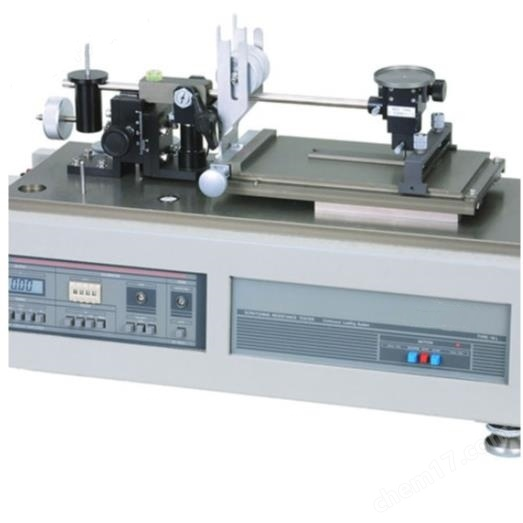
Scratch testing typically requires specialized instruments such as scratch testers, microscopes, and load control systems. A standard procedure includes:
Sample Preparation:
Samples should have a clean, smooth surface and be sized for instrument clamping. For coatings or films, ensure flatness and absence of defects.
Instrument Setup:
Set parameters such as:
Initial and final loads;
Load increment rate;
Scratch speed;
Indenter type and radius.
Conducting the Test:
The instrument scratches the sample according to the preset parameters, recording load, displacement, and time data.
Observation and Analysis:
After testing, microscopes or profilometers analyze scratch morphology, identifying cracking, delamination, chipping, or other failure modes, and correlating these observations with load-displacement data to determine critical metrics.
Critical Load: The load at which the first visible failure occurs, reflecting adhesion strength and surface integrity;
Scratch Depth and Width: Indicators of resistance to deformation and hardness, measured via profilometers or microscopy;
Friction Coefficient: Recorded throughout the scratch, providing insight into surface friction behavior;
Damage Mode: Identifying whether the failure is cracking, delamination, or complete removal helps interpret material properties and process issues.
Coating and Paint Evaluation: Assessing adhesion and scratch resistance in coatings, paints, and surface treatments, crucial for R&D and quality control;
Industrial Material Comparison: Comparing scratch resistance of different materials or surface treatments, e.g., automotive interiors, electronics enclosures, optical glass;
Polymers and Plastics: Evaluating surface resistance in plastics and composites, guiding material selection and post-processing;
Research and Materials Science: Investigating mechanical performance related to microstructure, such as adhesion mechanisms in nanomaterials, films, or coatings.
Scratch testing evaluates hardness, adhesion, and damage resistance simultaneously, providing more comprehensive data than simple hardness tests like Vickers;
Non-destructive compared to peel or detachment tests, enabling performance evaluation without altering surface state;
Provides quantitative metrics such as critical load, unlike simple tape peel tests.
Scratch testing is defined in ASTM, ISO, and GB standards, e.g., ASTM C1624 and ISO 19252. These standards specify testing methods, instrument calibration, sample dimensions, and environmental conditions, ensuring reproducibility and comparability across laboratories. Standardization enhances reliability and authority in research and production applications.
Advantages:
Quantitative evaluation of surface performance, including hardness, adhesion, and damage modes;
Direct assessment of coating-substrate bonding;
Applicable to metals, ceramics, plastics, and composites.
Limitations:
Sensitive to test parameters (load rate, indenter geometry, surface condition), requiring strict control;
Soft or extremely brittle materials may need special protocols;
Requires specialized equipment and analytical tools, demanding careful operation.
Scratch testing is a crucial method for evaluating material surface performance. By applying controlled scratches and analyzing resulting damage, it provides insights into scratch resistance, adhesion, hardness, and failure behavior. Its standardized methodology, rich set of metrics, and broad applicability make it a core technique in materials research, design, and quality control.


