In daily life, casters are widely used in many scenarios, ranging from office swivel chairs and supermarket shopping carts to industrial logistics carts and hospital beds. They are almost everywhere. The quality of a caster directly affects the smoothness of movement, service life, and even the safety of the equipment. One of the key indicators for evaluating caster quality is its wear resistance performance. This is where a professional testing instrument becomes essential—the Office Chair Caster Durability Tester.The Office Chair Caster Durability Tester, also known as a caster fatigue testing machine or chair wheel durability tester, is a mechanical testing device specifically designed to evaluate the wear resistance, fatigue resistance, and service life of office chair casters and chair bases under repeated movement conditions. Its primary purpose is to simulate the pressure, friction, and motion loads that casters experience during long-term use, in order to assess their durability, stability, and load-bearing performance.This article will introduce the equipment from the following aspects, with the aim of providing helpful insights.
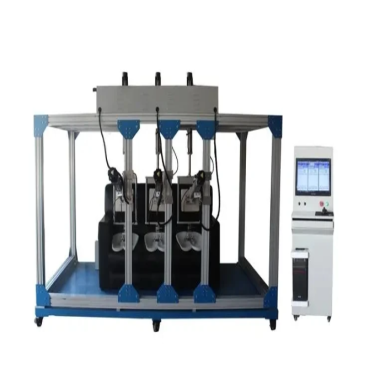
Some may wonder: why not simply install the caster and use it until it wears out? Wouldn’t that directly show its durability? In reality, relying on real-world usage alone is inefficient and unreliable. This is why a dedicated testing machine is necessary. The main reasons are as follows:
1. Standardization and Comparability
Real-world usage environments vary greatly. Floor conditions differ (such as concrete, tile, or carpet), as do loads, movement frequency, and operating styles. These variations make test results inconsistent and difficult to compare.
A durability tester provides a standardized and controlled testing platform, where all conditions are precisely regulated and kept consistent. This allows different brands and models of casters to be tested under the same “playing field,” ensuring fair comparison and highly reliable evaluation results.
2. Efficiency and Cost Reduction
As mentioned, natural usage testing can take months or even years, which is unacceptable for product development, quality control, and time-to-market requirements.
Testing machines significantly shorten the testing cycle, enabling manufacturers to quickly identify problems, improve designs, and validate materials. This greatly reduces both time and financial costs.
3. Safety Risk Prediction
For casters used in medical equipment, firefighting devices, or heavy industrial systems, failure may lead to serious safety hazards.
Through accelerated and extreme condition testing, the machine can predict the long-term failure behavior of casters, helping to prevent accidents caused by sudden breakage, detachment, or structural failure.
4. Data-Driven Analysis
A durability tester does far more than simply “wear out” the caster. It is typically equipped with sensors and data acquisition systems that record multiple parameters in real time, such as rolling resistance, temperature changes, and noise levels.
These detailed data sets provide engineers with a solid foundation for in-depth analysis, far beyond what a simple “it broke after use” conclusion can offer.
1. Simulation of Real Usage Conditions
The testing machine simulates various real-life movements of an office chair, such as forward/backward pushing, pulling, and rotational motion. This allows the caster’s durability and wear resistance to be evaluated under realistic operating conditions.
2. Load and Friction Testing
The tester applies additional loads and controlled friction forces to the casters, simulating long-term pressure and wear during actual use. This helps assess how the caster performs under continuous stress conditions.
3. Multi-Axis Motion Testing
Casters are not limited to linear movement; they also rotate during use. The equipment performs multi-directional testing, ensuring stability and performance under different movement orientations and complex motion paths.
4. High-Precision Data Acquisition
The system can accurately record key performance indicators during testing, such as friction coefficient, travel distance, wear level, and degradation behavior. These data are essential for evaluating product quality and optimizing design.
5. Automated Operation
Most caster durability testers are equipped with automated control systems, allowing long-duration continuous operation. The machine can automatically stop the test once preset conditions are met and generate standardized test reports, improving efficiency and consistency in quality evaluation.
1. Loading System
The loading system is the key component that simulates the actual load-bearing condition of casters. It applies a constant and adjustable vertical force to the tested caster through hydraulic, pneumatic, or mechanical weight loading methods. The applied load strictly follows relevant testing standards, simulating conditions such as a fully loaded chair or the weight of an adult user.
2. Drive and Transmission System
This system is responsible for enabling the caster to roll. Typically, a motor drives a rotating test platform or a linear reciprocating track, causing the caster to move at a constant speed. The motor speed is adjustable to simulate different movement velocities encountered in real usage.
3. Test Surface (Roadway System)
The test surface is the part in direct contact with the caster. To replicate real-world conditions, the machine is equipped with interchangeable surface modules, such as rough sandpaper belts, standard steel plates, carpets, or even obstacle-like bump structures. Different surfaces generate different levels of wear and abrasion on the caster.
4. Steering System
To better simulate real operating conditions where direction changes frequently, many advanced testers include a steering mechanism. This system periodically swings the caster mounting arm at a set angle, enabling the evaluation of wear resistance under combined rolling and steering motions.
5. Data Acquisition and Control System
This is the “brain” of the entire equipment. A computer or PLC system is used to set test parameters and control the automated testing process. During operation, the system continuously collects data from force sensors, temperature sensors, encoders, and other measurement devices. After the test is completed, it automatically generates detailed test reports for analysis and quality evaluation.
After the test is completed, a detailed report is generated. So how should this report be understood, and what key information does it provide? The results are mainly interpreted from the following aspects:
1. Appearance Inspection
This is the most intuitive evaluation method. Inspectors carefully examine the wear condition of the caster tread surface:
Is the wear pattern uniform or uneven?
Are there signs of cracking, chipping, peeling, or material shedding?
Has the wheel become deformed?
Does the bracket (fork) show any cracks or abnormal bending?
These visual observations are often the first step in determining whether the product passes or fails.
2. Dimensional Measurement
Precision instruments are used to measure the change in wheel diameter before and after testing. The amount of wear—typically expressed as the reduction in diameter in millimeters—is a key quantitative indicator. Generally, the smaller the wear loss, the better the material’s wear resistance performance.
3. Functional Failure Evaluation
The test is not always terminated only when the preset number of cycles is reached. If functional failure occurs during the test, the sample is considered invalid, even if the target cycles have not been completed. Such failures may include:
Bearing seizure or locking
Wheel detachment
Steering malfunction
Sudden increase in rolling resistance
These issues indicate structural or material defects in the caster.
4. Data Curve Analysis
Professional test reports usually include curves such as rolling resistance vs. time. A stable and smooth curve indicates consistent caster performance. However, if the curve shows significant fluctuations or a continuous upward trend, it suggests accelerated wear and possible internal structural degradation.
In conclusion, the Office Chair Caster Durability Tester plays an indispensable role in modern industrial quality systems. By accurately measuring data and simulating harsh real-world operating conditions, it objectively and scientifically evaluates the quality performance and durability of every caster.We sincerely welcome your messages or direct inquiries, so that we can provide you with more detailed and professional product information as well as technical support tailored to your needs.


