The Helmet Surface Friction Tester is a precision testing instrument specifically designed to evaluate the wear resistance, friction characteristics, and anti-slip performance of helmet shells and their protruding surface structures. It is widely used in the research and development, quality control, and certification testing of protective equipment such as motorcycle helmets, electric bicycle helmets, and other safety headgear.The primary purpose of this equipment is to ensure that helmets can effectively disperse external impact forces, reduce friction-related hazards, and maintain their structural integrity during accidental collisions or sliding incidents. By accurately assessing the surface friction performance of helmet materials and designs, manufacturers can verify whether their products comply with relevant safety standards and provide reliable protection to users.This article will introduce the equipment from the following aspects, with the hope of providing useful information and helping readers gain a better understanding of its functions, testing principles, technical advantages, and practical significance.
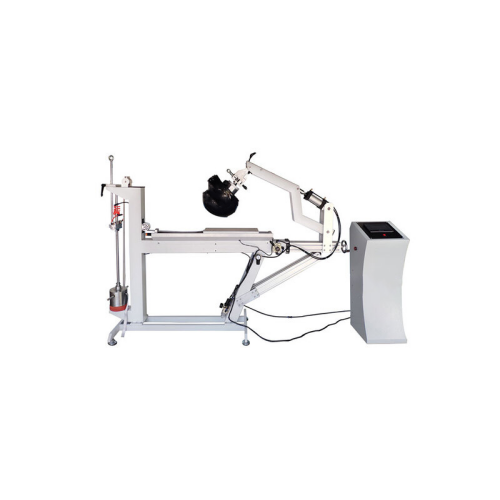
The Helmet Surface Friction Tester is primarily used to evaluate the frictional performance and shear force characteristics of helmet shells and protruding surface structures during sliding impacts. The objective of this testing is to minimize the risk of secondary injuries caused by excessive friction, such as scalp lacerations or excessive neck torsion, which may occur if helmet projections snag against the ground or other surfaces during an accident.
Core Functions
1. Surface Friction Coefficient Determination
One of the primary functions of the Helmet Surface Friction Tester is to measure the coefficient of friction between the helmet shell and a standardized abrasive surface.
The instrument simulates the sliding motion of a helmet against road surfaces or other objects encountered during an accident. By evaluating the frictional resistance generated during this interaction, manufacturers can ensure that the friction coefficient remains within an acceptable safety range.
Controlling the friction level is essential because excessive drag forces may increase rotational loads on the wearer's head and neck, potentially worsening injury severity.
2. Protrusion Shear Force Evaluation
Modern helmets often incorporate various external features, such as ventilation structures, decorative elements, visors, and aerodynamic protrusions. The tester assesses the shear resistance of these non-uniform surface structures when subjected to lateral forces.
This evaluation helps determine whether protruding components are likely to:
Catch or snag on the ground during sliding;
Generate excessive rotational forces;
Cause sudden head movement;
Increase the risk of secondary injuries.
By identifying potential hazards associated with external projections, manufacturers can improve helmet designs to enhance user safety.
3. Structural Integrity Verification
The Helmet Surface Friction Tester also verifies the overall durability of the helmet shell under frictional loading conditions.
During testing, a specified preload is applied while the helmet specimen moves across a standardized abrasive surface at a controlled speed. The instrument then evaluates whether the shell material exhibits:
Cracking or fracture;
Surface delamination;
Material detachment;
The formation of hazardous sharp edges;
Other forms of structural failure.
This process confirms that the helmet can maintain its protective integrity following friction-related events.
Main Applications
1. Safety Performance Optimization
The tester provides valuable data that enable manufacturers to optimize helmet safety performance by improving:
Shell curvature and contour design;
External protrusion geometry;
Ventilation structure configurations;
Surface finishing treatments;
Overall aerodynamic profiles.
Through these improvements, potential safety hazards can be minimized, reducing the likelihood of scalp abrasions, excessive neck rotation, and cervical strain during accidents.
2. Quality Control and Product Development
The Helmet Surface Friction Tester is widely employed throughout the helmet manufacturing process, including both routine quality inspection and product innovation.
Its applications include:
Production-line quality assurance;
Factory acceptance testing;
Certification preparation;
Evaluation of new shell materials;
Assessment of advanced coatings and surface treatments;
Comparative studies of different structural designs.
By quantitatively analyzing how various shell materials and coatings influence friction performance, manufacturers can develop safer, higher-quality helmet products.
Helmet surface friction testing is primarily used to evaluate the wear resistance and structural integrity of helmet shells under sliding friction conditions. Its core purpose is to prevent secondary injuries caused by shell failure during sliding accidents. This test does not measure the coefficient of friction; instead, it verifies the abrasion resistance and overall integrity of the helmet shell.
Core Technical Features
Standardized Loading Mass:
The testing device is typically equipped with a 15 kg standard weight or loading system to simulate the normal pressure generated by the human body during an accident, ensuring consistency and repeatability of the applied test load.
Tangential Friction Motion Mechanism:
A horizontal guide system is employed, with the abrasive material fixed to the outer surface of the guide rod. The abrasive moves in a tangential direction while remaining in close contact with the helmet test area, performing reciprocating or unidirectional friction to simulate actual sliding trajectories.
Precise Travel Control:
The standard drop height or friction travel distance is generally set at 500 mm. An electromagnetic release system controls the starting point, eliminating human operational errors and ensuring consistent energy input for each test.
Adjustable Headform Support:
The tester is equipped with an adjustable headform support, allowing it to accommodate helmet specimens of different sizes and curvatures, ensuring that the friction surface maintains the optimum contact angle with the helmet throughout the test.
Non-Destructive Evaluation Criteria:
After testing, the primary inspection focuses on whether the helmet shell exhibits penetration, cracking, or delamination, rather than simply recording friction values. If the integrity of the shell is compromised, the specimen is deemed non-compliant.
The core principle of helmet surface friction testing is to simulate the resistance generated when a helmet slides against the ground during an accident. By evaluating the helmet surface's ability to drive a loaded carriage to continue sliding under a specified normal load, the test assesses whether excessive frictional resistance could lead to neck injuries or other secondary injuries to the wearer.
Core Testing Logic
Simulation of Real Accident Conditions:
The test reproduces the loading conditions that occur when a rider falls and the helmet shell slides along the ground. If the frictional resistance between the helmet surface and the contact medium is excessively high, the loaded carriage may become "stuck" and stop moving. The resulting inertial forces can then be transmitted to the wearer's neck, potentially causing neck sprains, excessive rotational loading, or other secondary injuries.
Acceptance Criteria:
The testing requirement specifies that the loaded carriage shall not be prevented from sliding due to frictional resistance. Under the prescribed test conditions, the helmet surface must be capable of maintaining the continuous movement of the loaded carriage. If the carriage stops during the test as a result of excessive friction, the helmet specimen shall be deemed non-compliant.
Helmet surface friction testing is intended to simulate the resistance encountered when a helmet slides against the ground during an accident. The following outlines the standard testing procedure.
1. Test Preparation
Equipment Inspection
Before testing, verify that all components of the apparatus are functioning properly, including:
The horizontal guide carriage;
The 15 kg ± 0.5 kg drop weight;
The pulley transmission system;
The velocity measuring device.
The total mass of the carriage assembly shall be 5.0 kg ± 0.2 kg.
Abrasive Paper Installation
Attach aluminum oxide abrasive paper of the specified grit size to the surface of the carriage.
The following requirements shall be met:
The abrasive paper length shall be 300 mm to 303 mm;
A smooth, non-abrasive section of 80 mm ± 1 mm shall be retained at the front end of the carriage;
The surface of the smooth section shall be 0.5 mm ± 0.1 mm higher than the abrasive area.
Specimen Installation
Mount the helmet onto the appropriate size headform according to the prescribed method and fasten the retention system securely.
Adjust the headform support so that the selected test point on the helmet shell is in contact with the carriage surface.
Selection of Test Locations
Choose the area of the helmet outer surface that is considered to be relatively rough and likely to generate the greatest frictional resistance.
Each selected test point shall be tested only once.
2. Test Procedure
Initial Positioning
Adjust the helmet position so that the selected test point is located at the center of the smooth section of the carriage, with the contact point aligned directly in front of the abrasive paper.
Application of Preload
Using the loading mechanism, apply a force perpendicular to the carriage surface to the helmet.
The applied preload shall be:
400 N ± 10 N
The load shall be maintained steadily throughout the preparation stage.
Release of the Drop Weight
Raise the 15 kg drop weight to a height of:
500 mm ± 5 mm
Lock it in position and then release it, allowing it to fall freely and impact the steel cable or belt system connected to the carriage, thereby driving the carriage forward.
Observation and Recording
Observe whether the carriage is prevented from moving due to frictional resistance during sliding.
Particular attention shall be paid to determining whether the carriage can pass smoothly across the abrasive paper section without interruption.
Replacement of Consumables
After each test, the abrasive paper shall be replaced with a new piece to prevent wear of the abrasive surface from affecting subsequent test results.
3. Evaluation of Results
Acceptance Criteria
During the test, the carriage shall not be prevented from sliding by frictional resistance.
In other words, the carriage shall move smoothly across the abrasive paper surface under the specified test conditions.
Failure Criteria
If the carriage stops during its movement due to excessive frictional resistance, the tested location shall be deemed to have failed the surface friction requirement.
Precautions
Testing shall be conducted under laboratory conditions of 21°C ± 5°C and a relative humidity of 40% to 80%.
If the helmet shell contains multiple rough areas composed of different materials or surface finishes, representative test locations shall be selected and evaluated separately.
This equipment is also used for surface protrusion shear force testing. However, different fixtures and attachments are required for each test method. Care should be taken to avoid confusing the two testing configurations.
The fundamental importance of the Helmet Surface Friction Tester lies in its ability to simulate real-world sliding accident scenarios and quantitatively evaluate the frictional resistance generated between the helmet and the ground, thereby helping to prevent secondary injuries such as cervical spine strain and neck torsion. Ultimately, it is a critical tool directly related to the life safety of helmet users.
Core Safety Value
1. Preventing Secondary Cervical Spine Injuries
During traffic accidents, if a helmet generates excessive friction while sliding across the ground, the resulting resistance may cause the wearer's head to stop abruptly while the neck continues moving due to inertia. This sudden differential motion can easily lead to severe cervical spine strain, ligament tears, or neck sprains.
By evaluating helmet surface friction under controlled conditions, the Helmet Surface Friction Tester ensures that the frictional resistance remains within an acceptable safety threshold, allowing the helmet to slide smoothly rather than becoming "locked" against the contact surface.
2. Eliminating the Risk of Protrusion Snagging
When used in conjunction with protrusion shear force testing, the equipment can verify whether external helmet features, such as decorative components, ventilation structures, and other protruding elements, can either:
Separate safely under loading conditions; or
Avoid obstructing the cutting element during testing.
This assessment helps prevent protrusions from catching on the ground during sliding, which could otherwise result in violent head rotation, excessive neck loading, or secondary trauma.
3. Addressing the Limitations of Conventional Impact Testing
Traditional helmet impact tests primarily focus on evaluating energy absorption during vertical impacts and cannot adequately reproduce the sliding conditions frequently encountered in real-world accidents.
Helmet surface friction testing complements these evaluations by providing a multi-dimensional safety assessment, extending protection analysis beyond direct impacts to include sliding collisions, which are often more representative of actual accident scenarios.
4. Driving Helmet Design Optimization
The data obtained from friction testing provide valuable guidance for manufacturers seeking to improve helmet safety performance.
The results can be used to:
Optimize the friction characteristics of shell materials;
Refine shell surface treatments;
Eliminate unnecessary external protrusions;
Improve aerodynamic and structural configurations.
As a result, helmet development evolves from a design philosophy focused solely on impact resistance toward a more comprehensive approach combining impact protection and low-friction sliding performance.
5. Strengthening Quality Supervision and Market Regulation
The Helmet Surface Friction Tester also serves as an important scientific tool for regulatory authorities and quality inspection organizations.
By providing objective and quantifiable evaluation criteria, it helps identify and eliminate substandard helmet products, including those featuring:
Excessively rough shell surfaces;
Decorative components prone to snagging;
Unsafe protruding structures;
Designs that fail to meet established safety requirements.
This contributes to raising the overall safety level of products available in the marketplace.
In simple terms, the Helmet Surface Friction Tester serves as a critical technological safeguard for ensuring that helmets can effectively manage sliding forces encountered during high-speed accidents. By enabling helmets to absorb impacts, dissipate energy, and slide smoothly without generating excessive resistance, the equipment helps prevent the helmet itself from becoming a source of severe secondary neck injuries.Its rigorous and scientifically validated testing procedures, together with the performance data it generates, directly influence whether a helmet can satisfy the most stringent and advanced safety certification requirements adopted throughout the global industry.We sincerely welcome you to leave us a message or contact us directly should you have any questions or specific requirements. Based on your application needs, we will be pleased to provide comprehensive product specifications, detailed technical information, testing reports, and professional support to help you select the most suitable helmet testing solution.


