A Shoe Heel Surface Abrasion Sample Grinder is a specialized laboratory abrasion testing device used to evaluate the wear resistance of shoe heel surfaces. It simulates friction-based wear under controlled conditions to grind and abrade test specimens, allowing assessment of their resistance to surface damage. The equipment is widely applied in footwear material research, product development, and quality control.Its primary purpose is to provide standardized, high-precision, and highly repeatable abrasion sample preparation for leather shoe heels and uppers, ensuring reliable performance testing results related to wear resistance. In addition, it helps improve the efficiency and consistency of grinding and finishing processes in footwear manufacturing, supporting better product durability and uniform quality in production.
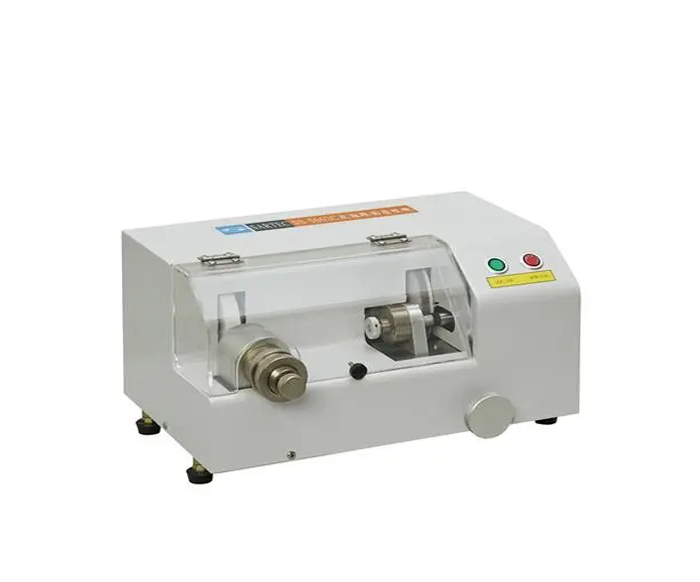
The Shoe Heel Surface Abrasion Sample Grinder is a specialized testing instrument developed in response to the growing demand for standardization, automation, and quality inspection within the footwear industry. Its development is closely tied to the establishment of standardized abrasion testing methods in the mid-to-late 20th century, as well as the advancement of precision engineering in light industrial machinery. It is not a traditional shoe finishing tool, but rather a laboratory-grade device used for specimen preparation and wear resistance testing.
Industrial Standardization Driving Force
During the 1980s and 1990s, as footwear testing standards gradually became more established, manufacturers and quality inspection institutions required consistent and repeatable specimen preparation equipment. This demand led to the development of dedicated grinding machines capable of producing standardized heel surface abrasion samples with fixed dimensions and consistent surface conditions.
Separation of Automation and Manual Finishing
Unlike early manual shoe finishing tools used for aesthetic shaping and surface polishing, the Shoe Heel Surface Abrasion Sample Grinder belongs to the testing equipment category. It emerged during the industry’s transition from labor-intensive production to quality-controlled manufacturing processes. The focus shifted toward dimensional accuracy, repeatability, and reproducibility, supporting reliable material comparison and compliance testing.
Technological Integration and Advancement
With the influence of general grinding machinery and the rise of numerical control technologies in light industry, equipment manufacturers began integrating servo control systems, dust collection units, and constant-speed grinding mechanisms in the early 21st century. This led to the development of rotary drum-type sample grinders capable of combining sample preparation and abrasion testing in a more integrated workflow.
Increasing Industrial Specialization
As footwear production clusters, particularly in major manufacturing regions, continued to mature, the division of labor within the industry became more refined. Testing equipment such as the Shoe Heel Surface Abrasion Sample Grinder is now primarily used in laboratories and quality inspection centers rather than on production lines. This reflects a broader industry shift from experience-based quality control to data-driven, standardized testing systems.
In summary, the evolution of this equipment mirrors the broader transformation of the footwear industry—from manual craftsmanship to standardized, automated, and scientifically validated quality assurance systems.
The Shoe Heel Surface Abrasion Sample Grinder is a specialized device used in the footwear manufacturing process for shaping and grinding shoe heels and upper surfaces. It features high precision and high efficiency, playing a critical role in ensuring that the appearance, smoothness, and dimensional accuracy of shoe components meet design specifications. Its main applications are as follows:
Heel Shape Trimming
This equipment is primarily used for the trimming and polishing of shoe heels. It can precisely adjust heel height, curvature, and angle, making the heel surface smoother and more aesthetically refined.
Through mechanical grinding, the heel surface can be leveled effectively, removing rough edges and imperfections, thereby improving both appearance quality and wearing comfort.
Upper Surface Profiling and Grinding
In addition to shoe heels, the machine is also used for processing the upper part of the shoe to ensure smooth contours and a uniform surface finish.
The equipment allows fine adjustment of grinding intensity and angle according to different design requirements, ensuring that the final shape of the shoe upper closely matches the design specifications.
Improving Production Efficiency
By adopting automated operation, the Shoe Heel Surface Abrasion Sample Grinder significantly reduces manual labor and processing time.
It can efficiently complete grinding tasks for multiple heel or upper samples, greatly enhancing overall production efficiency in footwear manufacturing.
Enhancing Product Quality
The precision control system ensures consistent grinding results, guaranteeing uniform appearance across all shoe components and reducing variability caused by manual processing.
High-precision shaping and finishing technology helps improve the overall quality and visual appeal of footwear products, meeting consumer expectations for high-quality shoes.
Adaptability to Various Shoe Types
Modern Shoe Heel Surface Abrasion Sample Grinders are designed with flexible configurations, allowing them to accommodate different types of footwear, including men’s shoes, women’s shoes, and sports shoes.
Operators can adjust machine parameters according to design requirements to perform customized grinding for different heel and upper structures, ensuring broad applicability across diverse production needs.
Footwear Manufacturing Enterprises
This equipment is widely used in shoe production factories for trimming, grinding, and surface finishing of shoe heels and upper components. It helps ensure consistent shaping and surface quality during the finishing stage of footwear manufacturing.
Leather and Footwear Testing Laboratories
In material testing laboratories, the grinder is used to prepare standardized abrasion specimens in accordance with national standards (for example, cylindrical samples of 16 ± 0.2 mm diameter). These specimens are used to evaluate the wear resistance and durability of shoe heel materials.
Third-Party Inspection and Certification Laboratories
Third-party quality inspection institutions and certification laboratories utilize this equipment for incoming inspection, outgoing inspection, and type testing of footwear products. It plays a key role in assessing abrasion resistance and surface morphology to ensure compliance with relevant industry standards.
Luggage and Leather Product R&D and Testing
Although not its primary application, certain adaptable models of the equipment can also be used in the research and testing of leather components in luggage and other leather products. In such cases, it supports abrasion testing of leather-based materials where durability evaluation is required.
Overall, the Shoe Heel Surface Abrasion Sample Grinder is primarily used within the footwear industry but also extends into testing and research applications across related leather product sectors, supporting standardized evaluation of material durability and surface performance.
The Shoe Heel Surface Abrasion Sample Grinder is primarily used for preparing standardized test specimens (typically 16 ± 0.2 mm in diameter) from intact shoe heel or upper materials that cannot be cut. It simulates frictional wear to evaluate abrasion resistance. Its key technical features are as follows:
High-Precision Specimen Preparation Capability
The equipment is equipped with precision fixtures and multi-directional fine-adjustment mechanisms, ensuring consistent specimen dimensions and smooth, well-defined edges. This guarantees high repeatability and accuracy in sample preparation.
Standard Compliance Design
The system strictly follows the rotary drum abrasion testing method. It is used to evaluate the wear resistance of leather and synthetic leather materials in shoe uppers and heels. The specimen is directly ground from intact shoe components into a standardized 16 mm circular sample without cutting, preserving the original structural integrity of the material.
Electromechanical Integrated Control System
The device is typically driven by a high-speed motor (around 120 W). Advanced models may include a touchscreen interface combined with an embedded control system, allowing parameter setting, process monitoring, and automatic counting functions for improved operational efficiency.
Compact Structure and Safety Design
With a compact footprint (approximately 430 × 260 × 210 mm), the machine is designed for laboratory use. It is equipped with a dust collection system to effectively capture grinding debris. The operating voltage is typically AC 220V / 50Hz, ensuring compatibility with standard laboratory power supplies.
High Adaptability and Stable Clamping System
The machine can accommodate various footwear types, including men’s shoes, women’s shoes, high heels, and flat shoes. Newer models often feature pneumatic or mechanical positioning clamping systems to prevent specimen displacement during the grinding process, ensuring stable and reliable results.
Non-Cutting Specimen Preparation Method
Unlike traditional cutting-based sample preparation, this equipment is specifically designed for intact footwear components that cannot be sectioned. It enables localized grinding to directly obtain standardized abrasion specimens while preserving the original material structure and layered composition, ensuring more accurate performance evaluation.
Overall, the Shoe Heel Surface Abrasion Sample Grinder combines precision engineering, standardized testing compliance, and flexible adaptability, making it an essential instrument for footwear durability testing and material performance evaluation in laboratory environments.
1. Standard Test Environment
The test shall be conducted under controlled environmental conditions of 23°C ± 2°C temperature and 50% ± 5% relative humidity.
2. Standard Rubber Abrasion Calibration
Set the standard rubber abrasion stroke to 40 mm. For each group of specimens, the standard rubber shall be tested three times before and after the experiment, respectively. Each test result should have a mass loss within the range of 180 mg to 220 mg to ensure calibration validity.
3. Specimen Preparation and Testing Procedure
Before each test, clean the abrasive cloth or sandpaper using a stiff brush or vacuum cleaner to remove debris.
Weigh the specimen accurately to 1 mg precision.
Fix the specimen onto the grinding machine holder, ensuring that the exposed length of the sample from the clamp opening is 2 mm ± 0.2 mm, measured using the provided gauge.
Apply a vertical force of 10 N ± 0.2 N to press the specimen firmly against the rotating drum.
Move the specimen holder from the slide track to the starting position of the drum, then start the machine for testing.
If abnormal vibration occurs during testing, the result shall be considered invalid.
After completion, reweigh the specimen to an accuracy of 1 mg, ensuring that any debris attached to the sample is removed prior to weighing.
4. Pre-Abrasion and Stroke Selection Procedure
Select one specimen for pre-abrasion testing with a preset stroke of 20 m.
Calculate the mass loss during pre-abrasion to determine the appropriate test stroke for the remaining specimens:
4.1 If the pre-abrasion mass loss is less than 200 mg, set the test stroke to 40 m. After pre-abrasion, readjust the specimen protrusion length to 2 mm ± 0.2 mm before continuing the remaining test. The 40 m stroke abrasion result must be clearly stated in the test report.
4.2 If the pre-abrasion mass loss is between 200 mg and 300 mg, set the remaining test stroke to 40 m. The test may be stopped at the 20 m point for evaluation purposes.
4.3 If the pre-abrasion mass loss is greater than 300 mg, set the remaining test stroke to 20 m, and the result of the 20 m abrasion test should be converted accordingly for reporting purposes.
5. Test Result Requirement
After testing, the specimen must not be worn through or broken, ensuring that the material maintains structural integrity throughout the abrasion process.
This experimental procedure ensures standardized, repeatable, and comparable abrasion testing results for shoe heel materials, providing reliable data for material evaluation, product development, and quality control in the footwear industry.
The Shoe Heel Surface Abrasion Sample Grinder is important because it enables standardized preparation of abrasion test specimens for shoe heels and uppers. This ensures compliance with testing standards, provides an objective evaluation of footwear wear resistance, guarantees product quality consistency, and supports both research and quality inspection activities.
Core Tool for Quality Control
In mass production and sampling inspection processes, the equipment replaces manual grinding operations, achieving highly consistent specimen shape and dimensional accuracy. This effectively eliminates human error that could otherwise compromise the validity of abrasion testing results.
Regulatory and Compliance Requirements
Relevant national standards specify that specimens prepared using a rotary drum-type abrasion sample grinder are the only valid samples for evaluating the wear resistance of shoe heel materials. Without this equipment, manufacturers and testing institutions cannot issue legally recognized and valid inspection reports.
Support for Manufacturing and R&D
With high preparation efficiency and compatibility with various footwear types, the device is widely used in incoming material inspection, finished product sampling, and durability comparison of new materials and structural designs. It provides essential data support for product optimization and innovation.
Safety and Quality Assurance Integration
Abrasion performance of shoe heels and uppers is directly related to service life and slip resistance during wear. The grinder plays a key role in accelerated wear testing by providing reliable sample preparation, forming an essential part of enterprise quality control systems and third-party testing workflows.
In summary, the Shoe Heel Surface Abrasion Sample Grinder is a critical piece of equipment in the footwear industry. Its efficient and precise processing capability, along with stable performance, makes it an indispensable tool for standardized testing and quality assurance. We sincerely welcome you to leave a message or contact us directly to share your requirements or inquiries, so that we can provide more detailed product information and technical support, and jointly promote the development and progress of the industry.


