With the rapid development of the global automotive industry, consumers are placing increasing demands on driving comfort, fuel efficiency, and power responsiveness. As the core medium of automatic transmissions, Automatic Transmission Fluid (ATF) directly determines the efficiency and durability of the transmission system. Among its performance characteristics, anti-shudder friction performance is one of the key indicators of ATF quality—it relates to whether high-frequency vibrations, known as “shudder,” occur during the engagement of wet clutches. This phenomenon can significantly affect driving experience and even lead to component wear.To accurately assess the friction behavior of ATF under complex operating conditions, the Passenger Car Automatic Transmission Fluid Anti-Shudder Friction Tester has been developed. This specialized testing equipment can simulate the friction state between clutch plates and counterpart plates under real vehicle operating conditions, enabling quantitative evaluation of the transmission fluid’s anti-shudder capability.
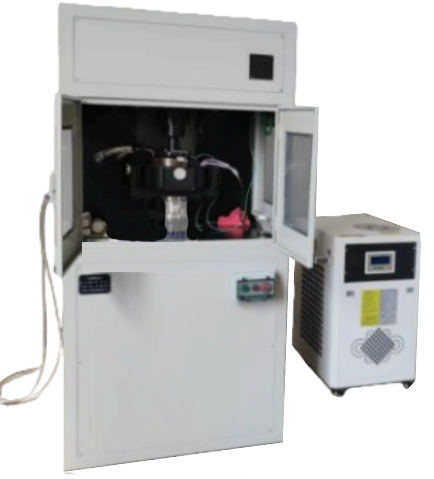
The working principle of this tester is based on the tribological characteristics of wet clutches and the lubrication film formation mechanism of transmission fluids. Its core function is to simulate the low-speed slip conditions of automatic transmission lock-up clutches and shift clutches—the conditions most prone to shudder—and evaluate the ATF’s anti-shudder performance by measuring the variation of the friction coefficient with sliding speed.
Before the test begins, standard friction plates and steel plates are installed on the main shaft and in the oil bath. The ATF sample is filled into the tester, and the oil temperature is raised to a set value (e.g., 80 °C) and maintained by the temperature control system. The loading system then applies a constant pressure to the friction pair (e.g., 1.0 MPa), while the drive system rotates the friction plates at stepwise low sliding speeds, gradually increasing from 0.006 m/s to 0.6 m/s.
During relative sliding, the transmission fluid forms a lubricating film between the friction surfaces, and the friction torque is captured in real time by a torque sensor. The computer automatically calculates the instantaneous friction coefficient using the formula:
[\mu = \frac{T}{F \times r}]
where μ is the friction coefficient, T is the friction torque, F is the applied load, and r is the effective radius of the friction pair. A μ–v curve is then plotted to represent the friction behavior.
The core criterion for evaluating anti-shudder performance is the slope of the μ–v curve. When the curve exhibits a positive slope (friction coefficient increases with sliding speed), the transmission fluid has good anti-shudder properties, effectively suppressing self-excited vibration of the friction pair. Conversely, a negative slope (friction coefficient decreases with sliding speed) indicates that the friction system is prone to instability, which can cause shift shudder, abnormal noises, and other issues. By precisely measuring this key characteristic, the tester provides a quantitative assessment of the ATF’s anti-shudder performance.
The tester typically uses wet clutch friction components from real transmissions as test specimens, including friction discs and steel plates. Driven by hydraulic or servo motors, it provides precise pressure loading and rotational motion, simulating the dynamic behavior of the clutch during engagement, slip, and lock-up stages.
ATF friction performance is highly sensitive to temperature. Modern testers are equipped with high-precision temperature control systems (typically ranging from 20 °C to 180 °C) to maintain stable oil temperature during testing. Meanwhile, the pressure control system allows precise adjustment from 0 up to several megapascals (MPa), simulating the clamping force of the clutch under different load conditions.
To replicate the speed variations during actual gear shifts, the tester offers a wide range of rotational speed adjustment (e.g., 0–6000 rpm) and programmable acceleration profiles. This capability is crucial for evaluating friction stability in the low-speed slip region, where shudder is most likely to occur.
The equipment integrates multi-channel sensors to capture torque, rotational speed, oil pressure, temperature, vibration acceleration, and other parameters in real time, with sampling frequencies exceeding 10 kHz. Signal processing techniques such as Fast Fourier Transform (FFT) are used to detect subtle shudder signals and quantify shudder intensity.
Controlled via PLC or industrial computer systems, the tester supports user-defined test cycles. The fully automated testing process minimizes human error and improves repeatability and comparability of results.
High-end testers feature a modular architecture, allowing replacement of different types of friction pairs to accommodate testing needs for AT, CVT, DCT, and other transmission types. Some equipment can also be expanded to evaluate comprehensive properties such as friction material durability and oxidation stability.
Lubricant manufacturers use this tester to rapidly screen combinations of base oils and additives (such as friction modifiers, antioxidants, and dispersants). It helps optimize formulations to achieve desirable friction–speed curves, suppress negative-slope regions, and improve anti-shudder performance.
OEMs and transmission manufacturers use the tester to evaluate the compatibility between different ATFs and specific friction materials. The results are used to calibrate transmission control strategies, ensuring a balance between shift smoothness and response performance.
During ATF production, each batch is subject to sampling tests for anti-shudder performance to ensure compliance with internal standards or OEM certification requirements, preventing after-sales complaints or product recalls caused by fluid quality issues.
Friction material suppliers use the tester to evaluate the performance of new paper-based, carbon-based, or metal-based friction plates. It is used to assess their durability and anti-shudder capability under different ATF environments.
This type of tester is a key piece of equipment for implementing standards such as JASO, ASTM, and ISO. It provides a unified testing platform for the industry and supports the continuous development and refinement of technical specifications.
Operating Procedure of the Automatic Transmission Fluid Anti-Shudder Friction Tester2
The anti-shudder performance (i.e., friction characteristics) of Automatic Transmission Fluid (ATF) is typically evaluated using a friction tester or a clutch-simulation bench that replicates sliding friction behavior. There is no single standardized “anti-shudder dedicated machine”; therefore, operation must strictly follow ASTM, SAE standards, or the manufacturer’s equipment manual. A general procedure is as follows:
1. Preparation Stage
Confirm that the test system is a friction tester (or an equivalent clutch disc-to-plate anti-shudder rig). Calibrate torque and speed sensors. Clean the steel discs and friction plates according to ASTM requirements. Pre-condition the ATF sample to the specified temperature (e.g., 70–120 °C) using the temperature control system.
2. Specimen Installation
Mount the standard friction disc (with friction lining) onto the drive shaft and install the chrome-plated steel plate on the driven side. Ensure proper alignment and concentricity with no misalignment. Inject the specified volume of ATF (typically 15–30 mL), ensuring no air bubbles are present.
3. Parameter Setting
Configure the sliding speed profile according to the relevant standard (e.g., acceleration from 0 to 100 rpm, dwell phase, and deceleration). Set the normal load (e.g., 1.5–2.5 kN) and the number of test cycles (e.g., 10–50 sliding repetitions). Enable real-time friction coefficient acquisition, which is critical for calculating the shudder tendency index.
4. Preheating and Start-Up
Activate the oil circulation and temperature control system and preheat for 10–15 minutes until the oil temperature stabilizes. Ensure that the safety cover is closed. Reset speed and load to zero, then start the test program gradually to avoid mechanical shock.
5. Operation Monitoring
During testing, continuously record the dynamic-to-static friction coefficient ratio (μ_static/μ_dynamic), friction fluctuations, and temperature. If abnormal noise or instability (simulating shudder) occurs, log the corresponding cycle and perform an emergency stop if necessary.
6. Post-Test Handling
After automatic shutdown, maintain oil circulation until the oil temperature drops below 50 °C before stopping the pump. Remove the specimens, measure friction plate wear, and clean metal components. Export friction–time curves and calculate anti-shudder evaluation indices such as friction fluctuation standard deviation and peak ratio.
7. Calibration and Maintenance
Before each test, verify load accuracy using standard weights and validate system repeatability using reference oil. After testing, clean the friction discs, apply anti-rust protection, and record ambient temperature, humidity, and oil batch information.
The Automatic Transmission Fluid (ATF) Anti-Shudder Friction Tester is a core testing device that ensures smooth shifting, durability, and driving comfort in automatic transmissions. Its importance is reflected across four key areas: standardized evaluation, formulation development, vehicle compatibility, and quality control.
1. Accurate Simulation of Real Operating Conditions
By using wet clutch friction pairs (friction discs and steel plates) under controlled oil temperature, pressure, and rotational speed, the tester reproduces the “shudder” phenomenon during low-speed slip phases. It quantifies the negative-slope characteristics of the friction coefficient–speed curve, which cannot be achieved with conventional friction testers such as four-ball or block-on-ring machines.
2. Support for ATF Formulation Development and Certification
The tester is used to screen friction modifiers (e.g., thiophosphate-based additives) and optimize additive packages to ensure ATF meets international and OEM standards such as JASO, ASTM, and GM. Failure in anti-shudder performance can lead to shift shudder, clutch wear, or even product recalls, making this device indispensable for OEM certification and batch sampling inspections.
3. Ensuring Transmission System Compatibility and Durability
OEMs and transmission manufacturers rely on the tester to evaluate the compatibility window between ATF and specific friction materials, guiding TCU shift logic calibration. Long-duration durability tests can predict the decline of anti-shudder performance over time, preventing “initially compliant, later failing” scenarios.
4. Driving Industry Standards and Technological Innovation
As the only specialized equipment capable of directly characterizing dynamic friction stability among the five key ATF performance metrics (viscosity–temperature behavior, extreme pressure wear resistance, friction/anti-shudder, oxidation stability, foaming resistance), it supports the development of CVT, DCT, and conventional AT technologies. The tester bridges the fields of lubrication chemistry, tribology, and vehicle dynamics.
The ATF Anti-Shudder Friction Tester serves as a critical bridge between materials science and vehicle engineering. Its highly realistic testing capabilities, precise data feedback, and standardized operational procedures make it indispensable for modern automotive transmission R&D. By continuously optimizing ATF anti-shudder performance, it not only enhances shift smoothness and driving comfort but also promotes transmission technologies toward higher efficiency and longer service life. We warmly invite you to leave a message or contact us directly for more detailed product information.


