The Block-on-Ring Test Machine is a specialized tribological testing device used to evaluate the anti-scuffing performance of lubricating oils/greases and the wear resistance of both metallic and non-metallic materials. Its core principle involves forming a sliding friction pair between a rotating ring specimen and a fixed block specimen. Under controlled conditions of load, rotational speed, and temperature, it simulates real working environments and measures parameters such as friction force and wear loss, thereby assessing the tribological properties of lubricants or materials.This article will introduce the equipment from the following aspects, and we hope it will be helpful to you.
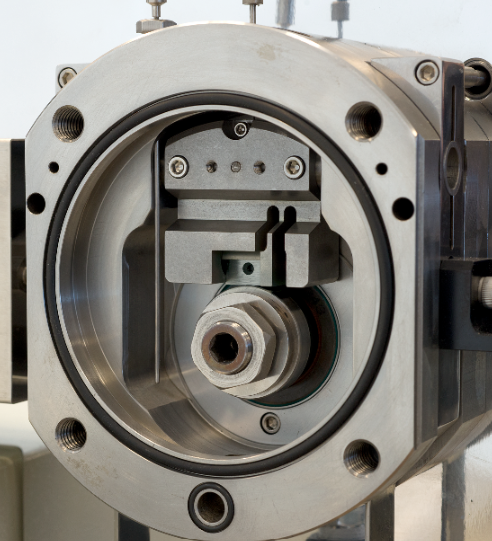
The Block-on-Ring Test Machine is a dedicated instrument used to evaluate the tribological performance of materials under sliding friction conditions, such as friction coefficient, wear resistance, and load-carrying capacity of lubricants. It is widely applied in testing lubricating oils, greases, and solid materials.
Main Functions
Measurement of friction coefficient:
The device calculates the friction coefficient (μ = f/P) by continuously monitoring the friction force and applied normal load during the test.
Evaluation of wear resistance:
It assesses material wear performance by measuring the wear of the block or ring specimen, such as mass loss or wear scar width.
Lubricant performance testing:
It evaluates the extreme pressure (EP) properties, anti-scuffing capability, and load-carrying capacity of lubricating oils and greases under different loads, speeds, and temperatures.
Simulation of complex working conditions:
Advanced models can simulate non-steady friction conditions such as acceleration, deceleration, reversing motion, sudden stopping, variable loads, and impact loading.
Multi-environment adaptability:
The machine supports various test environments, including dry friction, oil lubrication, and corrosive media (e.g., NaCl solution), enabling comprehensive performance evaluation under different operating conditions.
The Block-on-Ring Test Machine is a specialized instrument used to evaluate the load-carrying capacity of lubricants and the wear resistance of materials. It is widely applied across multiple industrial and technical fields. Based on authoritative public sources, its main application industries include:
Petrochemical Industry
Used to evaluate the anti-scuffing and extreme pressure (EP) performance of medium- and high-grade automotive gear oils (such as GL-3. GL-4. and GL-5). Testing is conducted in accordance with national standards such as SH/T and GB/T specifications.
Automotive Manufacturing
Simulates sliding friction conditions of key components such as gears and piston rings, and evaluates the friction and wear behavior of materials and lubricants under real operating conditions.
Materials Research and Academic Institutions
Widely used in tribology research for studying the wear performance of composite materials, coatings, metals, and non-metallic materials. It is also used to investigate the effects of microcapsules, additives, and other modifiers on wear resistance.
Aerospace Industry
Certain high-precision models are used for fundamental friction and wear testing of moving components such as rolling bearings and sealing elements.
Steel Metallurgy and Transportation Industry
Used for load-carrying capacity testing of lubricating greases and oils, supporting industry standards such as the Timken method and other tribological evaluation procedures.
High-End Manufacturing and Quality Inspection
In the product lines of tribology testing equipment manufacturers such as Jinan Hengxu and Falex, this type of equipment is used to measure key parameters including friction coefficient, wear scar width, and friction force–time curves.
Extended Applications in Advanced Simulation
Modern multi-condition block-on-ring testers can simulate complex working conditions such as acceleration, reversing, sudden stopping, variable loading, and impact. This further expands their application in advanced material development and extreme condition simulation research.
The Block-on-Ring Test Machine is a typical experimental device used to evaluate the friction and wear performance of materials and the anti-scuffing capability of lubricants. It is widely applied in automotive gear oils, metallic/non-metallic materials, coatings, and related research and testing fields. Based on publicly available information as of May 2026. its main technical features are as follows:
Core Technical Features
Line-contact sliding friction mechanism:
The system uses a standard rotating ring specimen and a fixed block specimen to form a line-contact friction pair, simulating sliding friction behavior found in real applications such as gears and bearings.
High-precision closed-loop control system:
The loading system typically adopts a servo motor or stepper motor combined with a lever mechanism (e.g., 1:3 or 10:1 ratio), enabling stepless loading in the range of 0–3000 N or up to 5000 N, with an accuracy of ±0.5% to ±1%.
The main drive system uses a variable-frequency three-phase induction motor or servo motor, with a speed range typically from 100–3000 r/min, and in some advanced models extended to 5–6000 r/min. Speed control accuracy is within ±1%, or ±1 r/min at low speeds.
Wide-temperature oil bath environment:
Oil temperature control typically ranges from room temperature to 100°C, while high-end models can reach up to 260°C, with a temperature accuracy of ±2°C.
The oil chamber is made of either transparent plexiglass (for room-temperature observation) or stainless steel heating chambers (for high-temperature testing).
Multi-parameter real-time data acquisition and computer-based control:
Equipped with friction force sensors (commonly 0–300 N range, accuracy ±1%–±3%) and load sensors, enabling synchronized recording of friction force–time, temperature–time, and speed–time curves.
Supports touchscreen operation or industrial computer remote control. Data can be stored, retrieved, and printed, and some systems support advanced functions such as Python-based secondary development.
Compliance with international and domestic standards:
Mainstream models comply with standards such as GB/T, ASTM, and SH/T.
Integrated and stable structural design:
The machine adopts an integrated welded base or cast frame structure to enhance rigidity and reduce vibration.
Some advanced models are equipped with cutting-edge features such as magnetic fluid sealing, vacuum environment modules, and laser confocal microscope interfaces.
The Block-on-Ring Test Machine is a dedicated instrument for evaluating the anti-friction and anti-wear performance of lubricants and materials. It is widely used in petrochemical, automotive manufacturing, and materials research fields. The standard operating procedure is as follows:
1. Pre-Test Preparation
Environmental requirements
Ambient temperature should be controlled at 10–35°C, with strict testing recommended at (23 ± 5)°C.
The environment must be well-ventilated, dry, and free from strong electromagnetic interference, corrosive gases, and dust.
Equipment inspection
Check the main spindle, fixtures, oil bath, loading system, and temperature control system to ensure they are in proper working condition.
Clean the test ring, test block, and all contact areas to remove any contaminants.
Specimen preparation and installation
Prepare the test ring and block according to standard dimensions.
Install the test block into the holder and apply the test lubricant (e.g., grease) evenly on one-quarter of its surface.
Tighten the locking nut using a torque wrench to 28.25 N·m.
Ensure that the edge of the test block is parallel to the edge of the ring, and that the block is properly aligned at the center of the ring.
2. Parameter Setting
Load: Select 163 kg, 218 kg, or 286 kg depending on the standard (corresponding to different lever ratios).
Oscillation angle: Set to 90°.
Oscillation frequency: 87.5 cycles per minute.
Temperature (if required): Room temperature to 200°C (standard configuration), and up to 250°C with optional pressure chamber.
Test duration / cycles: Typically set to 5000 cycles (approximately 57 minutes).
3. Test Start-Up
Manually rotate the system to ensure full contact between the block and the ring.
Secure the test block firmly.
Apply the load using a 10:1 lever ratio (e.g., 163 kg load requires 16.3 kg counterweight).
Start the oscillation system and begin timing the test.
4. In-Test Monitoring
Continuously monitor friction force, temperature, and wear behavior (some models provide real-time friction force–time curves).
If the friction force exceeds 18.14 kg, the machine will automatically shut down and record the abnormal condition.
5. Test Completion and Data Processing
Stop the machine and carefully remove the test specimens.
Measure the wear scar width on the test block using a microscope, taking three measurements (center and 1 mm on both sides) and calculating the average value.
Record abnormal wear patterns such as wedge-shaped scars, scuffing, or fractures.
If wedge-shaped wear occurs, the test must be repeated.
The data is used to evaluate material wear resistance, lubrication performance, and anti-scuffing capability.
6. Precautions
Safety protection
Operators must wear protective gloves, goggles, and other safety equipment during operation.
Equipment maintenance
Regular cleaning and calibration are required to ensure the accuracy of the loading and force measurement systems.
The importance of the Block-on-Ring Friction and Wear Test Machine lies in its critical role in simulating real operating conditions and evaluating the performance of materials and lubricants under sliding contact. Its value is reflected in the following key aspects:
1. Wide applicability and industry reliance
Coverage of multiple key industrial sectors:
This equipment is widely used in automotive, aerospace, oil and gas, and mechanical manufacturing industries. It is employed to evaluate the wear behavior of sliding tribological pairs such as piston ring–cylinder liner, gears, and bearings under service conditions.
Standardized testing methodology:
Testing is conducted in accordance with international and national standards such as ASTM, GB/T, and SH/T, ensuring high comparability, repeatability, and authoritative results.
2. Accurate simulation of real friction environments
The system can simulate a wide range of complex working conditions, including dry friction, lubricated (oil/grease) environments, high temperature, corrosive media, variable load, sudden stop, and directional reversal. In particular, it effectively reflects the anti-scuffing performance of lubricants under boundary lubrication conditions.
For example, testing piston ring materials in abrasive-containing lubricants can help predict wear life in real engine operation.
3. Quantitative evaluation of key performance parameters
Wear rate (K) calculation:
Wear resistance is quantitatively evaluated using measured wear volume, applied load, and sliding distance (K = V / (F × s)).
Real-time friction coefficient (COF) monitoring:
The system can distinguish between dry friction (COF ≈ 0.8) and lubricated friction (COF ≈ 0.09), clearly demonstrating the significant role of lubrication in reducing energy loss.
Surface morphology and roughness analysis:
When combined with 3D profilometers or optical microscopes, the machine enables direct observation of wear mechanisms such as three-body abrasive wear and oxidative delamination.
4. Driving material and lubrication technology development
The machine is widely used for screening and validating new coatings, composite materials, and lubricant additives, significantly accelerating R&D processes.
Its ability to simulate multi-condition scenarios (e.g., acceleration, impact, variable load) enhances the predictive capability of laboratory data for real-world service conditions.
5. Typical application scenarios
Anti-scuffing evaluation of automotive gear oils (GL-3 to GL-5 grades).
Material selection and lifespan assessment of engine components such as piston rings and cylinder liners.
Load-carrying capacity testing of lubricating greases and oils under boundary lubrication conditions.
In summary, the Block-on-Ring Friction and Wear Test Machine is a core experimental tool in tribology research. It not only enables in-depth investigation of surface friction behavior, wear mechanisms, and lubrication performance, but also serves as a critical technical foundation for improving the reliability, energy efficiency, and service life of mechanical systems.By accurately simulating complex frictional contact conditions, it provides essential scientific data for material selection, process optimization, and maintenance strategy development, ultimately ensuring safer and more durable mechanical operation.We sincerely welcome researchers, engineers, and industry professionals to contact us for more detailed technical information, application cases, and customized solutions to support your R&D and engineering needs.


