The Micro-Scale Abrasion Tester is a highly precise material performance evaluation instrument specifically designed for in-depth investigation and quantitative analysis of wear resistance, complex friction and wear behavior, and fretting fatigue characteristics of various materials at the micron scale.This instrument is particularly focused on systematically studying the surface wear mechanisms and damage evolution of coatings, functional thin films, soft materials, biological tissue samples, polymers, and various metallic alloys under precisely controlled micro-loads and limited sliding distances.This article aims to provide a comprehensive and systematic introduction to this precision testing system from multiple perspectives, including its working principle, core structural modules, typical testing methods, key parameter settings, and data interpretation techniques. It is intended to offer valuable reference information and practical guidance for researchers and technical professionals in related fields.
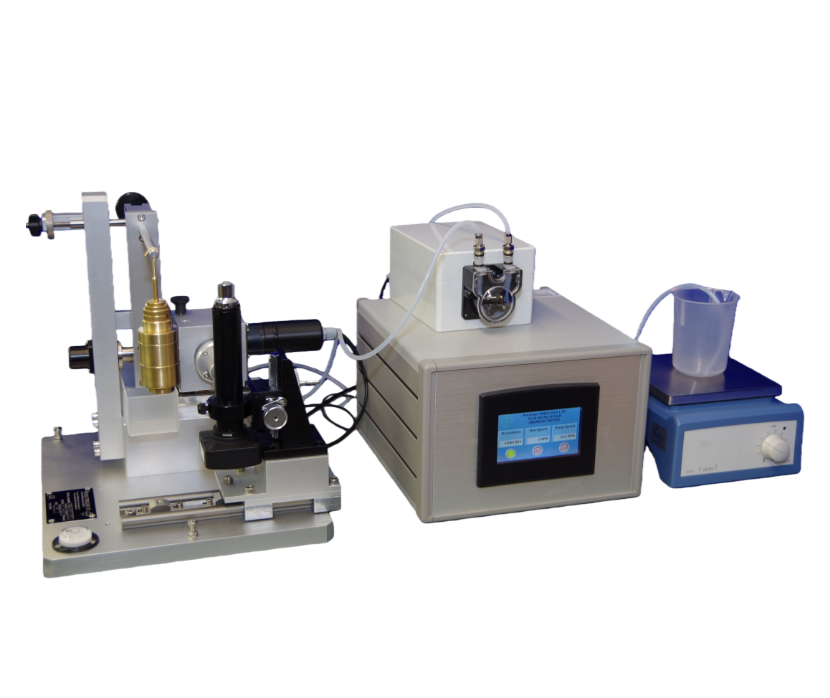
The Micro-Scale Abrasion Tester is a precision instrument specifically designed to evaluate the wear resistance, abrasion behavior, and surface characteristics of materials under micron-scale friction conditions. Its core functionality focuses on the study of wear mechanisms at the micro scale and is suitable for surface analysis of both hard and soft materials.
Micro-scale abrasion testing
Under controlled loads (such as 0.05 N to 5 N) and sliding distances, the tester simulates localized wear caused by fine abrasive particles or rough surface interactions.
Wear volume and weight measurement
Material loss before and after testing can be quantitatively measured using electronic balances or optical profilometers to determine wear volume or mass loss.
Multi-environment adaptability
Some models are equipped with heating systems capable of reaching temperatures up to 600°C, allowing simulation of wear behavior under high-temperature operating conditions.
Standardized testing
The equipment complies with international standards such as ASTM and ISO standards, ensuring reliable and comparable testing results.
High-precision control
Featuring micron-level displacement resolution and milli-Newton load accuracy, the tester is highly suitable for evaluating thin films, coatings, elastomers, and other soft materials.
Material research and development
Used to evaluate the resistance of materials such as rubber, plastics, coatings, and titanium alloys (such as TAMZ alloys) against micro-abrasive wear.
Quality control
Widely applied in wear resistance testing for products such as tires, shoe soles, and conveyor belts.
Failure analysis
Helps investigate wear failure mechanisms in components such as seals, joint prostheses, and other parts subjected to fretting and micro-abrasion conditions.
Accelerated life testing
Micro-scale abrasion tests can rapidly predict long-term performance degradation trends of materials during service life.
Scientific research applications
Provides technical support for fundamental studies in fields such as micro-tribology, surface engineering, and biomaterials research.
The Micro-Scale Abrasion Tester is primarily used to evaluate the wear resistance of materials under micron-scale abrasive conditions, especially in applications requiring high-precision and small-scale wear analysis. According to publicly available information, the industries where this equipment is widely applied include:
Automotive Industry
Used to test the fretting and micro-abrasive wear behavior of sealing components such as silicone rubber and NBR rubber dynamic seals operating in lubricated environments containing hard particles. The tester helps evaluate service life and reliability.
Aerospace and Advanced Manufacturing
Applied in the study of micro-scale wear characteristics of coatings, titanium alloys (such as TAMZ alloys), and other hard or functional materials used in high-performance engineering applications.
Medical Devices and Biomedical Implants
Can be integrated with joint simulation systems for friction and wear testing of artificial joint materials and biomedical implant components.
Material Research and Quality Control
Widely used in universities, research institutes, and industrial laboratories for standardized wear-performance evaluation of new polymers, composite materials, lubricants, and advanced engineering materials.
Energy and Heavy Machinery Industries
Used to assess the durability of critical components such as hydraulic systems, gears, and bearings operating under micro-abrasive environments.
The equipment typically adopts a “ball-on-flat” contact configuration with a load range as low as 0.05–5 N, making it highly suitable for simulating micro-abrasive wear under realistic operating conditions. It is an effective tool for accelerated wear testing and surface durability evaluation.
The Micro-Scale Abrasion Tester is a precision instrument specifically designed to evaluate the wear resistance of materials under micron-scale abrasion conditions. It is particularly suitable for studying the micro-abrasive wear behavior of hard and soft coatings, metals, polymers, sealing elastomers, and other advanced materials. Its major technical features are as follows:
Core Technical Features
Micro-scale wear simulation
The system can simulate surface wear caused by tiny hard particles, such as debris present in lubricants under real operating conditions. It is especially suitable for wear-sensitive materials including dynamic seals, coatings, and elastomers.
High-precision load control
The loading range is typically from 0.05 N to 5 N, while some models support milli-Newton-level precision loading. This enables accurate application of normal force and ensures excellent test repeatability and reliability.
Controllable sliding speed
The rotational speed of the ball or specimen is generally adjustable within a range of 30–150 rpm, allowing simulation of wear behavior under different relative motion conditions.
Standardized testing configuration
The equipment commonly adopts a Ball-on-Plate contact configuration and complies with relevant ASTM wear testing standards, ensuring consistency and comparability of results.
Integrated debris removal system
Equipped with vacuum cleaning systems or lubricant circulation devices, the tester can continuously remove wear debris during testing, minimizing secondary abrasion interference and improving result accuracy.
Micro-area wear morphology analysis support
After testing, wear scars can be quantitatively analyzed using optical profilometers, SEM (Scanning Electron Microscopy), and other surface characterization techniques. This is especially valuable for evaluating irregular wear scars in elastomeric materials and other non-rigid specimens.
Multi-functional expandability
Certain models can also be used for coating thickness measurement by generating controlled wear craters, enabling non-destructive thickness evaluation of thin coatings and surface films.
The Micro-Scale Abrasion Tester is a precision instrument used to evaluate the micro-scale wear resistance of materials. It is particularly suitable for studying the micro-abrasive wear behavior of sealing elastomers such as rubber and polymers under realistic operating conditions.
The core principle of this tester is based on a controllable micro-scale friction and wear process. By simulating localized scratching and material removal caused by hard micro-particles under lubricated conditions, the system quantitatively evaluates the micro-abrasion characteristics of materials.
Key Testing Principles
Friction mode
The tester adopts linear or rotational sliding contact, allowing relative motion between the specimen and abrasive particles (such as silicon carbide or aluminum oxide particles) or between the specimen and a counterface material.
Load control
Precisely controlled low loads—typically ranging from several milli-Newtons to several Newtons—are applied to simulate the actual forces generated by micro-abrasive particles in service environments.
Wear mechanism
The primary wear mechanism involved is three-body abrasion, where hard particles are trapped between two contacting surfaces. This interaction may lead to:
Micro-crack formation
Plastic deformation
Micro-cutting and material removal on the specimen surface
Wear Measurement Methods
Optical profilometry
An optical profilometer is used to measure the volume and three-dimensional morphology of the wear scar generated during testing.
Mass loss measurement
A high-precision electronic balance can be used to determine material mass loss. Combined with the material density, the wear volume can then be calculated quantitatively.
The Micro-Scale Abrasion Tester is used to evaluate the wear resistance of materials under micro-abrasive wear conditions. It is widely applied in research fields involving coatings, biomaterials, metal alloys, polymers, and advanced engineering materials. Its operation is generally based on standardized testing methods and equipment specifications.
Core Operating Procedure
1. Sample Preparation
Prepare the test material (such as coatings, metals, or polymers) into standard-sized specimens, typically in flat plate form.
Clean the specimen surface thoroughly to remove oil, oxide layers, and contaminants to ensure accurate testing results.
2. Test Parameter Setup
Load Range
Typically adjustable from 0.05 N to 5 N for micro-scale abrasion testing.
Ball Rotation Speed
Usually set within a range of 30–150 rpm.
Ball Diameter
Commonly uses a 25 mm hard ball made of materials such as tungsten carbide or alumina.
Abrasive Slurry Supply
Abrasive suspension (such as SiO₂ or Al₂O₃ particles dispersed in water or simulated body fluid) is continuously supplied by a pump at a flow rate of 0–60 mL/h.
3. Test Mode Selection
The tester can operate in different wear modes, including:
Two-body grooving abrasion
Three-body rolling abrasion
For studies involving tribo-corrosion or wear-corrosion synergistic effects, the system can be integrated with an electrochemical workstation for in-situ monitoring of:
Open circuit potential (OCP)
Current noise
Electrochemical response signals
4. Test Execution
Start the equipment so that the rotating ball contacts the specimen surface under the preset load.
During testing, data such as friction force, electrochemical response, and mass change are recorded simultaneously.
Typical test duration ranges from 10 to 60 minutes depending on the wear resistance of the material.
5. Post-Test Processing and Analysis
Mass Loss Measurement
Measure specimen mass loss using a high-precision electronic balance.
Wear Morphology Observation
Analyze wear scars using optical microscopy or Scanning Electron Microscopy (SEM).
Mechanism Analysis
Combine wear data with electrochemical measurements to study wear-corrosion synergistic mechanisms and material degradation behavior.
The importance of the Micro-Scale Abrasion Tester is mainly reflected in its ability to accurately evaluate the wear resistance of materials at the micro scale, especially for materials that are difficult to characterize effectively using traditional macro-scale wear testing methods, such as elastomers, soft coatings, and biomaterials. Its key significance is outlined below:
High Precision and Repeatability
This type of tester can operate under loads ranging from micro-Newtons to several Newtons, producing localized and highly consistent wear scars. It is suitable for comparative studies involving both hard materials (such as metals and ceramics) and soft materials (such as rubber and polymers).
Simulation of Real Service Conditions
In dynamic sealing systems, lubricating oil films may carry hard micro-particles into sealing interfaces, resulting in micro-abrasive wear. The Micro-Scale Abrasion Tester can effectively reproduce this wear mechanism, providing important data for seal life prediction and reliability evaluation.
Accelerated Wear Evaluation
Research has shown that the equipment can complete wear testing within a relatively short time while generating representative micro-abrasive wear morphologies. This makes it a valuable accelerated wear testing method that helps shorten material development and validation cycles.
Multi-Functional Applications
In addition to determining wear coefficients and abrasion resistance, the tester can also:
Measure coating thickness through controlled wear crater generation
Investigate tribological behavior between different material combinations
Analyze surface interaction mechanisms under micro-contact conditions
Support for Standardized Testing
The equipment is designed in accordance with international tribology testing standards, allowing test results to be directly compared across laboratories and widely accepted within the industry.
In summary, the Micro-Scale Abrasion Tester is an indispensable high-precision instrument in material science research and development, production quality control, and failure analysis. Its role is particularly critical in tribological studies and applications at the micron and even nanometer scale.By providing highly accurate friction and wear data, the instrument enables deeper understanding of microscopic surface interaction mechanisms, optimization of material performance, and advancement of related technologies, offering both significant theoretical value and practical engineering benefits.We sincerely welcome researchers, industry professionals, partners, and potential users to contact us or leave a message. Our team will be pleased to provide comprehensive technical documentation, application examples, and customized professional solutions based on your specific requirements.


