The Universal Abrasion Resistance Tester is a key industrial testing instrument designed for the precise evaluation of the wear resistance of a wide range of materials under complex frictional conditions. By closely simulating various wear scenarios encountered in real-world applications, the instrument enables scientific and quantitative assessment of a material’s abrasion resistance and durability.As a result, it is widely used in multiple critical fields, including materials science research, new product development, stringent quality control in manufacturing, and compliance verification with industry standards.This document will provide a comprehensive and systematic introduction to the instrument, covering its working principles, core testing methods, major application scenarios, and result evaluation standards.
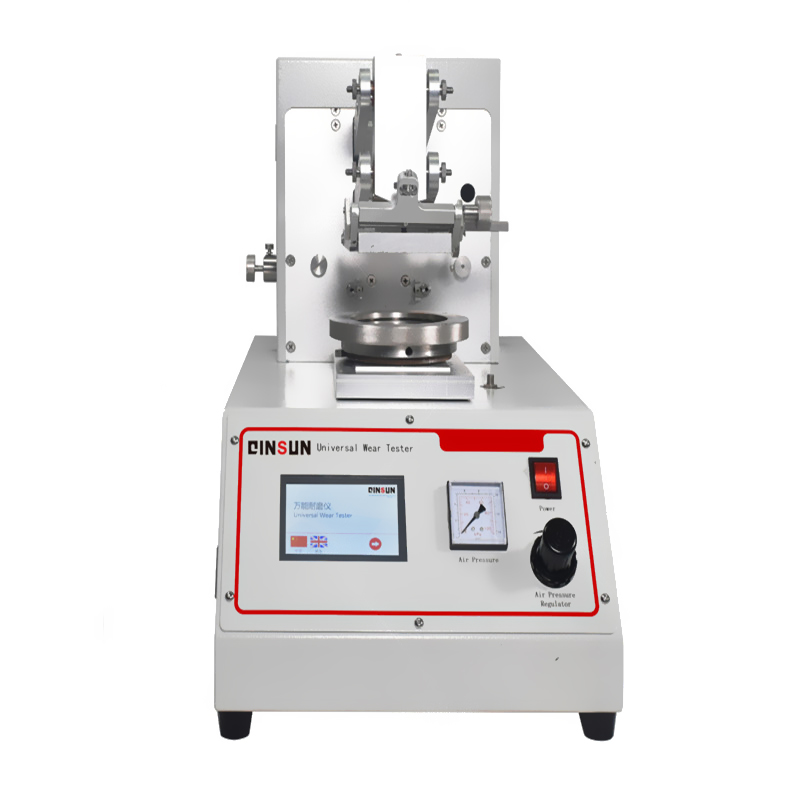
A Universal Abrasion Resistance Tester is an industrial instrument used to evaluate the wear resistance of various materials under different friction conditions. Its main functions and features are as follows:
Multiple Abrasion Test Modes:
Capable of performing various wear tests, including flat abrasion, curved abrasion, edge abrasion, folding edge abrasion, and frost resistance abrasion tests.
Wide Material Compatibility:
Suitable for testing a broad range of materials, such as textiles (woven, knitted, coated, suede), leather, plastic films, rubber, paper, carpets, nonwoven fabrics, yarns, electronic components, and automotive interior materials.
Multi-Standard Compliance:
Complies with multiple international and industry standards, including ISO 12947 (Martindale method), ASTM D3514. ASTM D3885. ASTM D4966. GB/T 21196. GB/T 9867. JIS L1018. JIS L1096. DIN 53516. and EN ISO 20344.
Liquid Environment Testing:
Certain models support testing under dry conditions as well as in liquid environments such as water or oil immersion.
High-Precision Control:
Features electronic counting, adjustable rotational speed, precise load application (e.g., 250 g, 500 g, 750 g, 1000 g), and stable abrasion wheel operation.
Integrated Multifunctional Design:
Combines an industrial control computer, dedicated software, and data acquisition modules to enable automated operation.
Dual Specimen Platform (Optional):
Some models are equipped with dual specimen holders, allowing simultaneous testing of two materials, improving efficiency and enabling comparative analysis.
Full-Angle Abrasion Simulation:
Offset abrasion wheel shafts generate sliding motion, producing complete circular wear tracks on the specimen surface and eliminating bias from unidirectional wear.
Vacuum Cleaning System:
Removes debris in real time to maintain a clean testing environment and ensure accurate results.
Wide Parameter Adjustment Range:
Rotational speed ranges from 0–90 rpm (some models: 50–2 r/min), with selectable loads from 250 g to 1000 g. The number of test stations can include 4. 6. 8. or 9 positions.
High-Precision Measurement:
Equipped with OLED or digital displays, with cumulative counting up to 999.999 cycles.
Robust and Durable Structure:
Compact models typically measure approximately 220 × 280 × 300 mm and weigh around 15 kg, while larger systems (e.g., Martindale-type testers) can weigh up to 150 kg.
A Universal Abrasion Resistance Tester is an industrial testing instrument used to evaluate the wear resistance of various materials under controlled conditions. Its primary purpose is to quantify material abrasion resistance by simulating real-world wear behaviors such as friction, scratching, and rolling. It is widely applied in research and development, quality control, and standards compliance verification.
Material Abrasion Resistance Evaluation
The instrument measures parameters such as weight loss, thickness reduction, or surface damage under specified pressure, rotational speed, and abrasive conditions, thereby determining the material’s wear resistance performance.
Wide Industry Applicability
It is suitable for a broad range of materials and industries, including leather, textiles (such as fabrics and carpets), plastics, rubber, paper, coatings, metal coatings, flooring materials, automotive interiors, footwear materials, and furniture finishes.
Support for Multiple Testing Modes
The tester supports various abrasion modes, including:
Flat Abrasion
Flex Abrasion
Edge Abrasion
Additional modes such as edge wear, pilling resistance, and suede abrasion (depending on configuration)
Compliance with International Standards
It complies with multiple international and national standards such as ASTM, ISO, GB, JIS, and DIN, ensuring result comparability and global recognition.
Tool for R&D and Quality Control
It is widely used for new material development, product lifespan prediction, raw material selection, and final product quality inspection before shipment.
A Universal Abrasion Resistance Tester is applicable across multiple industries and is primarily used to evaluate the durability of materials under friction and wear conditions. According to authoritative public sources, its main application industries include the following:
Textile and Apparel Industry
Used to test the abrasion resistance of woven fabrics, knitted fabrics, coated textiles, velvets, socks, felts, and nonwoven fabrics.
Leather and Footwear Industry
Used for abrasion testing of shoe soles, leather, and synthetic leather materials, in compliance with standards such as DIN 53516. ISO 4649. and GB/T 9867.
Rubber and Plastics Industry
Used to evaluate the wear resistance of rubber products (such as tires and conveyor belts), plastic films, and plastic sheets.
Automotive Industry
Used for testing the abrasion resistance of interior materials, sealing components, and rubber parts. The term “abrasion resistance” is widely referenced in automotive industry standards.
Paper and Packaging Industry
Used to test the scratch resistance and abrasion resistance of paper, cardboard, printed coatings, and labels, in accordance with standards such as ASTM D5264 and TAPPI T830.
Flooring and Construction Materials Industry
Applicable to wood flooring, laminate flooring, coatings, paints, and ceramic tiles for abrasion resistance testing.
Research and Quality Inspection Institutions
Widely used in universities, research laboratories, commodity inspection agencies, arbitration organizations, and technical supervision departments for material development and quality control purposes.
Such equipment typically supports multiple testing modes, including flat abrasion, edge abrasion, and flex abrasion, and complies with international standards such as ISO, ASTM, DIN, and GB. Therefore, it plays a critical role in material development, quality control, and product certification processes.
The operation of a Universal Abrasion Testing Machine varies depending on the specific model and applicable standards. However, the basic operating procedure is generally consistent as follows:
Preparation
Ensure the instrument is placed on a stable, vibration-free workbench, and connected to a suitable power supply (typically AC 220V).
Check that components such as the abrasion wheel, turntable, and loading weights are clean and in good condition.
Select the appropriate abrasion wheel and load weight according to the test material (e.g., rubber, leather, plastic, textiles, coatings, etc.). Common load weights include 250 g, 500 g, 750 g, and 1000 g.
Specimen Installation
Fix the specimen onto the turntable, ensuring it is properly centered and firmly attached.
Typical specimen size is Ø110 mm with a thickness of 1–6 mm (e.g., YL-3315T1 model). Some equipment may require circular specimens with an area of 30 cm².
Parameter Setting
Set the turntable speed, typically 60 RPM or 72 RPM. Some models support stepless speed adjustment from 0–90 RPM.
Install the corresponding loading weights to apply the required pressure. Note that the indicated load equals the actual weight plus the weight of the loading assembly.
If the machine is equipped with a vacuum dust removal system, activate it to remove wear debris during testing.
Test Operation
Start the motor to rotate the turntable. Under applied pressure, the abrasion wheel rubs against the specimen surface.
During testing, the abrasion wheel produces a circular wear track on the specimen surface.
The test can be set for a specific number of cycles (e.g., 100. 500. 1000 revolutions) or run until specimen failure.
Completion and Evaluation
After testing, stop the motor and remove the specimen.
Evaluate abrasion resistance using the mass loss method (weighing before and after testing) or visual/dimensional analysis.
Clean the turntable and abrasion wheel to prepare for the next test.
The maintenance of a Universal Abrasion Resistance Tester should be carried out based on the equipment type, frequency of use, and relevant standard requirements. The general maintenance guidelines are as follows:
Cleaning and Care:
After each test, remove residual specimens and abrasive dust. Keep the worktable, fixtures, and friction components clean to prevent contamination from affecting test accuracy.
Lubrication Inspection:
Regularly apply appropriate lubricant to moving parts such as guide rails, bearings, and abrasion heads to ensure smooth operation and reduce mechanical wear.
Calibration Verification:
Periodically calibrate key systems such as the load application system, counter, and travel mechanism according to usage frequency to ensure compliance with relevant standards such as GB/T 17636. ISO 4649. and ASTM D4157.
Power and Electrical Inspection:
Ensure a stable power supply (typically AC 220V). Check wiring for aging, looseness, or damage to prevent short circuits or overloads.
Monthly Maintenance:
Check whether all fasteners are loose.
Verify the accuracy of digital displays and control systems.
Quarterly Maintenance:
Calibrate the loading system (e.g., weights or electronic load units).
Inspect abrasion wheels and abrasive fixtures for wear and replace if necessary.
Annual or Usage-Based Maintenance:
Conduct a full inspection of the motor and transmission system.
Perform complete performance validation by qualified technicians.
The equipment should be operated in a dry and well-ventilated environment. High temperature and humidity should be avoided to prevent corrosion of electronic and metal components.
Non-professional personnel are not allowed to disassemble core components. In case of malfunction, technical support from the manufacturer should be contacted.
Maintenance requirements may vary depending on the brand or model (e.g., Qinsun). Users are advised to refer to the specific operation manual provided with the equipment.
If a detailed maintenance guide for a specific model is required, please provide the brand or model for further assistance.
The importance of a Universal Abrasion Resistance Tester can be summarized in the following aspects:
Multi-Material Applicability
The instrument is capable of testing the abrasion resistance of a wide range of materials, including textiles, leather, plastics, rubber, coatings, paper, and nonwoven fabrics, thereby meeting cross-industry testing requirements.
Simulation of Realistic Wear Conditions
It can perform multiple test modes such as flat abrasion, flex abrasion, edge abrasion, and rolling–sliding composite motion, providing a more accurate simulation of real-world wear conditions.
Support for Performance Validation and Standards Compliance
The tester is widely used in compliance with international and national standards such as ISO 12947. ASTM D3885. and GB/T 21196. providing reliable data support for product performance verification.
Enhancing Consumer Trust and Brand Reputation
In high-performance textile and material industries, independent testing using such equipment helps verify manufacturers’ claims regarding durability and protective performance, preventing misleading claims and strengthening market confidence.
Driving New Material Development
It provides a reliable evaluation method for emerging materials such as smart textiles and nanocomposites, accelerating innovation and practical application.
In summary, the Universal Abrasion Resistance Tester plays a vital bridging role between material research and development, production quality control, and market trust establishment. It is not only a core laboratory instrument for evaluating material wear resistance, but also a key tool for ensuring product quality, meeting industry standards, and building user confidence.We sincerely invite you to visit our official website for more detailed technical specifications, application cases, and operation guides.


