The Five-Finger Scratch Tester is a professional surface performance evaluation device, primarily designed to accurately measure the scratch and abrasion resistance of various materials under specific conditions. By simulating potential scratching and abrasion scenarios that may occur during actual use, the instrument provides quantitative analysis and scientific assessment of a material’s surface damage resistance.In the automotive industry, it is commonly used to test the durability of interior components, exterior coatings, and plastic parts. In the chemical industry, it evaluates the surface hardness and scratch resistance of coatings, paints, and polymer materials. Additionally, during the R&D of plastics and coatings, this device plays an indispensable role in quality control, helping manufacturers optimize material formulations, improve production processes, and ensure products meet relevant industry standards and performance requirements.As a result, the Five-Finger Scratch Tester is widely applied across critical sectors including automotive manufacturing, chemical production, plastics processing, and coating manufacturing.This article will introduce the device from several aspects, providing useful insights for professionals and researchers in related fields.
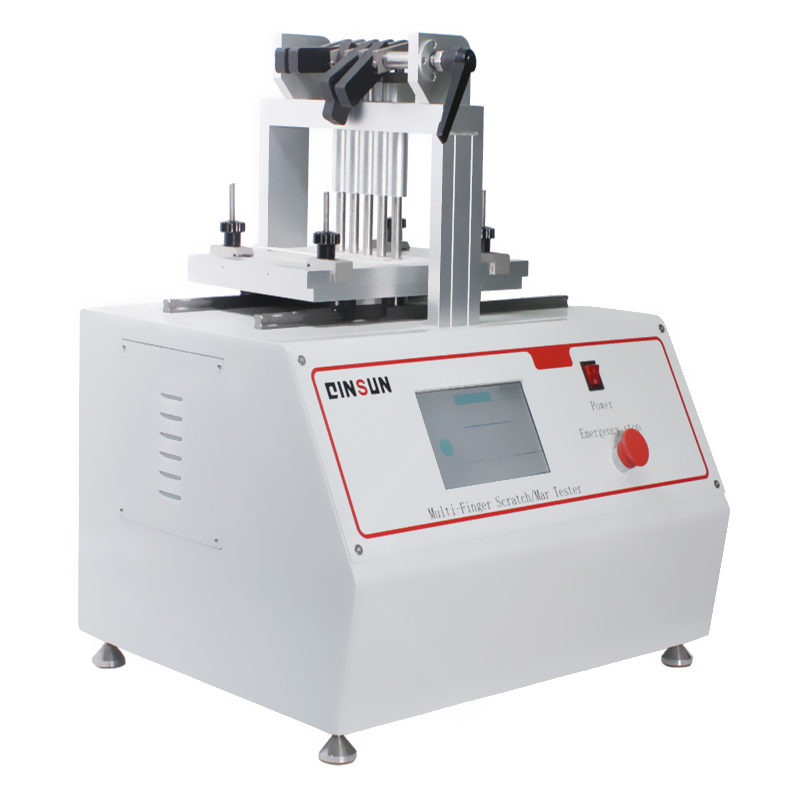
The Five-Finger Scratch Tester is a specialized testing device used to evaluate the scratch and abrasion resistance of material surfaces. Its main applications include the following:
1. Evaluating Material Scratch Resistance
The tester simulates the action of human fingers or hard objects (such as fingernails) on material surfaces, assessing their resistance to damage under everyday use conditions.
2. Supporting Quality Control in the Automotive Industry
It is particularly suitable for testing the wear resistance of automotive interior and exterior components, such as plastic trim, leather, coatings, and inks, and complies with multiple international automotive standards.
3. Material R&D and Verification
The device is used during the development of new materials or processes to verify performance and ensure that products meet design requirements.
4. Multi-Material Compatibility
It is not limited to plastics; it can also test paints, inks, soft metals, carpets, leather, and composite materials.
The Five-Finger Scratch Tester is primarily used to evaluate the scratch and abrasion resistance of material surfaces under simulated finger or fingernail contact. Its applicable industries include:
1. Automotive Industry
This is the primary application field. The tester is used to assess the scratch resistance of automotive interior and exterior components, such as plastic trims, leather, coatings, and inks, in compliance with standards from major car manufacturers including Ford, General Motors, Mercedes-Benz, and BMW.
2. Plastics and Rubber Industry
The device evaluates the surface wear resistance of various plastic and rubber products, especially suitable for smooth or textured plastic parts.
3. Coatings and Paint Industry
It tests the scratch resistance of paints, inks, powder coatings, and other surface treatments, widely applied in quality control and R&D processes.
4. Consumer Electronics and Home Appliances
The tester assesses the scratch resistance of housings, buttons, displays, and other components under everyday use conditions.
5. Leather, Textile, and Carpet Industry
It evaluates the durability of these materials when subjected to finger or hard-object abrasion.
6. Soft Metals and Composite Materials
Applicable for scratch testing of soft metals such as aluminum and copper, as well as their surface-treated layers.
Additionally, the Five-Finger Scratch Tester supports multiple international standards, including ASTM D7027. ISO 1518. GMW 14688. BMW GS 97034. and DIN EN 60068-2-70. further expanding its suitability for cross-industry quality testing applications.
The Five-Finger Scratch Tester operates by using five independent metal scratch fingers (typically made of tungsten carbide or high-carbon steel) to simultaneously simulate the action of human fingernails or fingers on a material surface. It quantifies a material’s resistance to external scratches and abrasions, i.e., its scratch and abrasion resistance. Below is the standard operating procedure and detailed guidance.
1. Preparation Before Testing
Ensure a controlled testing environment, typically with a temperature of 23±2°C and relative humidity of 50%±5%, to minimize environmental effects on results.
Thoroughly clean the test platform, all scratch fingers, and the sample surface to remove dust, oil, or other contaminants, ensuring a clean contact surface during testing.
Select appropriate scratch finger types, applied load, and scratching speed according to relevant international or industry standards, such as ASTM D7027. ISO 1518. GMW14688. Ford BN 108-13. etc.
2. Sample Installation and Fixation
Securely fix the sample flat on the testing platform, ensuring the entire test area is smooth, free from wrinkles, bending, or warping.
This ensures uniform contact between the scratch fingers and the sample, providing representative results.
3. Scratch Finger Installation and Test Parameter Settings
Install the five independently adjustable metal scratch fingers (usually tungsten carbide with hardness ≥ HRC62) and adjust their spacing as required, commonly 5–20 mm.
Set the contact angle between the scratch fingers and the sample surface. Standard angles are 45°±2°, with advanced models offering automatic angle calibration for improved accuracy.
Apply the vertical load on the scratch fingers according to the material type and test standard. Common loads include 1 N, 5 N, 10 N, with high-performance models supporting up to 20 N.
Set the scratching speed, typically 100 mm/s, and adjust the scratching stroke length, generally 100–200 mm.
4. Conducting the Scratch Test
Start the device. The five scratch fingers move across the sample surface under the preset load, speed, and stroke in a unidirectional or reciprocating motion.
Testing can be done under dry conditions or in simulated liquid environments (such as sweat, sunscreen, or cleaning agents) to assess durability under various real-world conditions.
5. Evaluating and Analyzing Test Results
After testing, visually inspect the scratches under a standard light source (e.g., D65) or natural daylight and evaluate scratch levels according to relevant standards.
For further quantitative analysis, use profilometers, microscopes, or other instruments to measure scratch depth, width, and geometric parameters. Image comparison techniques can also be applied to analyze surface changes. Some high-end models integrate automated image analysis software for rapid, objective evaluation of scratch characteristics.
Safety: Keep hands and other body parts away from moving scratch fingers and the testing area to avoid mechanical injury.
Calibration and Maintenance: Regularly calibrate load sensors and displacement measurement systems to maintain long-term accuracy and reliability, following the manufacturer’s maintenance guidelines.
Scratch Finger Management: Tungsten carbide fingers wear over time, affecting consistency. Regularly inspect and replace worn fingers to ensure uniform test conditions and comparable results.
Based on the structural characteristics of the Five-Finger Scratch Tester and general precision instrument maintenance principles, the following post-use maintenance recommendations are suggested:
1. Clean Test Components
After each use, remove residual debris or contaminants from the scratch needles, finger rods, and sample platform using a soft brush or lint-free cloth. This prevents cross-contamination and unnecessary wear on components.
2. Inspect Scratch Needles
Regularly check replaceable scratch needles for signs of wear, deformation, or looseness. Replace needles according to standards when necessary to ensure the accuracy and consistency of test results.
3. Lubricate Moving Parts
Lightly lubricate mechanical components such as finger rod sliding mechanisms and support shafts using instrument-compatible or specified lubricants to prevent sticking or corrosion.
4. Check Pneumatic System
Since the device uses a pneumatic-driven platform, periodically inspect the air lines for leaks, ensure stable air pressure, and remove any condensate from compressed air to maintain optimal operation.
5. Storage Environment Requirements
Store the instrument in a dry, dust-free environment at room temperature. Avoid exposure to high temperatures, high humidity, or corrosive gases, which may affect precision and longevity.
6. Calibration and Verification
It is recommended to perform regular calibration using standard samples (e.g., every six months or according to manufacturer guidelines) to ensure repeatability and reliability of test data.
The Five-Finger Scratch Tester is highly significant because it can realistically simulate the multi-point scratching action of human hands on material surfaces, enabling a more accurate assessment of a material’s scratch and abrasion resistance under actual use conditions. This testing method is especially valuable in industries with high surface durability requirements, such as automotive, home furnishings, and electronics. Its core importance can be summarized as follows:
1. Simulating Real-World Usage Scenarios
When humans grip, wipe, or rub objects, multiple fingers usually make contact with the surface simultaneously. The five-finger design authentically reproduces this multi-point mechanical interaction, providing a more representative evaluation than single-point scratch tests.
2. Compliance with International and Industry Standards
The device is widely referenced to mainstream automotive material testing standards, such as Ford BN 108-13. GM DMN3943. Daimler-Chrysler LP-463DD-18-01. making it an essential tool for quality control of automotive interior and exterior components, including plastic trims, dashboards, and door panels.
3. Wide Material Applicability
Beyond plastics, it can test the surface durability of paints, inks, soft metals, carpets, artificial leather, and other materials, making it highly suitable for product R&D and quality inspection.
4. High Precision and Repeatability
Equipped with tungsten carbide scratch fingers (high hardness and wear resistance), constant vertical load, and synchronized multi-finger motion, the tester ensures stable, repeatable, and comparable results.
5. Driving Material Innovation
In the development of advanced materials, such as polymer nanocomposites, the five-finger scratch test helps evaluate the real impact of additives (e.g., nano-fillers) on surface wear resistance, preventing reliance solely on theoretical assumptions during material selection.
In summary, the Five-Finger Scratch Tester is not only a professional instrument for evaluating material surface scratch resistance but also a critical bridge connecting laboratory testing under controlled conditions to real-world user experiences. Its core significance rests on two pillars:High-Fidelity Simulation: Through precise mechanical design and motion control, it faithfully replicates complex human-object interactions such as gripping, sliding, and pressing, capturing subtle scratches and surface damage that closely reflect end-user experiences.Standards Compliance and Reliability: Its testing methodology, parameter settings, and result evaluation are fully aligned with the strict standards and specifications of automotive interiors, consumer electronics, and home appliance panels, ensuring authoritative, comparable, and actionable data.We sincerely invite you to visit our official website to access comprehensive technical specifications, application cases, user guides, and the latest industry solutions for this advanced testing equipment.


