The Vertical Universal Friction and Wear Testing Machine is a high-precision testing device designed for in-depth study of the friction and wear behavior of various materials under strictly controlled laboratory conditions. By simulating key parameters that materials experience in actual applications—such as load, speed, temperature, and environmental media—this equipment accurately evaluates their coefficient of friction, wear rate, and wear resistance.Its range of applications is extremely broad. It plays an indispensable role in fundamental tribology research, the development of advanced materials, the evaluation of lubricating performance for petrochemical products, durability testing of critical mechanical components, and the verification of material performance under extreme conditions in high-tech fields such as aerospace. It is an important tool for improving product quality, optimizing material selection, and ensuring the reliable operation of equipment.
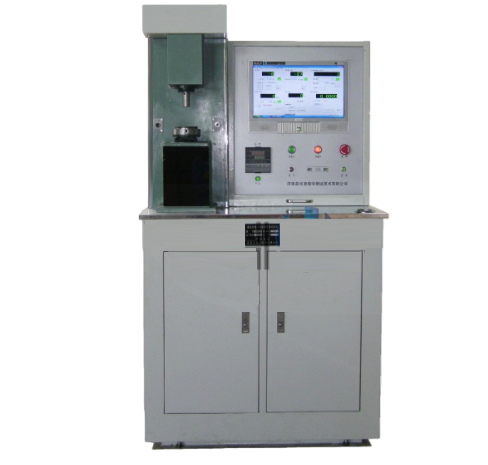
Its specific applications can be systematically summarized in the following core aspects:
1. Comprehensive Evaluation of Lubricant Performance:
The machine can accurately assess the wear resistance, friction-reducing properties, and load-bearing capacity of various lubricants—including lubricating oils, greases, hydraulic oils, and gear oils—under complex conditions of varying temperature, load, and speed. It provides critical data to support lubricant selection and formulation optimization.
2. In-Depth Research in Material Tribology:
Whether for metals, ceramics, rubber, plastics, or various surface coatings, the equipment can precisely measure the coefficient of friction, wear volume, and wear morphology under different conditions. This helps researchers deeply analyze wear mechanisms and failure modes of materials.
3. Excellent Real-World Condition Simulation:
Testing can be conducted under dry friction, oil lubrication, water lubrication, and even harsh media containing slurry or abrasives. The machine can precisely control key parameters such as temperature (up to 260°C), load, and relative motion speed, accurately reproducing actual working conditions.
4. Wide Compatibility with Various Tribological Pairs:
By using different fixtures, the machine supports multiple classical tribological pair configurations, including pin-disk, four-ball, thrust-ring, ball-three-plate, and pin-three-column types. It can flexibly simulate point contact, line contact, and surface contact, meeting diverse testing requirements.
5. Essential Tool for New Process and Material Development:
In cutting-edge fields such as petrochemical, machinery manufacturing, energy and power, metallurgy, aerospace, and even biomedical applications (e.g., dental restorative materials), this machine provides indispensable technical support and an experimental platform for developing new materials, optimizing surface treatment processes, and verifying product reliability.
The Vertical Universal Friction and Wear Testing Machine is widely used across multiple industrial sectors and research scenarios. Its main applicable industries include:
1. Petroleum and Chemical Industry:
Used for performance evaluation and development of lubricants such as hydraulic oils, gear oils, and engine oils.
2. Machinery Manufacturing Industry:
Tests the wear resistance of metal and non-metal materials as well as coatings, supporting component lifespan prediction and material selection.
3. Energy Industry:
Covers key components in wind power, nuclear power, hydropower, and other sectors to study friction and wear behavior.
4. Metallurgical Industry:
Evaluates the friction characteristics of metallic materials under high-temperature and high-pressure environments.
5. Aerospace Industry:
Verifies the reliability of materials and lubrication systems under extreme conditions such as high temperature and vacuum.
6. Dental and Biomedical Materials Research:
For example, wear comparison tests of dental materials such as titanium, zirconium, niobium, and tin alloys, simulating the oral environment (artificial saliva, 37°C).
7. Research and Development of New Materials:
Includes textiles, rubber, plastics, ceramics, coatings, thin films, and composite materials to evaluate friction and wear performance.
8. Universities and Research Institutions:
Serves as a core device for fundamental tribology research, teaching experiments, and new material development.
The operation of the Vertical Universal Friction and Wear Testing Machine follows strict standardized and automated procedures. It is suitable for various types of tribological pairs such as pin-disk, four-ball, and thrust-ring configurations, as well as diverse test conditions including oil lubrication, water lubrication, and high-temperature environments. The detailed operation steps are as follows:
1. Comprehensive Pre-Startup Inspection
Ensure that the power supply is normal and the air switch on the high-voltage panel is turned on.
Verify the spindle rotation direction (typically clockwise when viewed from top to bottom).
Carefully check that the sample fixtures, all sensors, and heating devices (if high-temperature tests are required) are properly installed and secured without looseness.
2. Precise Installation of Test Samples
Securely mount the upper sample chuck into the tapered hole at the lower end of the spindle and tighten the draw rod.
Place the lower sample in the designated sample seat. Manually rotate the knurled screw to slowly raise the lower guide spindle until the upper and lower tribological pairs are nearly in contact.
For specific test types such as pin-disk or four-ball tests, select and install the corresponding specialized tribological fixtures.
3. Detailed Setting of Test Parameters
Using either the host computer (PC) or the control panel on the electrical cabinet, set the following key parameters:
Axial test force: typically 2 N to 1000 N, with an error controlled within ±1%.
Spindle speed: stepless adjustment from 1 to 2000 rpm.
Total test duration or total number of rotations.
Test temperature: from room temperature up to 260°C, maintained with ±2°C accuracy.
Lubrication condition: dry friction, oil lubrication, water lubrication, or slurry/abrasive media.
4. Test Start and Operation
Press the automatic loading button. Once the test force stabilizes, click the start button to begin the test.
For high-temperature four-ball tests, install the high-temperature oil cup in advance. Start the test only after the temperature reaches the set value.
5. Real-Time Test Monitoring
Continuously monitor key parameters such as the coefficient of friction over time, real-time temperature readings, and friction torque.
All test data are automatically collected and stored by the computer system, supporting the generation of comprehensive post-test analysis reports.
6. Post-Test Procedures
Set the test force to “zero” to allow the system to automatically execute the unloading procedure; alternatively, manually bring the test force to zero.
Manually rotate the knurled screw to lower the guide spindle and safely remove the tested samples.
Analyze wear scar dimensions using a microscope or perform digital wear scar analysis using images displayed on the computer screen.
The Vertical Universal Friction and Wear Testing Machine offers significant technical advantages in high precision, multifunctionality, advanced automation, and broad applicability. Its main technical advantages are as follows:
1. Dual Display and Dual Control System:
Both the upper-level PC and the lower-level control panel can independently set test parameters and display key data in real time (such as test force, spindle speed, friction torque, temperature, and coefficient of friction). This supports fine control via a high-end PC while retaining the convenience of the lower-level panel, making it user-friendly for operators of different skill levels.
2. Wide Speed Range and High-Precision Loading:
The spindle speed covers 1–2000 rpm (some models up to 5000 rpm) with stepless adjustment. Axial test force typically ranges from 2 N to 1000 N, with an error controlled within ±1%, ensuring that test conditions can be reproduced accurately.
3. Multi-Mode Friction Simulation:
Capable of simulating sliding, rolling, and combined sliding-rolling friction modes, suitable for point, line, and surface contact wear simulations, closely replicating real-world working conditions.
4. High-Temperature and Multi-Medium Testing Capability:
Supports temperature control from room temperature up to 260°C and can perform tests in oil, water, slurry, abrasive media, and other environments, meeting the needs of lubricant evaluation and material research under extreme conditions.
5. Highly Integrated Automated Control:
Uses an industrial control computer combined with configuration software and embedded systems to form an integrated control platform. This enables automatic recording of the entire test process, real-time plotting (e.g., friction coefficient vs. time), data storage (supports CSV/TSV formats), and automatic shutdown protection in case of abnormalities.
6. Compatibility with Multiple Types of Tribological Pairs:
Standard configurations include four-ball, pin-disk, and thrust-ring tribological pairs. Optional attachments such as ball-three-plate, pin-three-column, gear, and cam can be added, supporting diverse applications such as material development, coating evaluation, and biomedical materials.
The Vertical Universal Friction and Wear Testing Machine holds a significant position in material science, mechanical engineering, lubrication technology, and various industrial fields. Its core value lies in its ability to accurately simulate friction and wear behavior under real-world operating conditions, providing essential data for material development, quality control, and performance evaluation.
Its main importance can be summarized as follows:
1. Multi-Scenario Simulation Capability:
It can simulate various motion types such as rolling, sliding, and combined rolling-sliding, suitable for testing tribological pairs with point, line, and surface contact, covering the complex friction states encountered in real mechanical systems.
2. Wide Applicability to Materials and Media:
The machine can evaluate the friction and wear performance of metals, ceramics, rubber, plastics, coatings, and lubricants (oils, greases, hydraulic fluids, etc.), and perform tests in diverse environments including air, oil, water, slurry, or high temperatures (up to 260°C).
3. High-Precision Parameter Control and Measurement:
It supports accurate setting and real-time acquisition of key parameters such as test force (10–1000 N), spindle speed (1–2000 rpm stepless), friction torque, and temperature (room temperature to 260°C, ±2°C accuracy), ensuring reliable and reproducible data.
4. Dual Display and Dual Control for Operational Flexibility:
Some models (e.g., MM-W1A, MM-W1B) feature a dual-display, dual-control system. This allows advanced data analysis via the upper-level PC while enabling independent basic testing on the lower-level control panel, meeting the needs of both high-end research and industrial on-site applications.
In summary,as an advanced material performance testing device, the Vertical Universal Friction and Wear Testing Machine brings significant advantages and convenience to both engineering practice and scientific research. It can accurately simulate friction and wear under various complex operating conditions, providing critical data for new material development and product optimization. Additionally, it improves testing efficiency and ensures the reliability of results, playing an irreplaceable role in quality control, lifespan prediction, and cost management. From the perspective of advancing industrial manufacturing or promoting progress in material science, this equipment demonstrates enormous potential and value, making it a technology tool worthy of sustained attention and research.


