Block-on-Ring Tribometer Tester is a precision testing instrument specifically designed to accurately evaluate the tribological performance of various materials under sliding or rolling contact conditions in a laboratory environment. The key performance parameters measured and analyzed by this equipment include, but are not limited to, the dynamic and static coefficients of friction of materials, wear rates under specific conditions, and the lubrication effectiveness and wear resistance imparted by different lubricants or surface treatments.The core mechanical structure consists of a precision ring specimen that can rotate at high or low speeds, paired with a fixed block counterface to which a controllable vertical load is applied. By precisely controlling variables such as rotational speed, applied load, environmental temperature, and lubrication conditions, the instrument can closely simulate actual contact conditions and load states in mechanical systems, such as gear meshing or bearing rolling.Based on these capabilities, researchers can systematically quantify material wear resistance, friction characteristics, and surface damage mechanisms, providing critical experimental data and theoretical guidance for material selection, lubricant development, and mechanical component design.
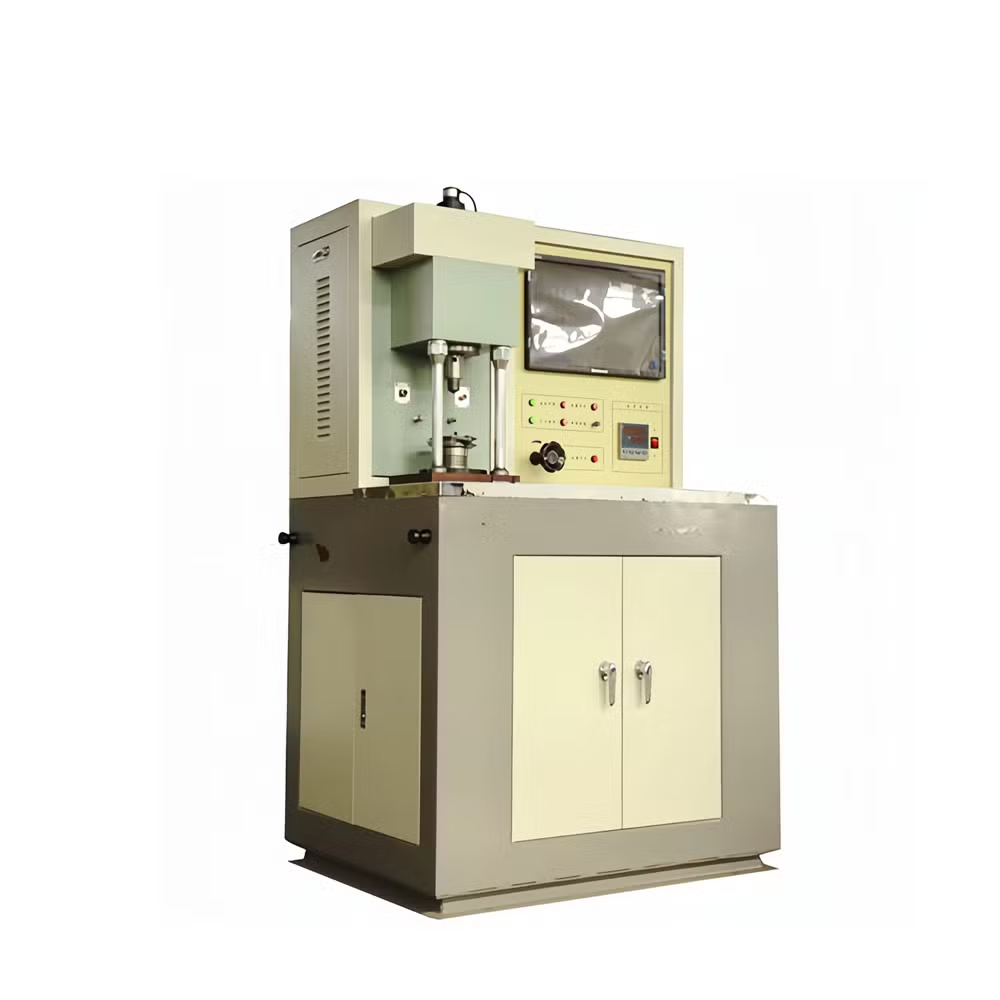
The Block-on-Ring Tribometer Tester is a laboratory instrument used to evaluate the tribological performance of materials under sliding friction conditions, including both friction coefficient and wear behavior. Its main applications include:
Simulating Sliding Contact Conditions:
By pressing a “block” specimen under a controlled load against a rotating “ring” counterface, it simulates common engineering sliding contact scenarios found in engines (e.g., valve systems), bearings, gears, and other mechanical assemblies.
Measuring Friction and Wear Properties:
It allows quantitative determination of the friction coefficient and wear rate of materials under specific loads, speeds, temperatures, or lubrication conditions.
Evaluating Lubricant Performance:
Commonly used to study the effects of different lubricants or additives (e.g., ZDDP, MoDTC) on the formation of tribofilms and the resulting anti-friction and anti-wear performance.
Supporting Multiple Test Standards:
This type of equipment typically complies with international standards such as ASTM G77 (Block-on-Ring Wear Test) and ASTM G99 (Pin-on-Disk Test).
Material R&D and Quality Control:
Widely used for evaluating the tribological performance of metals, alloys, PTFE-based polymer composites, coatings, and other advanced engineering materials.
This tester features a simple structure and stable operation, making it particularly suitable for comparative wear tests under dry or lubricated conditions. It is an essential tool for tribology research and industrial material screening.
The Block-on-Ring Tribometer Tester is a precision and high-performance tribological evaluation instrument, specifically designed to accurately measure and assess the tribological properties of various materials. Its core measured parameters include the coefficient of friction, wear rate, scratch resistance, and lubricant load-carrying capacity. This tester plays a critical role in research, development, and quality control across multiple industrial and scientific fields, including lubricants, metals and non-metals, gear oils, surface coatings, and composite materials. Below is a detailed explanation of its complete operation process, core working principle, and basic structural components.
Friction Pair Simulation Mechanism:
The core function of the instrument lies in simulating actual mechanical contact conditions. It achieves this by pressing a stationary rectangular or cylindrical block specimen against a high-speed rotating standard ring (usually a circular specimen), forming the classical “block-on-ring” friction pair. This contact configuration closely replicates real-world sliding or mixed friction conditions found in critical mechanical components such as gear meshing, bearing rolling/sliding, and piston ring–cylinder liner systems.
Loading, Drive, and Comprehensive Measurement Process:
Applied Test Load:
The tester is equipped with a high-precision loading system capable of applying a vertical normal load of adjustable magnitude to the fixed block. The maximum load typically reaches 3000 N, allowing simulation of different contact pressure conditions.
Rotational Drive:
The ring specimen is driven by a high-performance spindle system, typically powered by a servo motor, to achieve smooth rotation at adjustable speeds. The speed range generally allows continuous adjustment from 0 to 2000 revolutions per minute (r/min), simulating various sliding velocities.
Friction Force and Coefficient Calculation:
During testing, high-sensitivity friction force sensors continuously measure the tangential friction at the contact interface. Using the measured friction force (F_f) and the applied normal load (F_N), the system automatically calculates the instantaneous coefficient of friction (μ) using the formula:
[\mu = \frac{F_f}{F_N}]
The system can plot the coefficient of friction as a function of time for detailed analysis.
Multi-Parameter Synchronous Monitoring:
In addition to friction and load, the system integrates multiple sensors to monitor and record other critical parameters during the test, including:
Block wear (via displacement sensors or pre/post test weighing)
Contact surface temperature
Real-time rotational speed
Lubricant bath temperature (typically controllable from room temperature to above 100°C)
This multi-dimensional data provides comprehensive support for analyzing friction and wear behavior.
Rigid Base and Frame:
Provides a stable support structure for the tester, ensuring rigidity and stability during high-speed, high-load operation.
High-Precision Spindle Drive System:
Typically based on a servo motor with precision transmission components, enabling smooth and wide-range speed adjustment, closed-loop control, and high repeatability of rotational speed.
Precision Test Load Application System:
Uses hydraulic, pneumatic, or servo motor loading to apply, maintain, and dynamically control the normal load on the block specimen accurately.
Standardized Friction Pair Mounting Assembly:
Designed for rapid and precise installation of ring and block specimens that meet international or industry standards (e.g., ASTM G77), ensuring test consistency and comparability.
Comprehensive Measurement and Sensing System:
Integrates force sensors, friction torque sensors, rotary encoders, thermocouples, and infrared temperature sensors to capture all relevant physical signals during the test.
Computer-Based Intelligent Control and Data Analysis System:
Serving as the “brain” of the instrument, this system uses specialized software to achieve:
Fully automated test control (loading, start, stop)
Real-time data acquisition and storage
Post-test data processing and chart generation
In-depth analysis and detailed test report generation
This greatly improves testing efficiency and enhances the reliability of results.
The Block-on-Ring Tribometer Tester offers several key technical advantages:
Simple Structure and Easy Operation:
The tester uses a classical “block-on-ring” contact configuration, where a fixed block specimen is pressed against a rotating ring specimen to simulate sliding friction. This mature structural design ensures straightforward operation, ease of maintenance, and high reliability.
Wide Applicability:
It can be used under a variety of conditions, including dry friction and lubricated friction, and is suitable for investigating the tribological behavior of metals, polymers, ceramics, coatings, and other material systems.
Ability to Simulate Real Working Conditions:
By adjusting parameters such as applied load, sliding speed, temperature, and environmental atmosphere (e.g., air, argon), the instrument can closely replicate friction conditions found in practical engineering applications, such as engine valve systems and bearings.
Supports Multi-Dimensional Characterization:
When combined with advanced analytical techniques like SEM, EDS, FIB, TEM, and XPS, the tester enables detailed examination of worn surfaces, subsurface structures, and tribofilms. This allows in-depth understanding of the microstructural and chemical mechanisms behind friction and wear.
Suitable for Superlubricity Research:
Recent studies show that this type of instrument can be used to validate ultralow-friction lubricants, such as ionic liquids and nano-additive systems, on a macroscopic scale. Coefficients of friction (COF) as low as 0.006 have been achieved.
In summary,with its reliable structure, fully controllable parameters, and compatibility with multi-scale analytical techniques, the Block-on-Ring Tribometer Tester has become an essential tool for both tribology research and industrial applications.
The Block-on-Ring Tribometer Tester is important because it can simulate common sliding contact behaviors found in real engineering applications, providing critical data for material selection, lubricant evaluation, and component life prediction. Its significance can be summarized as follows:
Simulating Real Working Conditions:
This configuration is particularly suitable for simulating mechanical components with ring-shaped sliding contact, such as bearings, gears, piston rings, and camshafts. It can realistically reflect friction and wear behaviors that occur during actual service.
Evaluating Material and Lubricant Performance:
By controlling load, sliding speed, temperature, and lubrication conditions (e.g., dry friction or oil lubrication), the tester can quantitatively compare the coefficient of friction and wear rates of different material pairs or lubricants.
Supporting Standardized Testing:
Compliant with international standards such as ASTM G77. the tester ensures repeatable and comparable test results, making it widely used in industrial R&D and quality control.
Revealing Wear Mechanisms:
When combined with surface morphology analyses (e.g., 3D profilometry, SEM, FIB), the tester can provide detailed insights into adhesive wear, abrasive wear, fatigue wear, and other mechanisms, offering guidance for material modification and improvement.
Guiding Engineering Optimization:
For example, in the automotive field, tests have shown that proper lubrication can reduce wear rates by up to 10⁴ times, significantly enhancing component lifespan and reliability.
In summary,the Block-on-Ring Tribometer Tester is an indispensable tool for both tribology research and industrial applications.
The Block-on-Ring Tribometer Tester is a friction and wear testing instrument designed to simulate rolling and sliding combined contact conditions. Its typical applications are concentrated in the following industries:
Automotive Industry:
Used to evaluate the friction performance, fatigue resistance, and scratch resistance of components such as gear oils, bearing materials, camshafts, and valve mechanisms under high contact stress. Helps optimize fuel efficiency and extend component lifespan.
Aerospace Industry:
Tests the wear resistance of lubricants and lightweight high-strength materials under high temperature and high vacuum conditions. Ensures the reliability of critical rotating components, such as turbines and actuators, under extreme operating environments.
Energy and Power Transmission:
Suitable for performance verification of lubricants and metal/polymer contact pairs in high-power rotating machinery, such as wind turbine gearboxes and transmission systems.
Materials Research and Surface Engineering:
Used to study wear mechanisms of coatings (e.g., PEO coatings), alloys (e.g., Al-Si alloys), and composite materials. When combined with microstructural analysis (e.g., FIB/TEM), it provides in-depth insights into tribological behavior.
Biomedical Engineering:
Although less directly applied to implants, its testing principles can assist in designing low-friction materials for sliding interfaces, such as artificial joints.
The device conforms to ASTM G77 standards and uses a block-on-ring contact geometry, effectively simulating complex motion states in real mechanical systems, such as gear meshing and bearing raceways.
Overall, the Block-on-Ring Tribometer Tester is a critical instrument in the field of friction and wear testing. It can accurately simulate and evaluate material tribological performance under specific conditions. Its unique design and reliable testing capabilities make it an indispensable tool in both research and engineering applications, providing significant value for advancing materials science and surface engineering.


