The High-Speed Reciprocating Friction and Wear Testing Machine is a professional testing device designed to accurately simulate the friction characteristics and wear behavior of materials under high-speed reciprocating motion conditions. This equipment can precisely control key parameters such as load, speed, temperature, and stroke, reproducing the high-frequency, small-stroke relative sliding processes that materials experience in actual working environments.It is not only an essential tool for fundamental tribology research, but is also widely applied in materials science and engineering, advanced lubrication technology development, critical components of automotive engines and transmission systems, high-speed trains and rail transportation equipment, aerospace components, and precision machinery manufacturing. The machine provides critical experimental data and scientific support for evaluating material wear resistance, friction reduction performance, and service life.
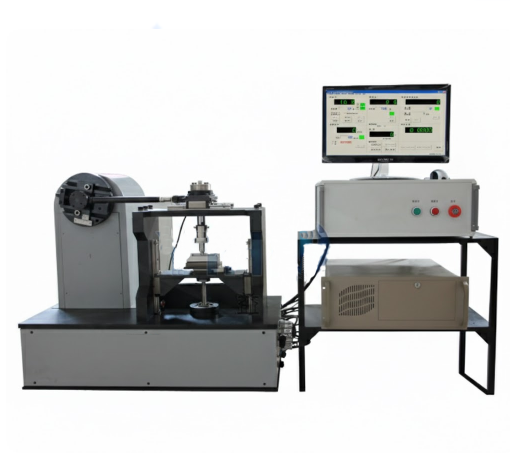
Friction testing machines are the core equipment for measuring friction force, and they are particularly widely used to determine the coefficient of friction (COF), degree of wear, and lubrication condition between two contacting surfaces.
These devices include dedicated coefficient-of-friction testers and portable slip-rate testers, which can precisely measure the resistance during motion. Some advanced models are also capable of providing real-time on-site monitoring data, making them extensively applicable in industrial safety inspections, material performance testing, and quality control.
Friction force can be mainly classified into four basic types: static friction, sliding friction, rolling friction, and fluid friction. These classifications are based on the different modes of motion or environmental conditions of the objects in contact.
Static Friction occurs when two surfaces are in contact but at rest relative to each other, while there is a tendency for relative motion.
Sliding Friction arises when two surfaces are already sliding against each other.
Rolling Friction involves the resistance encountered when an object rolls over another surface.
Fluid Friction refers specifically to the viscous resistance experienced by an object moving through a fluid medium, such as a liquid or gas.
In general:
Static friction is usually the greatest because it must be overcome to initiate motion.
Rolling friction is typically the smallest, as the contact points continually change and energy loss is minimal.
Sliding friction falls between static and rolling friction in magnitude.
Fluid friction depends heavily on the properties of the fluid and the speed of the object moving through it.
The High-Speed Reciprocating Friction and Wear Tester is primarily used to quantitatively evaluate the wear resistance and friction behavior of material surfaces or coatings under varying loads, frequencies, temperatures, and environmental conditions.
Simulating Real Operating Conditions:
It can replicate reciprocating sliding contacts commonly found in components such as engine piston rings, cylinder liners, hydraulic seals, gears, and bearings.
Multi-Environment Testing Capability:
Tests can be conducted in controlled environments ranging from ambient to high temperatures, vacuum, inert or corrosive atmospheres.
Lubrication Performance Evaluation:
Particularly suitable for evaluating the anti-wear performance of lubricants, diesel, greases, and other oils under boundary lubrication conditions, compliant with ASTM D6079. SH/T 0765. GB 19147-2009. and other international and national standards.
Coating and Material Development:
Used to test new wear-resistant materials, such as laser-clad coatings, ceramic-metal composites, and high-entropy alloys, to assess performance improvement.
Magnetic and Special Environmental Studies:
Can be combined with external magnetic fields or other special conditions to investigate their effects on friction and wear mechanisms.
Automotive Industry:
Helps optimize the wear resistance and fuel efficiency of engine components, brake pads, and sealing materials.
Aerospace:
Evaluates the reliability of high-temperature alloys and thermal barrier coatings under extreme conditions.
Energy Industry:
Tests agricultural machinery blades (e.g., rotary tiller blades), drilling tools, and other components under dry friction or soil conditions.
Biomedical:
Conducts friction and wear studies of artificial joint implants, such as hip and knee replacements.
Consumer Electronics:
Evaluates the durability of miniature sliding components, such as camera modules and headphone jacks.
The High-Speed Reciprocating Friction and Wear Tester is a precision instrument designed to simulate friction and wear behavior of materials under reciprocating sliding conditions, widely used for evaluating the performance of lubricants, coatings, metals, and nanomaterials. Its core operating principles are as follows:
1. Drive System
A variable-frequency motor drives a crank-slider mechanism, converting rotational motion into high-speed reciprocating linear motion of the test specimen. By adjusting the motor frequency, the sliding speed can be continuously controlled.
2. Loading System
Normal loads are applied using either weighted gravity loading or magnetic loading methods. Some advanced models (e.g., patented design CN102435520A) use magnetic loading to achieve high-precision control under low loads.
3. Contact Mode
The test specimen is fixed on a movable base and forms sliding contact with a counter body (e.g., steel ball or counter disk) during reciprocating motion. This setup simulates boundary lubrication or dry friction conditions encountered in real-world applications.
4. Signal Acquisition and Control
Equipped with force sensors, displacement sensors, and temperature sensors, the system monitors friction force, wear, and environmental parameters in real time. A computer-controlled system automatically manages the test process while recording and storing experimental data.
5. Environmental Simulation
Some models can perform tests under controlled atmospheres (e.g., nitrogen, vacuum), varied temperatures (e.g., high-temperature furnace attachments), or external magnetic fields (e.g., permanent magnet environments) to study multi-physics coupling effects.
The High-Speed Reciprocating Friction and Wear Tester is a precision instrument designed to simulate friction and wear behavior of materials under high-frequency reciprocating motion. It is primarily applicable to the following industries:
1. Petrochemical Industry
Used to evaluate the anti-wear performance of fuels (e.g., diesel), lubricating oils, and greases under boundary lubrication conditions, in compliance with standards such as SH/T 0765. ASTM D6079. ISO 12156. EN 590. and GB 19147-2009.
2. Automotive Manufacturing and Components Industry
Used to test the friction and wear characteristics of engine components, gear oils, piston ring-cylinder liner assemblies, and more under simulated operating conditions, supporting the development of new materials and lubricants.
3. Materials Science and Research
Widely applied in studying the tribological performance of metals, ceramics, coatings (e.g., micro-arc oxidation films), and composite materials under varying loads, speeds, and temperatures.
4. Aerospace and High-End Equipment Manufacturing
Used to evaluate the wear resistance and reliability of critical components under extreme or specialized environments, such as vacuum, high or low temperatures.
5. Universities and Research Institutes
Serves as a fundamental tribology research platform, supporting experiments and research in lubrication mechanisms, surface modification, and tribology, as well as teaching applications.
The High-Speed Reciprocating Friction and Wear Tester is important because it serves as a key instrument for evaluating the friction and wear behavior of materials under simulated real-world operating conditions in fields such as materials science, mechanical engineering, and surface engineering. Its core significance is reflected in the following aspects:
1. Precise Quantification of Tribological Performance
This equipment can quantitatively measure key parameters, such as coefficient of friction and wear rate, of material surfaces or coatings under varying loads, frequencies, temperatures, and environmental conditions. The data it provides is critical for material selection and optimization.
2. Supporting Advanced Material Development
For example, in carbon fiber-reinforced resin composites, tests using this machine have shown that synergistic modification with multi-walled carbon nanotubes and graphene nanosheets can reduce material wear rate by 72%, significantly enhancing service life. Similar studies are applied to micro-arc oxidation coatings, laser surface-textured materials, and other novel functional surfaces.
3. Meeting Industrial Standards and Practical Application Requirements
Some models comply with SH/T 0765. ASTM D6079. ISO 12156. and other international standards. They are used to assess the anti-wear performance of fuels and lubricants (e.g., diesel, engine oils) under boundary lubrication conditions, directly serving industries such as energy and transportation.
4. Revealing Complex Wear Mechanisms
The tester is employed to study cutting-edge tribological issues, such as the effect of electric arc discharge on contact materials of electric locomotive pantographs or the influence of magnetic environments on steel friction pairs, helping researchers understand wear mode transitions and failure mechanisms.
5. Enabling Numerical Simulation Validation
The wear coefficients obtained from experiments are essential for accurate finite element simulation of component wear. The high-speed reciprocating friction tester is the primary tool for acquiring these critical parameters.
In summary, the High-Speed Reciprocating Friction and Wear Tester is an advanced experimental instrument that serves not only as a core tool for fundamental research in materials science and engineering but also as a bridge connecting material design, development, and practical engineering applications. It plays a crucial role in simulating real-world friction and wear behavior, evaluating material performance, and optimizing material selection.By providing precise experimental data and analysis, this tester demonstrates irreplaceable value in improving the reliability of various equipment, significantly extending service life, and effectively reducing energy consumption. Its application not only drives advances in materials technology but also provides scientific evidence and technical support for engineering practice.


