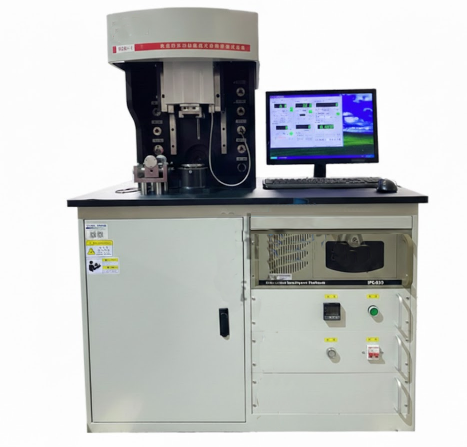
The rotary reciprocating friction and wear tester is a precision instrument specially designed to simulate the tribological characteristics of materials under the combined action of rotational motion and linear reciprocating motion. It is used to evaluate the tribological performance of materials under simulated real-world conditions, including friction coefficient, wear rate, and lubrication effectiveness. This tester integrates both rotational and reciprocating testing modes and can be widely applied in materials science, automotive, aerospace, petrochemical, and other industries.
Evaluation of Material Wear Resistance and Friction Performance:
By applying controlled loads and motion patterns, the tester measures material mass loss, changes in friction coefficient, and other properties during the friction process.
Lubricant Performance Screening:
It simulates boundary and mixed lubrication conditions to evaluate the anti-wear and friction-reducing performance of oils and greases.
Coating and Film Testing:
It assesses coating/film adhesion, scratch resistance, corrosion resistance, and failure behavior.
Simulation of Real Working Conditions:
The tester can mimic actual mechanical contact states, such as piston ring–cylinder interaction, gear meshing, and threaded connections.
Environmental Adaptability Testing:
Some high-end models support testing under extreme temperatures (e.g., -40°C to 1200°C), vacuum, or corrosive atmospheres.
The rotary reciprocating friction and wear tester is a device used to simulate the friction and wear behavior of materials under complex motion conditions. Its core functionality lies in simultaneously or alternately implementing rotational motion and reciprocating linear motion, thereby more realistically reproducing the actual working conditions of engine components, joint bearings, and other mechanical assemblies.
Working Principle
1. Motion Drive Mechanism:
The device typically employs a crank-slider mechanism or a servo motor with an eccentric wheel system to convert the motor's rotational motion into the reciprocating linear motion of the test specimen. Simultaneously, an independent rotational drive module (such as a stepper motor or DC servo motor) enables the specimen to rotate around its axis.
2. Dual-Motion Combination:
In the “rotary-reciprocating” mode, the specimen both slides reciprocally along a linear guide and rotates around its own axis, forming a helical composite motion. This more closely simulates the motion state of real mechanical pairs, such as piston pins or connecting rod bearings.
3. Load Application:
The load is applied to the contact surface of the friction pair either via gravity using weights or through an electromechanical servo loading system, typically ranging from 0 to 100 N (expandable to higher loads).
4. Friction and Wear Measurement:
Friction Force: Detected using strain gauge sensors mounted on elastic support arms. The deformation is converted into a voltage signal and, after calibration, yields the friction force value.
Wear Measurement: Determined either via displacement sensors (measuring wear depth) or the mass loss method (weighing before and after testing).
5. Environmental and Parameter Control:
Reciprocating speed can be set (e.g., 1–400 mm/min) and stroke is adjustable.
Rotational speed is also adjustable (in rpm).
Some high-end models support temperature control (high/low temperature) and atmosphere control (vacuum or corrosive gases).
6. Automation and Data Acquisition:
Equipped with PLC or computer control systems, parameters can be set via touchscreen or software. The system automatically records friction coefficient vs. time and wear vs. time curves and supports data export via USB.
The rotary reciprocating friction and wear tester is essential because it can simulate complex motion conditions encountered in real-world applications, allowing precise evaluation of the tribological performance of materials, coatings, or lubricants under actual operating conditions. This type of equipment plays an irreplaceable role in scientific research, industrial quality control, and product development.
Key Importance:
Multi-Motion Mode Compatibility:
The tester can perform rotational and reciprocating motions simultaneously or alternately, more realistically simulating complex contact scenarios such as engine cylinder–piston ring interfaces, joint bearings, and precision transmission components.
Strong Environmental Control:
It can conduct tests under extreme conditions, including high and low temperatures, vacuum, or corrosive atmospheres, meeting the evaluation requirements of materials in aerospace, renewable energy, and high-end manufacturing industries.
High-Precision Quantitative Data:
The system provides key parameters such as friction coefficient, wear rate, and load–displacement curves, offering scientific data for material selection, process optimization, and service life prediction.
High Modularity and Automation:
Advanced systems, such as Bruker UMT TriboLab, support tool-free quick replacement of drive modules, automatic configuration recognition, and intelligent software integration, greatly enhancing testing efficiency and repeatability.
Support for Industry Standards and R&D Innovation:
Widely used in automotive, electronics, energy, and medical device industries, the tester is also a fundamental tool for developing national standards (e.g., GB/T 46835-2025) and for research in lubricants and coatings.
The rotary reciprocating friction and wear tester is a precision testing instrument designed to simulate the friction and wear behavior of materials under complex motion conditions. This type of equipment is widely used in the following industries:
Automotive Manufacturing:
Used to test the friction and wear performance of critical components such as engine bearings, piston rings, clutch plates, and brake pads under simulated operating conditions. It is particularly suitable for lubricant evaluation and the development of low-friction materials.
Aerospace:
Used to evaluate the wear resistance and tribological properties of materials, such as CFRP composites and high-temperature alloys, under high temperature, high pressure, or vacuum environments.
Mechanical and Metallurgical Engineering:
Supports the study of metals, coatings, and lubricants under heavy load and high-speed conditions, aiding in equipment lifespan prediction and reliability enhancement.
Petrochemical Industry:
Used to test the tribological performance of pump and valve seals, drilling tools, and other components in corrosive environments or under extreme temperatures.
Rail Transportation:
Evaluates the friction and wear behavior of rails, wheels, braking systems, and other components to ensure operational safety.
Electronics and Microelectromechanical Systems (MEMS):
Used for force–displacement characterization and micro-scale friction testing of miniature devices, such as sensors and micro-motors.
Universities and Research Institutions:
Serves as a fundamental research tool in materials science, tribology, and surface engineering, supporting the development and validation of new alloys, coatings, and lubricants.
Core Advantages:
The equipment features a modular design capable of simulating rotational, reciprocating, and ring-block motion patterns. It can operate under high/low temperature, vacuum, and corrosive conditions, closely replicating real-world operating scenarios.
There is a significant difference between the coefficient of friction (COF) and the wear coefficient. Although both relate to the performance of materials during contact and relative motion, they describe completely different physical phenomena and properties.
Firstly, the coefficient of friction is a dimensionless quantity that measures the ratio of the frictional force to the normal load between two contacting surfaces during sliding or impending motion. It primarily reflects the lubrication state and surface characteristics of the interface: a higher COF indicates poor lubrication and greater resistance to motion, while a lower COF implies good lubrication and smoother movement. The COF directly affects energy consumption, heat generation, and motion control precision of mechanical systems.
In contrast, the wear coefficient (or the related wear rate) is a parameter describing the rate of material loss. It represents the amount of material mass, volume, or thickness lost per unit time or per unit sliding distance under specific operating conditions. Wear rate focuses on material durability and service life—a higher wear rate indicates faster material degradation and shorter component lifespan. Wear involves material detachment, transfer, or deformation, and is closely related to material hardness, toughness, microstructure, as well as operating conditions such as load, speed, and temperature.
Clearly, the COF and wear rate are not the same concept. The COF mainly reflects the lubrication effectiveness and motion resistance of the interface—higher COF generally means poorer lubrication—while wear rate emphasizes material loss due to friction. Although these two properties can influence each other in actual tribological processes (for example, higher friction often leads to greater energy dissipation, which may accelerate wear), they differ in physical nature, measurement methods, and engineering significance and should be considered separately in material selection and mechanical design.
One of the most common and reliable methods for measuring surface static friction is by determining the force required to move a slider placed on the test surface. In practice, the slider is placed gently on the surface to be tested, and a horizontal force is gradually applied until the slider begins to move. The maximum force required to initiate motion is recorded. The COF is then calculated by dividing this force by the weight of the slider. Results are often evaluated according to relevant standards to assess the surface's friction performance.
Overall, with ongoing advancements in materials science, mechanical engineering, and surface treatment technologies, the development of the Rotary Reciprocating Friction and Wear Tester has accelerated, and its importance in industrial R&D and academic research has grown significantly. This equipment can simulate friction and wear behavior under complex operating conditions, providing critical data for new material performance evaluation, lubricant effectiveness verification, and component lifespan prediction, making it an indispensable tool in modern engineering testing.If you would like to learn more about its working principle, applications, or technical specifications, we welcome you to contact us. Our team can provide detailed technical explanations and professional consultation services.


