The Wide-Range Load Friction and Wear Testing Machine is a precision instrument used to evaluate the tribological performance of materials under varying load conditions. By applying controllable normal loads, it simulates sliding, rolling, or contact friction behaviors encountered in real working conditions, thereby measuring key parameters such as friction coefficient, wear rate, and anti-wear performance.
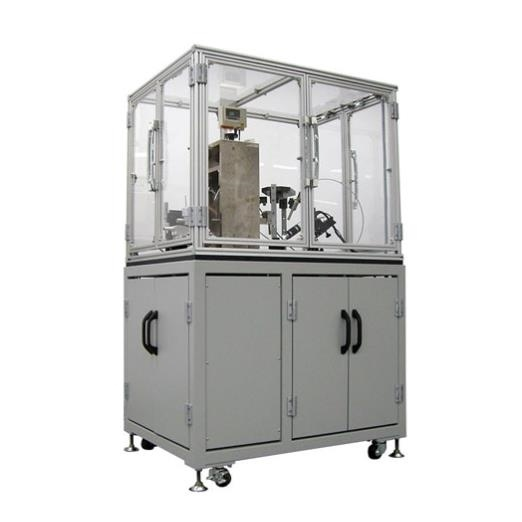
The core principle of the Wide-Range Load Friction and Wear Testing Machine is based on the controlled variable method. By precisely applying normal load and relative sliding speed, and by measuring friction force and wear volume, the tribological behavior of materials is quantitatively evaluated.
Friction Process Simulation:
The specimen and counter body (such as ball, disk, ring, etc.) remain in contact under a preset normal load and slide relative to each other at a specified speed, simulating real-world friction and wear processes.
Loading System:
A constant-pressure compliant loading mechanism or a weight-lever system is adopted to apply accurate normal loads over a wide range (from several newtons to several thousand newtons). The system can automatically compensate for wear to maintain constant contact pressure.
Drive and Motion Control:
A high-precision servo motor or stepper motor drives the counter body in linear reciprocating or rotational motion. The speed is adjustable (from micrometers per second to meters per second).
Signal Acquisition:
Friction Force: Measured in real time by a high-sensitivity force sensor.
Wear Volume: Determined after testing through laser displacement measurement, weighing methods, or profilometry to calculate specimen volume loss.
Multiple parameters such as temperature, current, and vibration can be synchronously acquired, especially under high-speed or current-carrying conditions.
Control System:
Based on a microcomputer or PLC, enabling automatic setting and execution of test parameters (load, speed, time, cycle count), with power-off memory function.
Material R&D:
Evaluation of wear resistance of coatings, lubricants, alloys, and other advanced materials.
Industrial Quality Inspection:
Quality control testing for key components such as gears, bearings, and piston rings.
Scientific Research:
Investigation of the effects of load, speed, and environment on friction and wear mechanisms (such as adhesion, abrasion, and fatigue).
1. Preparation Before Startup
Ensure the equipment is connected to a 220V, 50Hz AC power supply.
Check that the main power switch and circuit breaker are turned on.
Clean and correctly install the specimens:
The upper specimen is clamped into the spindle taper hole.
The lower specimen is placed on the corresponding specimen seat.
Manually adjust the knurled screw to reduce the gap between upper and lower friction pairs to approximately 1 mm.
2. System Initialization
Turn on the computer and control software.
Select the test method (such as pin-on-disk, four-ball, reciprocating, etc.).
Set test parameters, including:
Test load (e.g., 10N–1000N or higher)
Spindle speed (e.g., 1–3000 r/min)
Test duration
Temperature (for high-temperature tests, set furnace temperature to target value, e.g., room temperature to 260°C)
3. Loading and Test Start
Click “Automatic Loading.”
After the test force stabilizes, lock the nut.
Zero the friction force and friction torque values.
Click “Start Test.”
For high-temperature tests, connect the temperature control system and wait until temperature stabilizes before starting.
4. Data Acquisition and Recording
The system automatically records friction coefficient, friction torque, temperature, and time, generating real-time curves.
After the test ends, the system unloads automatically.
Once the spindle stops completely, manually lower the guide spindle and remove the specimen.
5. Data Saving and Shutdown
Save data in system file, Excel, or Word format.
If the equipment will not be used for a long period, turn off the power and apply dust-proof and anti-rust protection.
Specimen Installation:
Follow the instruction manual diagrams strictly to ensure parallel contact surfaces without eccentric loading.
Parameter Consistency:
When reopening historical files, ensure the current test method matches the file settings.
High-Temperature Testing:
For four-ball high-temperature wear tests, install the high-temperature oil cup before activating the temperature controller.
Environmental Requirements:
Place the equipment in an area free from strong airflow and vibration.
Ambient temperature: 10–40°C
Humidity: 30–70% RH (no condensation)
1. Wide Load Range Adaptability
Capable of covering loads from micro-Newton levels (e.g., certain MFT-5000 models ranging from nN to 10.000N) to several thousand newtons, making it suitable for testing materials from thin-film coatings to heavy-duty metal components.
2. Strong Simulation Capability
Supports rolling, sliding, and combined rolling-sliding friction modes. Configurable contact forms include ball-on-disk, pin-on-disk, and four-ball configurations, enabling realistic reproduction of actual working conditions.
3. High Precision and Automation
Adopts closed-loop servo control with stepless speed regulation (e.g., 1–3000 r/min). Load accuracy can reach ±1%. Integrated computer systems allow parameter setting, data acquisition, curve plotting, and automatic report generation.
4. Strong Environmental Simulation Expandability
Some high-end models support high temperature (room temperature–260°C, or even –120°C to 1200°C), low temperature, high vacuum, and current-carrying conditions (e.g., 400 A / 36 V), meeting the demanding requirements of aerospace and rail transit industries.
5. Multi-Media Compatibility
Tests can be conducted in oil, water, slurry, abrasives, and other lubricating or corrosive media to evaluate wear resistance under complex environments.
1. Routine Cleaning and Protection
After each use:
Wipe the machine surface with a clean soft cloth to remove dust, oil, and specimen residue. Do not use corrosive cleaning agents.
Dust and sunlight protection:
Cover the machine when not in use to prevent dust intrusion and direct sunlight exposure.
Electrical cabinet protection:
Prevent oil, moisture, and dust from entering; ensure proper sealing.
2. Component Inspection and Maintenance
Fasteners and Moving Parts:
Regularly check screws, guide rails, and bearings for looseness or jamming. Ensure smooth movement.
Replacement of Wear Parts:
Replace friction pairs (pin-disk, four-ball, thrust rings, etc.) and wear wheels according to usage frequency and wear condition to maintain testing accuracy.
Specimen Clamping System:
After each installation or removal, ensure the spindle taper (1:7), pull rod, and knurled screw are clean and undamaged to avoid eccentric mounting.
3. Lubrication and Anti-Rust Treatment
Regular Lubrication:
Apply appropriate lubricating oil or grease to key components such as spindle guide rails, gears, lead screws, and linear bearings according to the manual.
Anti-Rust Measures:
Clean unpainted metal surfaces (e.g., spindle, fixtures) and apply a thin layer of anti-rust oil. Increase anti-rust frequency in humid or rainy seasons.
In the future, the development of Wide-Range Load Friction and Wear Testing Machines will focus on intelligent technologies, functional integration, and high-end market positioning.
Technologically, the integration of high-performance servo motors and electromagnetic loading systems will enable wider load ranges, higher precision, and faster dynamic response. The application of high-precision sensors and intelligent measurement and control systems will promote automation and real-time, in-depth data processing.
Functionally, testing systems will evolve toward diversification and multi-functional integration to meet the stringent requirements of new energy vehicles, aerospace, and other advanced industries for material performance verification under complex working conditions.
From a market perspective, policy support and industrial upgrading will drive the industry toward high-quality development. Green, energy-efficient, and low-power equipment will become a new trend. Cutting-edge technologies such as quantum sensing may contribute to breakthroughs in micro-scale wear mechanism research.
Overall, the field is evolving toward greater hardware precision, software intelligence, and integrated service ecosystems.


