In the printing, packaging, labeling, paper printing, and plastic surface printing industries, durability requirements for printing inks and graphic surface layers go beyond accurate color reproduction. Printed materials must also demonstrate strong abrasion resistance and color fastness during handling, processing, and end use.
Color fastness refers to the ability of a dyed or printed material to retain its original color when subjected to external influences such as friction, cleaning, and environmental exposure. While the concept has long been defined in the textile industry, it is equally applicable to printed materials. Color fastness testing is one of the key quality indicators used to evaluate a material’s ability to maintain color stability under real-use conditions.
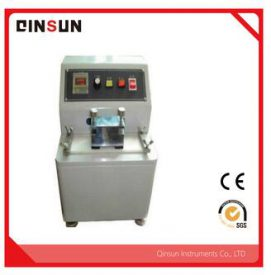
For printed products, the Ink Abrasion Color Fastness Testing Machine is a specialized instrument designed to evaluate the abrasion resistance and color fastness of ink layers. By simulating real friction conditions, it performs standardized rubbing tests on printed patterns, ink layers, coatings, and photosensitive plate (PS plate) surfaces to quantify wear resistance and color durability. This type of testing is widely used not only for ink performance evaluation but also for print quality control, product development, and durability verification.
An Ink Abrasion Color Fastness Testing Machine is a professional testing device used to evaluate the abrasion resistance and color fastness of printed ink layers, surface coatings, PS plate photosensitive layers, and other coated or printed materials. Its primary objective is to simulate controlled friction cycles to assess the degree of color loss, fading initiation, wear resistance, and overall durability.
The development of this testing equipment is driven by several industry needs:
Print quality control: to verify ink adhesion, rub resistance, and durability after printing
Industrial process evaluation: to determine whether printed products will experience color loss during processing, packaging, and transportation
Surface coating performance testing: to evaluate the abrasion resistance of protective coatings and cured layers
Product consistency and standardization: to classify color fastness grades based on standardized test results
The machine provides a standardized, repeatable, and quantifiable testing method and is an essential tool for ink research and printing process optimization.
The testing principle is based on the relationship between mechanical friction and color degradation. The core mechanism can be summarized as follows:
Friction Simulation
The device uses a mechanical system to create periodic relative motion between a rubbing head and the specimen surface. The motion is typically linear reciprocating movement. A specified load is applied to the rubbing head to simulate real-life friction conditions. Advanced models allow adjustment of rubbing mode, speed, and cycle count according to different testing standards.
Color Change Detection
During testing, a standardized rubbing medium (such as white paper or cotton cloth) is fixed to the rubbing head. After a defined number of rubbing cycles, the extent of color transfer, fading, or ink removal is evaluated either visually or instrumentally using a color difference analyzer.
Rubbing cycles, applied load, and rubbing speed are critical parameters that directly influence the test results and help determine the abrasion resistance and color fastness grade of the ink layer.
Color Fastness or Abrasion Resistance Grading
Test results are typically expressed using standardized grading systems, such as scales from 1 to 5 or 1 to 8. where higher grades indicate better color fastness. The applicable standard depends on the region and industry. Common standards include JIS (Japanese Industrial Standards), ASTM (American Society for Testing and Materials), GB (Chinese National Standards), and TAPPI (Technical Association of the Pulp and Paper Industry).
The equipment is widely used across multiple industries, including:
Printed Product Durability Testing
It evaluates the abrasion resistance and color fastness of business cards, labels, packaging materials, brochures, and other printed products to ensure that graphics and text do not fade or peel during handling, stacking, or transportation.
Ink Adhesion Assessment
The test helps determine the adhesion strength between ink and substrate. If bonding is weak, rubbing tests can quickly reveal potential quality issues. It also evaluates changes in color fastness after exposure to moisture, cleaning agents, or heat treatment.
Photosensitive Plate and Coating Wear Testing
In certain printing processes, such as screen printing or PS plate production, protective or photosensitive coatings are applied. The testing machine assesses whether coatings peel or degrade under friction, helping identify defects in surface treatment processes.
Manufacturing Optimization and Quality Control
By comparing results across different processing methods, ink formulations, and substrates, manufacturers can optimize production processes and improve overall product durability.
Ink abrasion color fastness testing machines typically support multiple international and regional standards, which define test conditions, parameter settings, and evaluation methods. Common standards include:
JIS K5701
A Japanese Industrial Standard for evaluating the rub resistance and fading resistance of printed materials.
GB/T 7706
A Chinese national standard specifying methods for testing ink adhesion strength, including rubbing action, medium selection, and grading criteria.
ASTM D5264
A standard for assessing the abrasion resistance and color fastness of printed images on paper and packaging materials.
TAPPI T830
A standard used in the paper and printing industries to specify rubbing load and cycle conditions for evaluating ink rub resistance.
The typical structure of an ink abrasion color fastness testing machine includes:
Rubbing Mechanism
This is the core component, consisting of a rubbing head, arm, load application system, and reciprocating drive mechanism. The load is usually set by weights or springs to meet different standard requirements.
Specimen Fixture
The fixture securely holds the test sample on the platform to ensure stable and consistent contact during the rubbing process, minimizing errors caused by sample movement.
Control System
Modern machines are equipped with microcomputer control systems that allow automated test setup, cycle count programming, speed adjustment, and real-time display of test progress. Many systems include preset standard parameters for one-touch execution.
Display and Data Recording Module
The system displays test parameters such as cycle count, speed, and load. Some models also support data storage and export functions for quality documentation and analysis.
The standardized testing process generally includes:
Sample Preparation
Specimens are cut to standard dimensions and inspected to ensure they are clean and free from defects.
Parameter Setup
Operators input the relevant standard, rubbing cycles, speed, and load. Custom parameters may also be configured for non-standard testing.
Execution of the Rubbing Test
After starting the machine, the rubbing mechanism performs controlled reciprocating motion under specified load and speed until the preset cycle count is reached.
Result Analysis
After testing, the sample surface is evaluated visually or using color measurement instruments to determine fading, ink removal, and color fastness grade.
Two primary evaluation methods are commonly used:
Visual Comparison Method
Using a grayscale rating card, operators visually compare the tested sample to standard reference scales to classify the degree of fading or color transfer. This method is quick and widely used.
Instrumental Color Difference Measurement
A colorimeter measures changes in color parameters (such as L*, a*, b* values) before and after testing. The calculated ΔE value quantifies color difference, providing higher objectivity and precision.
Printing and Packaging Industry
Abrasion testing ensures that printed information on packaging boxes, labels, manuals, and catalogs remains legible and visually intact during transportation and handling.
Paper and Paperboard Industry
Ink abrasion testing ensures that printed text and graphics maintain readability and aesthetic quality in paperboard packaging.
Textile and Dyeing Industry
Although primarily designed for printed ink layers, the same friction color fastness principles are widely applied to textile rubbing fastness testing.
Surface Coatings and Plastic Products
The equipment can also evaluate the abrasion resistance of sprayed coatings, heat transfer prints, and other decorative surface treatments.
With continuous advancements in printing technology and ink formulations, abrasion color fastness testing equipment is also evolving. Future trends include:
Intelligent Control and Remote Monitoring
Integration of advanced control systems and digital interfaces to improve automation, reduce human error, and enhance test consistency.
Data Management and Cloud Analysis
Test data can be transmitted to cloud platforms for centralized analysis, supporting product development and process improvement through big data insights.
Multi-Functional Integrated Testing
Future systems may combine abrasion resistance, light fastness, and stain resistance testing into a single instrument, providing more comprehensive material performance evaluation.
The Ink Abrasion Color Fastness Testing Machine is a specialized device used to evaluate the abrasion resistance and color fastness of printed inks, coatings, and graphic surface layers. By simulating real-world friction conditions through standardized testing procedures, it quantitatively assesses color change and durability.
Widely used in printing, packaging, labeling, paper, textile, and surface coating industries, this equipment plays a critical role in quality control and product development. Through standardized testing and objective evaluation methods, manufacturers can accurately assess product durability, enhance reliability, and strengthen market competitiveness.


