With the widespread use of outdoor clothing, quilts, down jackets, and other down-filled products, the performance of the filling material has become a crucial indicator in evaluating product quality. One key property is the “downproof” property of the fabric, which refers to the fabric’s ability to prevent down or feathers from escaping through the gaps in the textile. To accurately test the downproof performance of fabrics during use, the Downproof Tester was developed. It is an essential instrument in textile testing laboratories, R&D institutions, and production lines.
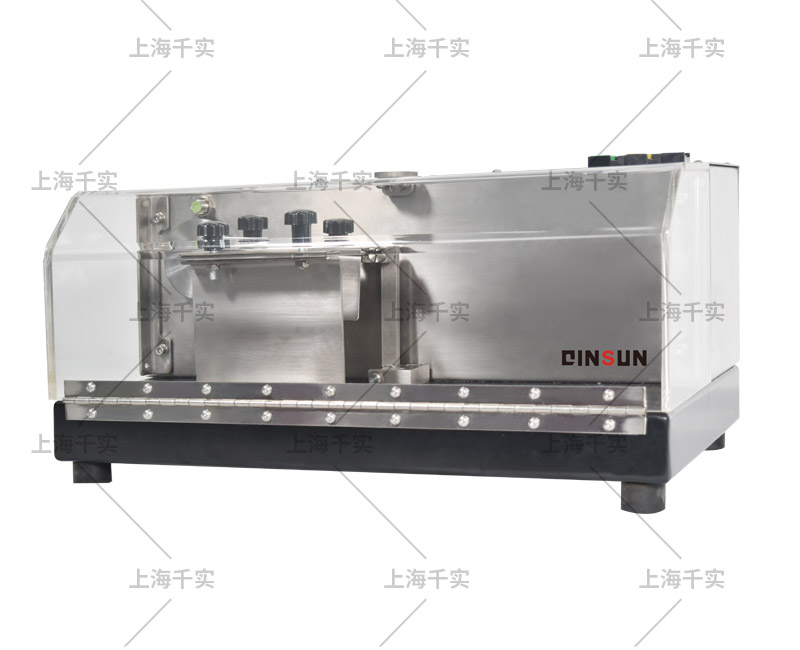
A Downproof Tester is an instrument used to measure the ability of a fabric to prevent down or feathers from escaping through the surface or gaps of the fabric under certain conditions. The instrument simulates the friction, compression, and impact that down-filled products such as down jackets or quilts experience during daily wear, use, or transportation. The downproof performance of the sample is then evaluated by measuring the amount of feathers, down, or fibers that escape.
Unlike other textile testing instruments, the Downproof Tester is specifically designed to assess the protective performance of fabrics in down-filled products. The test results are directly related to the product’s comfort, appearance, durability, and consumer satisfaction.
The primary function of down-filled products such as down jackets and quilts is to provide warmth. If down escapes from the fabric surface, it not only affects the product’s appearance but may also lead to loss of filling, reducing its thermal insulation performance. Good downproof performance reduces the loss of fibers or down, improves product durability, and increases customer satisfaction. Therefore, scientifically and standardly testing the downproof performance of fabrics is a key step to ensure product quality and compliance with industry standards.
The core principle of the Downproof Tester is to simulate real usage conditions, causing the sample to experience friction, compression, impact, or other mechanical actions. The number of down, feathers, or fibers that pass through the fabric is observed and measured. There are two commonly used testing methods:
1. Tumble Method
This is the most commonly used method, suitable for most downproof performance testers. During testing, the fabric sample is enclosed in a specific test bag containing down and/or feathers, and then placed into a rotating chamber with silicone or rubber balls. The chamber rotates at a set speed and number of cycles, causing the balls to roll and impact the sample, simulating the friction and impact that the fabric experiences in daily use. The number of down or feathers that escape the fabric is then measured to evaluate its downproof performance.
This method effectively simulates the external forces fabrics experience during use, such as turning, compression, and movement. The tester is generally equipped with a control panel that allows the operator to set rotation speed and cycles, and can perform forward and reverse rotation to more comprehensively simulate real use.
2. Friction or Impact Method
Another method uses friction or impact to simulate the process of down penetrating the fabric. Small cylindrical samples of the fabric are filled with down and repeatedly rubbed against a fixed platform or subjected to impacts, and the escape of down and feathers is observed. This method is used in specific standard-compliant downproof testing equipment.
Regardless of the method, the core principle is to subject the sample to mechanical action and measure the amount of down or feathers that escape to assess the fabric’s downproof performance.
To ensure consistency and comparability of results, downproof testing is performed according to national and international standards. Common standards include:
GB/T 12705.1 / GB/T 12705.2: Chinese national standards specifying testing methods for downproof performance.
GB/T 14272-2021: Standards for evaluating the downproof performance of down-filled clothing and bedding products.
EN 12132-1 / BS EN 12132 series: European standards for measuring fabric and product downproof performance.
These standards define sample preparation, filling weight, testing cycles, instrument parameters, and evaluation methods, ensuring that testing results are scientific and comparable.
A Downproof Tester typically includes:
Rotating Test Chamber
The core component of the tester, usually made of transparent or durable material, capable of forward and reverse rotation. It holds the sample and rubber balls for testing.
Control System
Used to set rotation speed, number of cycles, and to display test status in real-time. Control panels or touch screens make operation convenient.
Observation Window
The transparent chamber allows operators to observe the test process in real-time, helping control test progress and ensure safety.
Rubber Balls or Impact Bodies
Placed inside the rotating chamber to simulate forces acting on the fabric, promoting the penetration of down through the material.
These components work together to complete the downproof performance test of the sample.
To ensure accurate results, the testing procedure generally follows standardized steps:
Sample Preparation
Samples are cut according to standards, sewn into test bags with a specified weight of down and/or feathers, and fixed in the testing instrument.
Setting Instrument Parameters
Select appropriate rotation speed and number of cycles based on standards to accurately simulate fabric wear.
Starting the Test
The tester runs automatically. Observe the instrument during the test to ensure normal operation and safety.
Counting and Evaluation
After the test, collect and count the down or feathers that escaped the fabric to determine whether the fabric meets downproof standards.
Result Analysis
Analyze the data according to standards to evaluate whether the fabric or product has adequate downproof performance, and issue a test report.
Downproof Testers are widely used in:
Textile and Apparel Quality Testing
Evaluating the downproof performance of fabrics and overall product structure in down jackets, quilts, and sleeping bags.
OEM/ODM Production Quality Control
Ensuring products meet standards during R&D and mass production for consistent product quality.
Third-party Testing Institutions
Professional labs provide testing services and certification for brands or clients.
Standard Development and Industry Research
Research institutions use the instrument to collect data for fabric performance optimization and structural improvement studies.
Compared with traditional visual inspection or manual evaluation, the Downproof Tester offers:
Standardized Measurement: Testing follows industry standards, ensuring repeatable and reliable results.
Simulation of Real Usage Conditions: Can replicate friction, impact, and wear experienced in actual use.
Quantifiable Results: Down escape is counted, providing objective evaluation of performance.
The Downproof Tester is a specialized instrument for evaluating a fabric’s ability to prevent down, feathers, or fibers from escaping. By simulating friction, compression, and impact conditions, it provides an accurate assessment of the material’s downproof capability. With mature functionality and standardized testing methods, it is an essential tool for textile manufacturers, apparel brands, testing laboratories, and research institutions to ensure the quality of down-filled products.


