The Rubber Hose Wear Testing Machine is designed to evaluate the abrasion resistance of hydraulic hoses and other similar hoses with fabric or steel wire reinforcement and a smooth, flat surface. It can also be applied to other pipes, tubing, and flat plates to determine their wear resistance. The tester is widely used by hose manufacturers, research institutes, and quality inspection units to ensure product durability and reliability under specific working conditions.
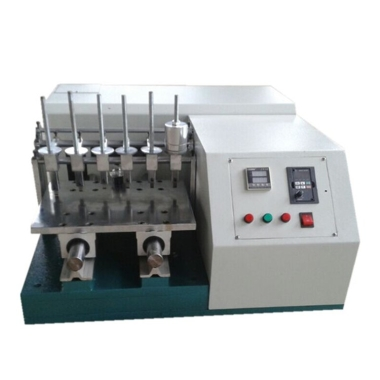
(1) Hydraulic hose testing: Measuring wear resistance of hoses with fabric or steel wire reinforcement.
(2) Other hose testing: Evaluating wear properties of rubber hoses for industrial or automotive use.
(3) Pipe and plate testing: Determining abrasion resistance of rubber or polymer-based pipes and flat plates.
(4) Quality control: Ensuring products meet required durability and reliability standards.
(5) Scientific research: Assessing material performance in laboratory studies and R&D projects.
(1) GB/T 12721-2007 — Determination of abrasion resistance of rubber hose outer coating
(2) ISO 6945:1991 — Rubber hose cladding — Determination of abrasion resistance
(3) KS M ISO 6945-2013 — Determination of abrasion resistance of the outer coating of rubber hoses
(4) EN ISO 6945-1996 — Determination of the abrasion resistance of rubber hose outer coatings
(5) DS/ISO 6945-1984 — Determination of wear resistance of rubber hose cladding
(1) Main tester ×1
(2) Standard weight set ×1
(3) Mandrel/shaft set ×1
(4) Instruction manual ×1
(5) Power cable ×1
| Item | Specification |
|---|---|
| Test station | 1 or more stations for sample placement |
| Weight load | 50 N, 100 N, 150 N (adjustable per test requirements) |
| Test stroke | 5–100 mm (adjustable) |
| Test speed | 5–120 times/min (adjustable) |
| Mandrel length | 150 mm |
| Shaft diameter | 5. 8. 10. 13. 16. 19. 22. 25. 32. 38. 45. 51 mm (customizable) |
| Reciprocating frequency | 1.25 Hz (45 RPM) |
(1) Accurate wear testing: Evaluates hose and pipe abrasion resistance under controlled conditions.
(2) Standard compliant: Meets national and international testing standards (GB, ISO, EN, KS).
(3) Versatile application: Suitable for hoses, pipes, and flat rubber or polymer plates.
(4) Quantitative results: Provides precise measurement of wear resistance for quality control and R&D.
(5) Durable design: Built to withstand repeated testing cycles in laboratories and production environments.
(1) Mount the hose sample onto the test station and secure it to prevent axial movement or rotation.
(2) Position the abrasive tool to contact the hose surface and apply the specified vertical static load (default 50 N ±0.5 N if not specified).
(3) Start the machine and run the test for the required number of cycles.
(4) After testing, remove the hose assembly and clean off any attached debris.
(5) Weigh the sample again if required to assess wear loss.
(6) Record the test data for evaluation of wear resistance.
(1) Clean the abrasive tool and test stations after each use to prevent material buildup.
(2) Inspect the mandrels and shafts regularly for wear or deformation.
(3) Check the weight load system for proper calibration and adjust if necessary.
(4) Lubricate moving parts periodically to maintain smooth operation.
(5) Store the machine in a dry, dust-free environment when not in use.
1. What is the primary purpose of this machine?
It evaluates the abrasion resistance and durability of rubber hoses by simulating repeated friction and wear under controlled conditions.
2. Which types of hoses can be tested?
The tester is suitable for hydraulic hoses, industrial hoses, automotive hoses, and other rubber or reinforced hoses.
3. How does the machine simulate real-world conditions?
It applies cyclic movement, friction, and sometimes load or pressure to the hose surface, replicating operational wear experienced in service.
4. Which standards does this tester comply with?
It supports international hose and rubber testing standards, including ASTM, ISO, and relevant industrial specifications.
5. Who typically uses this equipment?
Hose manufacturers, quality control laboratories, and R&D teams use it to ensure product durability, optimize material selection, and maintain safety standards.


