In the automotive industry, wire harnesses serve as the “neural network” of a vehicle, carrying out the critical functions of power transmission and signal control. Their long-term reliability is directly related to the safe and stable operation of the entire vehicle electrical system. During use, automotive wires inevitably experience contact and friction with surrounding components, brackets, or even with themselves. This is especially common in dynamic or vibration-prone areas such as the engine compartment, door hinges, and chassis, where the scratch and abrasion resistance of cable insulation layers and sheaths becomes extremely important.The Automotive Wire Abrasion Tester is a specialized device designed to evaluate the abrasion resistance performance of automotive wire insulation layers. Through millimeter-level precision control, it has become a critical tool for safeguarding automotive cable safety, promoting the industry’s transition from experience-based judgment to data-driven precision quality control. By simulating real-world scratching and abrasion conditions, the equipment assesses the wear resistance strength of wire insulation layers, ensuring that wire harnesses maintain stable performance under complex road conditions.
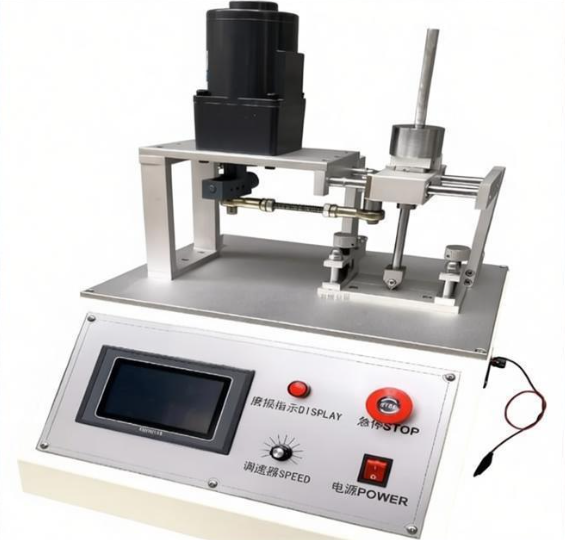
The Automotive Wire Scratch Resistance Tester is a specialized testing device designed to evaluate the scratch and abrasion resistance performance of automotive wire insulation layers.
Main Functions
1. Simulation of Real Scratch Conditions
The tester uses a standard scratching needle—such as a hardened steel needle with a 40° tip angle and a rounded radius of 0.25 mm ± 0.02 mm—to perform scratch tests on the surface of the wire insulation layer under a specified load (typically 10 N ± 0.5 N) and speed (20 mm/s ± 5 mm/s).
2. Multi-Directional Scratch Testing
Some models support automatic 90° rotation of the specimen tray, allowing scratch tests to be conducted in both longitudinal and transverse directions. This more accurately reflects the stress conditions experienced by wire harnesses during assembly and actual vehicle operation.
3. Programmable Parameter Control
Parameters such as scratch distance, test cycles, speed, and spacing can all be preset to ensure high repeatability and consistency of the testing process.
4. Compatibility with Different Wire Sizes and Structures
The equipment is suitable for various specifications of automotive wires and is equipped with cable fixing fixtures adaptable to different wire diameters.
Core Applications
1. Quality Control
During automotive wire harness production, the tester verifies whether insulation materials possess sufficient scratch resistance, preventing insulation damage caused by transportation, installation, or vibration.
2. Compliance Verification
The equipment helps ensure compliance with international and domestic standards for the mechanical performance of automotive wires, such as:
GB/T 25085
ISO 6722
3. Research, Development, and Material Comparison
The tester is used to evaluate the scratch resistance performance of new insulation materials or coatings, assisting in material selection and process optimization.
4. Failure Analysis
It can also be used for retrospective testing of insulation damage, short circuits, or related field failures to determine whether insufficient scratch resistance was the root cause.
The Automotive Wire Scratch Resistance Tester is a professional testing device used to evaluate the scratch and abrasion resistance performance of automotive wire insulation layers. Its technical features are mainly focused on simulating the mechanical wear conditions encountered in actual use while ensuring test repeatability and accuracy. Typical technical features include the following:
1. Adjustable Load and Scratch Frequency
The equipment usually supports applying different constant loads to the scratching head (such as 100 g, 200 g, 500 g, etc.) and allows the scratch frequency to be adjusted (such as 10–60 cycles/minute), thereby simulating wear conditions under different operating environments.
2. Standardized Scratch Head Design
The tester uses carbide or steel scratch heads that comply with international standards, ensuring consistency and comparability of test results.
3. Multi-Channel Testing Capability
Some high-end models support simultaneous testing of multiple cables, significantly improving testing efficiency and meeting the requirements of batch quality inspection.
4. Automatic Counting and Shutdown Function
The equipment is equipped with an electronic counter that allows preset scratch cycles (such as 1.000 cycles or 5.000 cycles). Once the preset value is reached, the machine automatically stops, reducing manual intervention.
5. Strong Fixture Adaptability
Adjustable cable fixtures are provided to accommodate automotive wires of different diameters (such as 0.2 mm²–10 mm²), ensuring stable cable fixation throughout the testing process.
6. Data Recording and Output
Some models integrate digital displays or PC communication interfaces (such as USB or RS-232), enabling test data export for further analysis and documentation.
The working principle of the Automotive Wire Scratch Resistance Tester is to simulate the scratching and abrasion conditions that automotive wire harnesses may encounter in actual road environments, thereby evaluating their scratch resistance performance. During testing, the machine applies a certain scratching force to the wire harness and simulates stress conditions under different road conditions and driving speeds by adjusting parameters such as scratching speed and angle. At the same time, the equipment monitors changes in electrical properties such as resistance and insulation resistance during the scratching process to evaluate abrasion resistance performance.
Operating Procedure
1. Sample Preparation
Cut automotive wire harness samples to the specified length (typically 100–300 mm).
Clean the sample surface to remove oil, dust, and other contaminants, ensuring that the test surface is smooth and dry.
If actual operating conditions need to be simulated, the sample may undergo preprocessing such as bending or fixture clamping.
2. Equipment Calibration and Setup
Check whether the tester is within the valid calibration period (recommended calibration interval: ≤24 hours).
Set test parameters according to standards such as ISO and GB/T:
Scratch load: typically 0.5 N to 5 N (depending on wire harness sheath material and application standards).
Scratch needle type: commonly diamond or tungsten carbide scratch needles with a tip radius of 0.1–0.5 mm.
Scratch speed: generally maintained at a constant speed of 1–10 mm/min.
Scratch cycles: single or multiple cycles (such as 1–5 cycles), depending on testing requirements.
3. Installation and Fixing
Securely fix the sample onto the testing platform to ensure no displacement occurs during the scratching process.
Install the scratch needle onto the loading mechanism and adjust the height so that the needle tip lightly contacts the sample surface.
4. Test Execution
Start the equipment, and the scratch needle will move along the sample surface at the preset speed and load.
Observe the scratching process and record whether phenomena such as sheath cracking, peeling, or substrate exposure occur.
5. Result Evaluation
After testing, inspect the scratched area visually or using a 10× magnifying glass.
Determine the rating level according to the relevant standards (such as no visible scratch, slight scratch, or deep scratch damage).
Optional optical microscopes or profilometers may be used for quantitative analysis of scratch depth and width.
6. Recording and Reset
Record testing conditions, observation results, and evaluation conclusions.
Clean the equipment, switch off the power supply, and prepare for the next test.
Precautions
Environmental Control
It is recommended to conduct testing in a stable environment with a temperature of 15–35°C and humidity ≤75% RH.
Safety Protection
Avoid accidental contact between the scratch needle and skin. Protective gloves should be worn during operation.
With the rapid development of vehicle electrification and intelligent technologies in the automotive industry, automotive wire harnesses—often referred to as the “nervous system” of a vehicle—play a critical role in determining overall vehicle safety and service life. As a specialized device for evaluating the scratch resistance performance of automotive wire insulation layers, the Automotive Wire Scratch Resistance Tester plays an indispensable role in quality control, standards compliance, and R&D optimization. Its importance is mainly reflected in the following aspects:
1. Ensuring Driving Safety and Preventing Electrical Failures
Automotive wire harnesses are typically arranged within narrow and complex vehicle spaces, such as door hinges, seat slide rails, and underbody areas. During vehicle operation, wire harnesses inevitably experience friction, compression, or scratching against metal body parts, clips, or other wire bundles.
Preventing Short-Circuit Risks
Once the insulation layer is damaged by scratching or abrasion, exposed conductors can easily cause short circuits, open circuits, or even fire hazards. Through scratch resistance testing, products with insufficient insulation toughness or manufacturing defects can be identified in advance, eliminating potential safety risks at the source.
Ensuring Signal Integrity
For coaxial cables or USB connection systems transmitting high-frequency signals, even minor insulation damage may alter impedance characteristics and affect signal transmission quality. Scratch resistance testing helps verify cable performance stability under mechanical stress conditions.
2. Optimizing Material Formulations and Manufacturing Processes
During automotive wire harness development, the scratch resistance tester serves not only as a quality inspection tool but also as an analytical instrument for material science research.
Guiding Material Selection
Different formulations of PVC, cross-linked polyethylene (XLPE), or specialty polymers exhibit varying abrasion resistance characteristics. By comparing damage depth and surface morphology under identical scratch conditions, engineers can identify insulation materials with the best balance of performance and cost efficiency.
Adjusting Process Parameters
Test results can be fed back into extrusion molding processes to optimize parameters such as cooling speed and wall thickness uniformity, thereby improving the overall density and mechanical damage resistance of the insulation layer.
Although nano-scratch testing is more commonly used in coating research, its principles also provide insights into polymer surface modification—particularly by enhancing the material’s elastic recovery capability (“healing”) to reduce permanent scratch depth.
3. Reducing After-Sales Costs and Brand Reputation Risks
In the total life-cycle cost of automotive products, after-sales maintenance accounts for a significant proportion. Wire harness failures are often difficult to detect and diagnose due to their concealed nature.
Extending Service Life
Wire harnesses that undergo rigorous scratch resistance testing can maintain structural integrity throughout a vehicle service life of 10 years or longer, significantly reducing recall rates and repair frequency caused by wire abrasion.
Protecting Brand Reputation
A high-quality wire harness system is a key indicator of overall vehicle quality. Preventing consumer trust from being damaged by failures of seemingly small components is essential for premium automotive brands to maintain market competitiveness.
4. Meeting the Special Requirements of New Energy Vehicles
With the increasing popularity of electric vehicles, the use of High Voltage Harnesses has become more widespread. These harnesses not only withstand higher voltages but also face greater electromagnetic interference and thermal management challenges. Their insulation layers generally require thicker walls and stronger mechanical protection.
High-Voltage Safety Protection
Damage to high-voltage wire insulation may result in fatal electric shock hazards. Therefore, scratch resistance testing standards for high-voltage environments are far more stringent, making the precision and repeatability of the testing machine critically important.
Balancing Lightweight Design and Mechanical Strength
New energy vehicles pursue lightweight designs and therefore tend to use thinner and lighter cables, placing higher demands on the mechanical strength of insulation materials. The scratch resistance tester helps verify whether reduced wall thicknesses can still meet required anti-scratch safety thresholds.
In summary, the Automotive Wire Scratch Resistance Tester is not only a quality gatekeeper on the production line, but also a bridge connecting material science, engineering design, and end-user safety. It has irreplaceable strategic significance in ensuring electrical system reliability, complying with international standards, optimizing R&D efficiency, and safeguarding the lives and safety of drivers and passengers.
We sincerely welcome you to leave a message or contact us directly so that we can provide you with more detailed product information.


