The Pin/Ball-on-Disc Tribometer is a typical tribological testing instrument used to study the friction and wear behavior of materials under sliding contact conditions. It operates by pressing a stationary pin or ball against a rotating disc under a constant normal load, generating relative sliding motion to simulate two-body sliding wear. This equipment is widely applied in materials science, lubrication engineering, and coating performance evaluation.This article will introduce the instrument from the following aspects, aiming to provide a useful reference for readers.
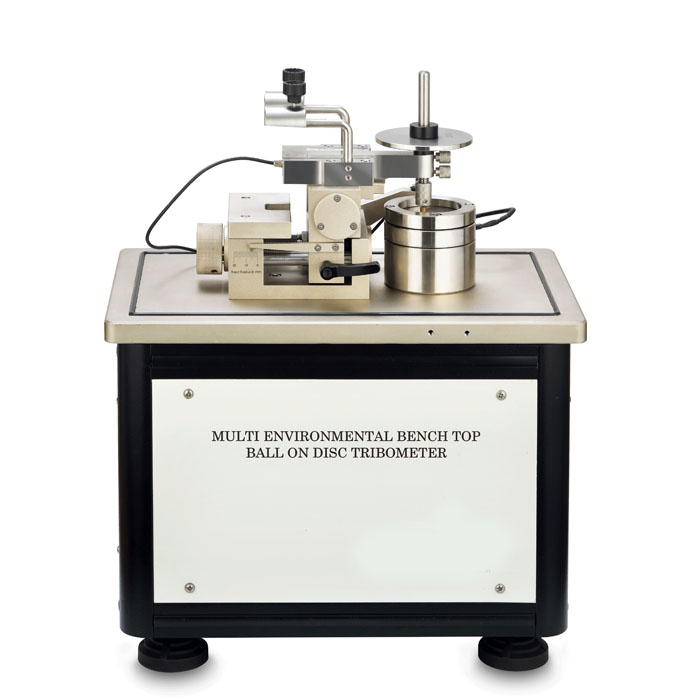
The Pin/Ball-on-Disc Tribometer is a classic tribological testing device widely used in both research and industrial fields to investigate the frictional behavior and wear characteristics of materials under sliding contact conditions.
1. Measurement of Coefficient of Friction (COF):
The instrument continuously monitors the friction force generated during relative sliding between the counterface (pin/ball) and the rotating disc, allowing real-time calculation of the coefficient of friction.
2. Wear Evaluation:
Wear performance is quantified by measuring mass loss, volume loss, or surface morphology changes of either the pin/ball or disc, enabling assessment of material wear resistance.
3. Control of Experimental Parameters:
Normal load: Adjustable from 0.1 N to 1000 N (via weights or servo loading system)
Sliding speed: Typically 0.001–1 m/s, with some systems capable of reaching up to 100 m/s
Sliding distance / time: Programmable for constant or cyclic testing modes
Environmental conditions: Some systems support temperature and humidity control (e.g., 30%–90% RH), and even elevated temperatures up to 500 °C
1. Material comparative evaluation:
Used to compare friction and wear properties of metals, ceramics, polymers, coatings (e.g., Ni–P/SiC), and composite materials.
2. Lubricant and additive testing:
Evaluates the effect of lubricating oils, greases, or nano-additives on friction reduction and wear resistance.
3. Standard compliance testing:
Performs two-body sliding wear tests in accordance with international standards such as ASTM.
4. Simulation of special working conditions:
Simulating brake systems (e.g., cast iron vs. Fe–Cu–Cr–graphite materials) and wheel–rail contact behavior
Studying interactions between polishing pads and wafers in CMP (Chemical Mechanical Planarization) processes
Analyzing three-body abrasive wear by introducing hard particles
5. Coating and surface modification research:
Evaluates improvements in wear resistance resulting from coatings, heat treatment, or composite surface engineering techniques.
The Pin/Ball-on-Disc Tribometer is a standardized tribological testing instrument widely used to evaluate the friction and wear behavior of materials. It is designed in accordance with international standards such as ASTM and is applicable across a wide range of industrial and research fields.
1. Automotive Industry
Used to test friction and wear behavior of engine components such as piston rings and cylinder liners, braking materials (e.g., brake pads and discs), transmission systems, and lubricants containing nano-additives.
2. Aerospace Industry
Applied to evaluate the wear resistance and reliability of critical components such as gears, bearings, and surface coatings under extreme conditions, especially under lubrication-failure (LOL) scenarios.
3. Rail Transportation
Used to study the frictional compatibility and wear characteristics between railway brake blocks (e.g., cast iron and composite materials) and wheels.
4. Mechanical Manufacturing Industry
Used for testing the sliding wear performance of metals, alloys, composites, and coatings, helping optimize material selection and surface engineering processes.
5. Energy Equipment Industry
Applied in the life assessment of high-load friction pairs such as wind turbine gear systems and oil drilling tools.
6. Biomedical Engineering
Used to simulate wear behavior of artificial joints, supporting the development and optimization of biomedical implants.
7. Chemical and Surface Engineering Industry
Used to evaluate the tribological response of anti-corrosion coatings and wear-resistant surface coatings in corrosive environments.
8. Research and Education
Widely used in universities and research institutes for fundamental tribology studies, new material development, and validation of standardized testing methods.
The Pin/Ball-on-Disc Tribometer is a widely used standard instrument in tribological research. Its core principle is to simulate friction and wear behavior between two contacting surfaces under controlled load, speed, and contact geometry conditions.
Contact configuration:
A stationary pin or ball acts as the upper specimen and is pressed against a rotating disc, forming a point or line contact interface.
Loading system:
A constant normal load (typically ranging from 0.1 N to 1000 N) is applied using weights, springs, hydraulic systems, or servo-controlled actuators to maintain continuous contact between the pin/ball and the disc.
Motion mechanism:
The disc is driven by a motor at a constant rotational speed, generating relative sliding motion, while the pin/ball remains stationary.
1. Friction force:
Measured in real time by force sensors during the sliding process.
2. Coefficient of friction (COF):
Calculated using the ratio between friction force and normal load:
\mu = \frac{F}{N}
3. Wear volume:
Wear scars are analyzed using optical or contact profilometers to determine depth, width, or volume loss of the worn surface.
4. Additional parameters:
Advanced systems may simultaneously record temperature, vibration, and acoustic emission signals to better understand friction and wear mechanisms.
The Pin/Ball-on-Disc Tribometer evaluates tribological performance by precisely controlling load and motion conditions while continuously measuring friction and wear responses. This enables systematic analysis of material behavior under sliding contact, supporting both fundamental research and engineering applications.
1. Pre-Test Preparation
Specimen preparation:
Pin/Ball specimen: Typically cylindrical or spherical; diameter range: 2–10 mm. For ball configuration, commonly used materials include alumina or steel balls.
Disc specimen: Diameter 30–100 mm, thickness ≥ 5 mm. The surface should be polished to the specified roughness (e.g., Ra < 0.1 μm).
Hardness requirement: The hardness of the pin/ball should be equal to or lower than that of the disc to avoid abnormal wear behavior.
Specimen installation:
Mount the pin/ball on the loading arm, ensuring its axis is perpendicular to the disc surface.
Fix the disc securely onto the rotating shaft, ensuring firm clamping and zero eccentricity.
Environmental setup:
Set temperature and humidity according to test requirements, or use an environmental chamber (e.g., inert gas or vacuum conditions).
For lubricated tests, apply the specified lubricant and pre-wet the contact area if required.
2. Parameter Setting
According to ASTM standards, the following key parameters should be defined:
Normal load: Typically 5–50 N, applied via hydraulic, spring, or precision loading systems (suspended weights are not recommended due to vibration issues).
Sliding speed: Recommended range is 0.01–1 m/s (approximately 60–600 rpm depending on disc diameter).
Sliding distance: Typically 100–5000 m, depending on expected wear severity.
Test duration: Calculated based on sliding speed and distance.
Contact configuration: Pin-on-disc or ball-on-disc; the latter is commonly used for coatings or thin film evaluation.
3. Test Execution
Start the motor to rotate the disc at a constant speed. Apply the preset load to bring the pin/ball into contact with the disc surface. During the test, the following data are recorded in real time:
Friction force (measured via load cell or torque sensor)
Coefficient of friction (COF = friction force / normal load)
Temperature (infrared sensor)
Wear depth (LVDT or optical measurement systems)
Acoustic emission signals (used for detecting sudden wear events)
4. Post-Test Analysis
Stop the test, unload, and remove the specimens. Clean the specimens using ultrasonic cleaning to remove wear debris, then dry and weigh them for mass-loss-based wear calculation.
Surface morphology analysis:
Use optical profilometry or white-light interferometry to measure wear track width, depth, and volume.
It is recommended to perform at least four cross-sectional scans along the wear track to improve volumetric accuracy.
Wear rate calculation:
Wear volume ( V ) can be calculated using:
( V = \frac{\text{wear mass loss}}{\text{material density}} )
Alternatively, 3D surface reconstruction methods can be used for direct volume integration.
5. Important Notes
Vibration control: The instrument should be installed on an anti-vibration platform, and the specimen fixture must be rigidly connected.
Boundary condition stability: Maintain constant temperature and humidity to minimize environmental influence.
Repeatability: Each test condition should be repeated at least three times to ensure statistical reliability.
Safety precautions: Operators must wear protective eyewear during high-speed rotation tests to prevent injury from lubricant splashing.
The Pin/Ball-on-Disc Tribometer is one of the most widely used instruments in tribology research. Proper maintenance is essential to ensure measurement accuracy and extend the service life of the equipment.
1. Cleaning of contact surfaces
After each test, thoroughly clean the disc surface and the pin/ball holder to remove any wear debris or lubricant residues that may affect subsequent experiments. It is recommended to use a lint-free cloth with ethanol or acetone.
2. Stability check of loading system
Avoid using suspended weights as a loading method due to their susceptibility to vibration. It is recommended to use spring-based, hydraulic, or servo motor loading systems. Regularly calibrate the load cell to ensure the accuracy of normal load (0.1 N–1000 N).
3. Calibration of rotation system
Periodically verify that the disc rotational speed (typically 60–600 rpm, in accordance with ASTM G99) remains stable. Motor vibration or encoder errors may cause fluctuations in sliding speed.
4. Alignment check of pin fixture
Although self-aligning pin holders can compensate for slight misalignment, long-term use may still result in changes in pin inclination, affecting the stability of the friction coefficient. Regular inspection using a high-precision inclinometer is recommended, especially under lubricated conditions.
1. Weekly / Every 10 Tests
Check whether all fastening screws are loose;
Clean guide rails and sliding components, and apply a small amount of lubricant (avoiding contamination of the test area);
Zero-calibrate displacement/wear sensors (e.g., LVDT or laser displacement sensors).
2. Monthly / Every 50 Tests
Perform full-system calibration of motor, encoder, and load sensor;
Check environmental control systems (temperature/humidity) if equipped, ensuring stable test conditions;
Clean or replace air filters to prevent dust ingress into precision components.
3. Semi-Annual to Annual Maintenance
Replace hydraulic oil in the loading system (if hydraulic loading is used);
Conduct comprehensive verification of wear track measurement systems (e.g., optical profilometer or stylus profilometer) for repeatability;
Validate data acquisition system sampling rate and synchronization accuracy.
The Pin/Ball-on-Disc Tribometer is one of the most classical and widely used instruments in tribology research. Its importance can be summarized in the following key aspects:
1. High versatility and strong standardization
This instrument is capable of simulating sliding contact friction and wear behavior across a wide range of materials, including metals, polymers, ceramics, composites, coatings, and lubricants.
The testing methodology follows internationally recognized standards such as ASTM, ensuring high comparability and repeatability of experimental results.
It can operate under various environmental conditions, including dry friction, lubricated contact, high temperature, and vacuum environments, making it suitable for diverse engineering applications.
2. Excellent controllability of experimental conditions
The system allows precise control of critical test parameters, including:
Normal load: 0.1 N to 1000 N
Sliding speed: 0.001–10 m/s or higher
Sliding distance/time
Temperature and environmental conditions
Compared with other tribological configurations such as four-ball or block-on-ring testers, the pin-on-disc system provides superior control over contact area, sliding velocity, and load stability, enabling more reliable and reproducible results.
3. Wide range of applications
Material research:
Used to evaluate the wear resistance and friction performance of new alloys, coatings, and composite materials.
Industrial testing:
Applied in performance verification of critical components such as brake materials (e.g., railway braking systems), bearings, and seals.
Lubrication studies:
Used to evaluate the anti-wear and friction-reducing performance of lubricants, greases, and solid lubricants such as graphite.
Micro/nano manufacturing:
Simulates friction behavior between polishing pads and wafers in processes such as chemical mechanical polishing (CMP).
Biomedical materials:
Used for wear testing of artificial joint materials.
4. Comprehensive and quantifiable data acquisition
The system can directly measure key tribological parameters such as friction coefficient, wear depth/volume, and surface morphology changes.
By integrating advanced sensing technologies such as optical profilometry, laser displacement sensors, acoustic emission systems, and digital holographic microscopy, real-time and high-precision wear monitoring can be achieved.
Wear volume can also be quantitatively evaluated using calculation models such as:
( V = 2\pi N R \sum_{i=1}^{N} W_{q,j} )
5. High cost-effectiveness for early-stage screening
Compared with full-scale component or system-level testing, the pin-on-disc tribometer offers a simpler structure, easier operation, and lower testing cost, making it highly suitable for rapid screening of new materials and process optimization at the early development stage.
In summary, the Pin/Ball-on-Disc Tribometer has become an indispensable fundamental instrument in tribology and surface engineering due to its simple structure, precise controllability, wide applicability, and reliable data output.It not only effectively simulates various real-world friction and wear conditions but also plays a crucial role in both fundamental scientific research and industrial development, offering significant scientific and engineering value.Researchers, engineers, and industry professionals are welcome to contact us for further information regarding technical specifications, application cases, or procurement support.


