The dry friction and wear tester is a precision experimental device specifically designed to study the friction behavior and wear characteristics of materials under non-lubricated or dry friction conditions. As a core instrument in the field of tribology, it can accurately simulate the contact and relative motion between materials in the absence of lubricants, thereby evaluating parameters such as wear resistance, coefficient of friction, and surface damage mechanisms.This equipment is widely used in materials science, mechanical engineering, surface engineering, and related industrial research and development. It provides essential experimental data for the development of new materials, evaluation of coating performance, and prediction of component service life. This article will provide a systematic and comprehensive introduction to this key testing apparatus, aiming to offer valuable reference and assistance for researchers and engineers in related fields.
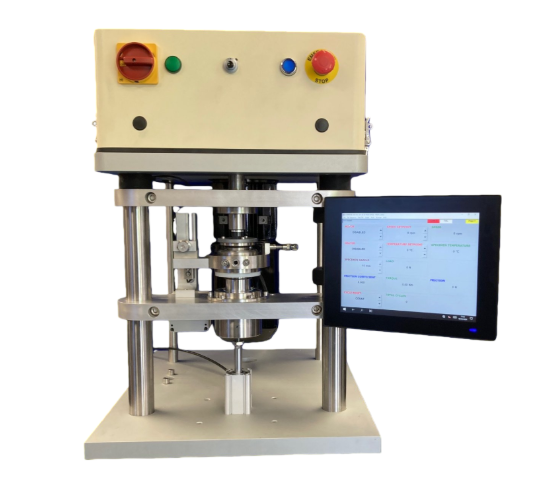
Measurement of Coefficient of Friction (COF) under Dry Conditions
The instrument evaluates the frictional behavior between two materials under dry (non-lubricated) conditions, measuring the coefficient of friction during relative sliding motion.
Quantification of Wear Rate
Wear performance is quantified using methods such as gravimetric analysis (mass loss), surface profilometry (volume loss), or microscopic imaging techniques, enabling accurate evaluation of material degradation.
Control and Monitoring of Experimental Parameters
The tribometer allows precise control of key test variables, including:
Applied normal load
Sliding speed
Sliding distance or test duration
Environmental temperature (some systems support elevated temperatures up to 1000 °C)
Test atmosphere (optional vacuum or controlled gas environments)
Real-Time Monitoring of Contact Temperature and Friction Noise
Some advanced systems can monitor interface temperature and acoustic emission during testing, helping analyze thermal effects and wear mechanisms.
Support for Multiple Contact Configurations
Common test modes include:
Pin-on-Disc: The most widely used configuration for evaluating coatings, polymers, and metals
Ball-on-Three-Plate: Used for comparative studies between lubricated and dry friction systems
Reciprocating Linear Motion: Simulates real-world back-and-forth mechanical movement
Material Development and Screening
Used to evaluate the dry friction performance of materials such as carbon fiber reinforced polymers, magnesium alloy composites, and hard coatings.
Engineering Design Optimization
Provides critical wear resistance data for moving mechanical components in aerospace and automotive industries, such as piston rings, bearings, and gears.
Validation of Theoretical Models
Supports tribological research by validating models such as Archard’s wear law and finite element simulations, and helps identify wear mechanisms including abrasive wear, adhesive wear, and delamination.
Evaluation of Surface Treatment Effects
Used to compare how surface finishing processes (e.g., electropolishing, vibropolishing) affect friction and wear behavior of materials like copper and polymers.
Standardized Testing
Complies with international standards such as:
ASTM G99 (Pin-on-Disk Method)
ASTM G133 (Reciprocating Sliding Test)
The Dry Friction and Wear Tribometer is a fundamental tool in tribology research and engineering applications. It provides reliable experimental data for understanding friction mechanisms, improving material performance, and supporting the development of durable mechanical systems.
The Dry Friction and Wear Tribometer is an experimental device used to simulate and measure friction and wear behavior of materials under dry or boundary lubrication conditions. It is widely applied across multiple high-performance and engineering-driven industries, as outlined below:
1. Aerospace Industry
Used to evaluate materials such as carbon fiber reinforced polymers (CFRP) and high-temperature alloy coatings under dry friction conditions. Applications include critical components like turbine blades, bearings, and structural connectors, where wear resistance and reliability are essential.
2. Automotive Industry
Extensively used in the study of wear behavior of components such as dry clutch friction plates, piston rings, cylinder liners, and gears. It is also applied in evaluating advanced materials like PEEK and magnesium-based composites to improve durability and efficiency.
3. Mechanical Manufacturing and Bearing Industry
Used to analyze friction and wear behavior of metals, ceramics, and polymer materials in sliding contact systems. This helps optimize the service life and reliability of bearings, seals, cams, and other mechanical components.
4. Micro-Electromechanical Systems (MEMS)
Applied in testing hard coatings such as DLC, TiN, and AlTiN used in micro-devices. The tribometer ensures stable performance under low-load and high-frequency operating conditions typical of MEMS applications.
5. Energy and Power Equipment Industry
Used to investigate wear mechanisms of material pairs such as ceramic/carbon or Fe-based amorphous coatings under high-temperature conditions. Typical applications include gas turbines, nuclear power systems, and other energy-related equipment.
6. Medical Devices and Biomaterials
Although many biomedical applications involve wet environments, dry friction testing is used to evaluate initial wear behavior of implant surfaces and artificial joints before exposure to body fluids.
7. Electronics and Semiconductor Industry
Used to test the friction performance of copper and other conductive materials after surface treatment. This helps improve reliability in heat dissipation components and precision electronic assemblies.
Across all these industries, the Dry Friction and Wear Tribometer plays a crucial role in quantitatively analyzing material behavior under harsh conditions such as dry friction, high temperature, high load, and micro-motion. The data obtained provides essential guidance for material design, performance optimization, and engineering applications.
The dry friction and wear tribometer is a specialized device designed to simulate and measure the friction and wear behavior of materials under non-lubricated (dry) contact conditions. Its primary objective is to reproduce real working conditions in a controlled laboratory environment, enabling the evaluation of friction coefficient, wear rate, and related mechanisms.
1. Contact Simulation
A counter-body (such as a ball, disc, or block) is brought into contact with the test specimen under a defined normal load. Relative motion is then generated between the two surfaces in sliding or rolling contact modes, forming a controlled tribological interface.
2. Friction Force Measurement
During the sliding process, a high-precision force sensor continuously monitors the friction force. The coefficient of friction is calculated using the relationship:
COF = \frac{F_f}{F_n}
Where:
COF = coefficient of friction
F_f = friction force
F_n = normal load
This allows real-time evaluation of frictional behavior during the test.
3. Wear Quantification
Wear is evaluated using multiple measurement techniques, including:
Gravimetric analysis (mass loss measurement)
Surface profilometry (wear track depth and profile)
Optical microscopy
Laser scanning or 3D surface reconstruction
These methods are used to determine volume loss or wear depth, from which the wear rate is calculated.
4. Environmental Control
Many tribometers are equipped with environmental chambers that allow testing under controlled conditions such as:
Constant temperature and humidity
Vacuum environments
Inert or reactive gas atmospheres
This helps eliminate external interference and enables simulation of specific service conditions.
The testing principle of the Dry Friction and Wear Tribometer is based on controlled contact, real-time friction measurement, precise wear quantification, and environmental regulation. This integrated approach allows accurate simulation of real-world tribological behavior and provides essential data for material performance evaluation and engineering design optimization.
1. Sample Preparation
Prepare test specimens according to relevant standards, using configurations such as ball-on-disc, pin-on-disc, or ring-on-disc.
Clean the sample surfaces thoroughly to remove oil, oxide layers, and particulate contamination, and record the initial surface roughness (e.g., Ra value).
For composite materials or coated samples, clearly document coating thickness and the interface condition between coating and substrate.
2. Instrument Calibration and Parameter Setting
Calibrate the load system to ensure accurate normal force control (typically within the range of 1 N–100 N).
Set the sliding speed according to test requirements (commonly 0.001–1 m/s, with high-speed systems reaching up to 100 m/s).
Select the test mode:
Rotating (rotational sliding)
Reciprocating (linear back-and-forth motion)
Confirm environmental conditions such as:
Dry friction (no lubrication)
Room temperature or elevated temperature (up to approximately 450°C in some systems)
3. Installation and Alignment
Mount the stationary specimen (e.g., disc) and the moving counterpart (e.g., pin or ball) into the fixture correctly.
Adjust alignment to ensure the normal load is applied precisely through the contact point, avoiding eccentric loading or misalignment.
4. Test Execution
Start the drive system to initiate relative motion between the contact surfaces.
During testing, the system continuously records key parameters, including:
Friction force (used to calculate the coefficient of friction μ)
Wear amount (measured via mass loss, volume loss, or displacement sensors)
Temperature (contact zone or ambient)
Sliding distance and test duration
The coefficient of friction is determined using:
\mu = \frac{F_f}{F_n}
Where:
μ = coefficient of friction
F_f = friction force
F_n = normal load
5. Test Completion and Post-Processing
Stop the motion and unload the specimen.
Analyze the worn surfaces using techniques such as SEM, EDS, optical microscopy, or surface profilometry to identify wear mechanisms, including abrasive wear, adhesive wear, and oxidative wear.
Calculate the wear rate, typically expressed in mm³/N·m.
6. Data Processing and Reporting
Plot the variation of the coefficient of friction versus time or sliding distance.
Compare friction and wear performance across different materials, surface treatments, or processing conditions to evaluate tribological behavior.
The operation of the Dry Friction and Wear Tribometer follows a structured process of specimen preparation, system calibration, controlled testing, and post-test analysis. This ensures accurate and repeatable evaluation of friction and wear behavior, providing essential data for material development and engineering design optimization.
The Dry Friction and Wear Tribometer is a precision instrument used to measure friction coefficient and wear behavior under dry conditions. Regular maintenance is essential to ensure long-term stability and reliable test results.
Cleaning of Contact Surfaces
After each test, clean the counter bodies (e.g., ball, disc) and fixtures using a lint-free cloth or soft brush to remove wear debris. Residual particles may affect subsequent test results and should be fully eliminated.
Environmental Condition Control
Maintain stable laboratory conditions, preferably:
Temperature: 20–25°C
Relative Humidity: <60% RH
Stable environmental conditions help minimize fluctuations in friction coefficient measurements.
Load System Calibration
Regularly verify the loading system using standard weights or force sensors. Ensure that the normal load error remains within ±1%.
Lubrication of Mechanical Components
Apply light anti-rust oil or grease to mechanical moving parts such as guide rails and lead screws. Care must be taken to avoid contamination of the test area.
Every 1–3 Months
Calibrate displacement sensors and speed controllers to ensure accurate sliding velocity (typically 0.001–1 m/s).
Check temperature sensors (if equipped with high-temperature modules) for proper response and recalibrate if necessary.
Every 6–12 Months
Replace or clean air filters if the system includes a controlled or clean environment module.
Inspect electrical cables for aging or damage and ensure proper grounding.
Clean and calibrate optical or laser-based measurement systems used for real-time friction monitoring.
Annual or Post-Major Testing Maintenance
Evaluate wear condition of critical components such as spindles, bearings, and motors, and replace them if necessary.
Perform full system performance validation using standard reference materials (e.g., GCr15 steel, PTFE) to verify repeatability and data reliability.
Proper maintenance of the Dry Friction and Wear Tribometer ensures measurement accuracy, operational stability, and long-term reliability. A structured maintenance schedule covering daily cleaning, periodic calibration, and annual system validation is essential for high-quality tribological testing results.
The importance of the Dry Friction and Wear Tribometer is mainly reflected in its critical role in tribology research, material development, and engineering applications. Its core significance can be summarized as follows:
1. Simulation of Real-World Operating Conditions
The dry friction and wear tribometer can simulate common sliding contact behaviors under non-lubricated conditions, such as those found in gears, bearings, piston rings, and other mechanical components. It is especially valuable for evaluating material performance under extreme environments, including vacuum, high temperature, and dry conditions.
2. Precise Quantification of Friction and Wear Parameters
The instrument enables accurate measurement of key tribological parameters, including coefficient of friction and wear rate. These data provide a reliable foundation for material selection, surface treatment optimization, and service life prediction of engineering components.
3. Identification of Wear Mechanisms
By combining tribological testing with analytical techniques such as SEM, EDS, and XRD, different wear mechanisms can be clearly identified, including:
Abrasive wear
Adhesive wear
Oxidative wear
Delamination wear
This helps guide material design and performance improvement.
4. Support for New Material Development
The tribometer plays a vital role in validating the performance of advanced materials in high-tech industries, including:
Semiconductor materials (e.g., Co interconnect polishing processes)
Aerospace coatings (e.g., high-temperature protective layers)
Biomedical coatings (e.g., DLC thin films)
It is an essential tool for verifying wear resistance, stability, and reliability of new materials.
5. Contribution to Energy Efficiency and Sustainability
Frictional losses account for approximately 20% of global energy consumption. Optimizing dry friction systems can significantly improve energy efficiency. The tribometer provides experimental support for developing low-friction, long-life materials, thereby contributing to energy conservation and carbon reduction goals.
6. Standardized Testing and Quality Control
Compliant with international standards such as ASTM G99 (pin-on-disc method) and ASTM D3702. the tribometer is widely used in industrial quality control and product certification to ensure the reliability and stability of mechanical components during service.
In summary, the Dry Friction and Wear Tribometer is not only a core instrument for fundamental tribology research but also a key technological platform supporting innovation in advanced manufacturing, new energy, and microelectronics industries. It provides indispensable experimental data for material development, process optimization, and product life prediction under real-world operating conditions.We sincerely welcome researchers, engineers, and industry professionals to contact us for more detailed technical specifications, application cases, and customized solutions, and to explore potential collaboration opportunities.


