The Four-Ball Tribometer is a standardized tribological testing instrument widely used in industrial and research settings. It is specifically designed to systematically evaluate the tribological performance of various lubricants (such as oils and greases) and different materials under simulated sliding contact conditions. Key assessment metrics include, but are not limited to, material wear resistance, the extreme pressure (EP) load-bearing capacity of lubricants, and the measurement of dynamic friction coefficients.This article aims to provide a comprehensive and detailed introduction to the device from multiple perspectives, including its basic structural components, working principles, standardized test methods, typical application scenarios, and key points for data analysis. The goal is to offer valuable reference information and practical guidance for researchers, engineers, and technical enthusiasts in the field.
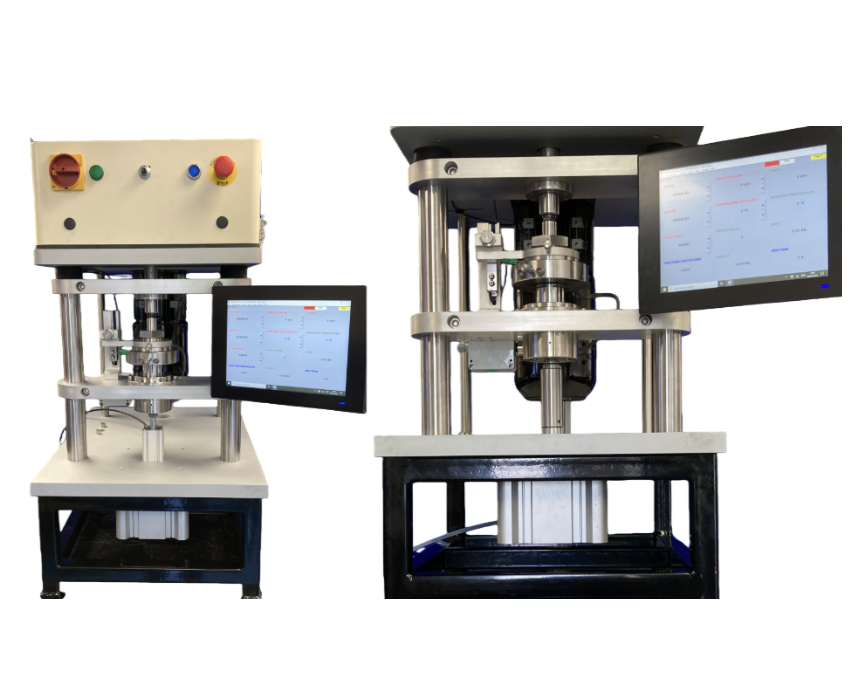
The Four-Ball Tribometer is a specialized instrument widely used to evaluate the tribological performance of lubricants, additives, and materials. Its core function is to simulate sliding contact under boundary lubrication or extreme pressure (EP) conditions and to assess lubricant performance by measuring friction coefficients and wear characteristics.
1. Evaluating the anti-wear (AW) and extreme pressure (EP) performance of lubricants:
Under standard load, speed, and temperature conditions, the wear scars on the contact area of steel balls (e.g., Wear Scar Diameter, WSD) and changes in friction force are observed to determine the anti-wear and EP properties of greases or lubricating oils.
2. Testing the effects of nanomaterial additives:
Nanoparticles such as graphene, TiO₂, and MgO used as lubricant additives can significantly reduce friction coefficients (by up to 61%) and wear scar diameters (by up to 45%). The Four-Ball Tribometer is widely used to verify the mechanisms by which these additives enhance lubrication.
3. Developing new lubricating materials:
The instrument is suitable for performance screening and optimization of special lubricant systems, including synthetic oils, bio-based fuels, and fluoropolymer lubricants for aerospace applications.
4. Meeting international testing standards:
It enables repeatable friction and wear testing in accordance with standards such as ASTM D4172 and D2266. ensuring the comparability of results.
The Four-Ball Tribometer is a standardized instrument widely used to evaluate the anti-wear (AW) and extreme pressure (EP) performance of lubricants. Its applicable standards are primarily established by internationally recognized organizations. The currently mainstream and widely adopted standards include:
ASTM D4172 — Standard Test Method for Extreme Pressure and Anti-Wear Characteristics of Lubricating Fluids (Four-Ball Method)
This standard specifies the procedure for measuring the performance of lubricants under extreme pressure and anti-wear conditions using the four-ball method. It is one of the most commonly used standards in the industry.
ISO 20623 — Petroleum and Related Products — Determination of Anti-Wear Properties of Lubricating Oils — Four-Ball Test Method
This international standard, issued by the International Organization for Standardization (ISO), defines the four-ball test method for evaluating the anti-wear performance of lubricating oils.
GB/T 12583 (China National Standard) — Method for Determination of Extreme Pressure Performance of Lubricants (Four-Ball Method)
Essentially equivalent to ASTM D4172. this standard is applied to the evaluation of EP and AW performance of domestic lubricants in China.
DIN 51350-2 (German Industrial Standard) — Testing of Lubricants — Part 2: Testing with the Four-Ball Apparatus
This German standard provides normative guidelines for four-ball testing, focusing on wear resistance and load-carrying capacity.
The Four-Ball Tribometer is a core instrument for evaluating the load-carrying capacity, anti-wear (AW) performance, and extreme pressure (EP) performance of lubricants. Its working principle is based on a standardized point-contact sliding friction model. The core principles and key points are as follows:
Basic Structure and Contact Configuration
The tribometer uses four standard steel balls (typically φ12.7 mm, made of GCr15 bearing steel) arranged in a tetrahedral configuration.
The lower three balls are fixed in an oil cup, forming a load-bearing base and fully immersed in the lubricant under test.
The upper ball is mounted in the spindle chuck, pressed against the lower three balls under axial load, and driven to rotate by the spindle.
1. Loading:
An accurately controllable axial load (typically 60 N – 10 kN) is applied to the upper ball via a mechanical lever, hydraulic, or electro-hydraulic servo system, producing high Hertzian contact stress at the point of contact.
2. Frictional Motion:
The spindle drives the upper ball at a set rotational speed (e.g., 200–2000 r/min), generating predominantly sliding point-contact friction with the lower three balls.
3. Lubrication Simulation:
The entire ball contact assembly is immersed in the lubricant to simulate real operating conditions such as heavy load, high speed, or boundary lubrication.
4. Data Acquisition:
Parameters such as friction force/torque, friction coefficient, temperature, and rotational speed are monitored in real time.
After the test, a measuring microscope is used to measure the wear scar diameters on the lower balls; the average is taken as the anti-wear performance index.
Maximum Non-Seizure Load (PB): The highest load at which no seizure occurs, reflecting the lubricant film strength.
Weld Load (PD): The minimum load that causes steel balls to weld together, indicating the EP limit.
Comprehensive Wear Value (ZMZ): A combined index evaluating both anti-wear and EP capabilities.
Wear Scar Diameter (WSD): The smaller the value, the better the anti-wear performance.
1. Equipment and Material Preparation
Use a four-ball extreme pressure (EP) tester with a drive system speed of 1760 ± 40 rpm.
Prepare three fixed steel balls and one rotating upper ball, made of AISI E-52100 chromium steel, diameter 12.7 mm, hardness HRC 64–66.
Prepare cleaning solvents: non-chlorinated, residue-free Stoddard solvent for cleaning, and high-volatility solvents like n-heptane for rinsing.
Calibrate the microscope used to measure wear scar diameter (precision 0.01 mm) and the timer used for recording time (precision 0.1 s).
2. Pre-Test Preparation
Thoroughly clean the test balls, oil cup, and fixtures, and dry with compressed air.
Inspect the upper ball chuck for wear; it must be replaced after each test.
Bring the lubricant sample and test components to a stable temperature of 18–35 °C.
Place the three fixed steel balls in the oil cup, fill with lubricant to fully cover the balls, then tighten the oil cup nut (torque 68 ± 7 N·m).
3. Initial Load Test
Install the fourth (upper) ball into the rotating chuck.
Set an initial load of 784 N (80 kgf) and run the machine for 10 ± 0.2 s.
Stop the machine and measure the wear scar diameter of the three fixed balls (accuracy 0.01 mm).
4. Progressive Load Test
Gradually increase the load according to the standard load gradient (e.g., Table 1).
After each load increase, run for the specified time and record the wear scar diameter and friction coefficient.
Continue testing until a welding/seizure phenomenon occurs (any of the following conditions can be used to stop the test):
Severe deflection of the friction indicator
Significant increase in motor noise
Smoke from the test chamber
Sudden drop of the load lever
5. Data Recording and Analysis
Record the applied load (kgf), measured wear scar diameter (mm), and Hertz contact diameter (mm) for each test.
Calculate the corrected load:
Corrected Load=Applied Load×(Hertz DiameterMeasured Diameter)\text{Corrected Load} = \text{Applied Load} \times \left(\frac{\text{Hertz Diameter}}{\text{Measured Diameter}}\right)Corrected Load=Applied Load×(Measured DiameterHertz Diameter)
Calculate the load-wear index (G): Take the average of the corrected loads for the 10 tests prior to welding.
Determine the weld load (PD): The lowest load that causes four-ball welding.
The Four-Ball Tribometer is a critical instrument for evaluating the anti-wear (AW), extreme pressure (EP), and other tribological properties of lubricants. The quality of its maintenance directly affects both test accuracy and the service life of the equipment.
1. Cleaning
After each use, thoroughly clean the ball seats, grease cup, and the surfaces of the balls to prevent residue from affecting subsequent tests.
Use high-purity solvents such as anhydrous ethanol or acetone to ultrasonically clean steel ball samples, preventing impurities from introducing measurement errors.
2. Lubrication
Periodically lubricate moving parts (e.g., spindle, guide rails) with the lubricant specified by the manufacturer to prevent dry friction and component wear.
Pay special attention during vacuum or cleanroom testing to avoid contamination of the test area by lubricants.
3. Tightening and Calibration
Regularly inspect and tighten bolts, clamps, and other fasteners to prevent vibrations or load deviations caused by looseness.
Calibrate load sensors, torque measurement systems, and displacement sensors on schedule to ensure data accuracy.
1. Preventive Maintenance (PM)
Conduct a comprehensive inspection every 100–500 operating hours (depending on usage frequency), including:
Checking the motor and drive system operation.
Verifying the vacuum system’s sealing integrity (if the equipment is used for vacuum tests).
Replacing aged or worn components such as O-rings and filters.
2. Condition-Based Maintenance (CBM)
Use the built-in monitoring functions (e.g., temperature, vibration, friction coefficient fluctuations) to detect abnormal operation.
If test repeatability is poor (e.g., failing Cochran’s test) or wear scar diameters (WSD) fluctuate significantly, immediately stop the machine for inspection.
3. Vacuum System Maintenance (if applicable)
Regularly replace vacuum pump oil and clean the vacuum chamber.
Use a helium mass spectrometer leak detector to check the sealing of flanges and interfaces, ensuring vacuum levels reach 10⁻⁶ Pa.
The Four-Ball Tribometer holds significant importance due to its wide application and unique advantages in tribology research and industrial lubricant performance evaluation. Its core value is reflected in the following aspects:
1. Standardized Lubricant Performance Evaluation
The Four-Ball Tribometer is an internationally recognized standardized instrument, widely used to assess the anti-wear (AW) and extreme pressure (EP) performance of lubricating oils, greases, and additives.
Testing procedures comply with standards such as ASTM D4172 and ISO 20623.
2. Simple Structure and Low Cost
Compared to full-size engine or gearbox testing, the Four-Ball Tribometer is compact, easy to operate, and cost-effective.
It is ideal for rapid laboratory screening and preliminary evaluations.
3. High Repeatability and Controllability
Testing can be performed under strictly controlled parameters, including load, speed, temperature, and duration, ensuring highly repeatable and comparable results.
4. Wide Applicability Across Fields
Evaluating lubricity of diesel, biodiesel, and nano-additive fuels, such as studying the effect of SiO₂, TiO₂, graphene, and other nanoparticles on friction and wear.
Analyzing lubrication behavior of cutting fluids and grinding fluids to support process optimization.
Supporting performance verification of new lubricant materials, including nano-lubricants and bio-based lubricants.
5. Provides Key Tribological Parameters
Directly measures friction coefficient, wear scar diameter (WSD), and wear volume, providing essential data for material selection, formulation optimization, and service life prediction.
6. Integration with Advanced Characterization Techniques
Can be combined with SEM, 3D surface profilometry, EDS, and other techniques to deeply analyze wear mechanisms such as adhesive wear, abrasive wear, and corrosive wear.
In summary, the Four-Ball Tribometer, with its highly standardized testing procedure, excellent cost-effectiveness, outstanding experimental controllability, and broad applicability to multiple materials and operating conditions, has become an indispensable fundamental testing tool in both tribology research and engineering applications.We warmly welcome inquiries regarding the instrument’s technical specifications, application cases, or purchasing details. Our professional team is ready to provide comprehensive information and support, helping you gain a deeper understanding and effective utilization of this essential device.


