The Rotary Tribometer is a precision instrument specifically designed to accurately measure the tribological properties of materials under rotational sliding contact conditions. This device can reliably capture and analyze key parameters such as dynamic friction coefficients, wear rates under specific operating conditions, and changes in material surfaces during the friction process.It is widely used in materials science and engineering, advanced lubrication research, surface coating, and modification engineering. The Rotary Tribometer can closely simulate the complex frictional contacts and relative motion conditions experienced by real mechanical components, such as rolling bearings, transmission gears, and rotary shaft seals, during operation.By providing precise experimental data, it supports the evaluation of material performance, validation of lubricants, and prediction of component lifespan, making it an essential tool for both research and engineering applications.
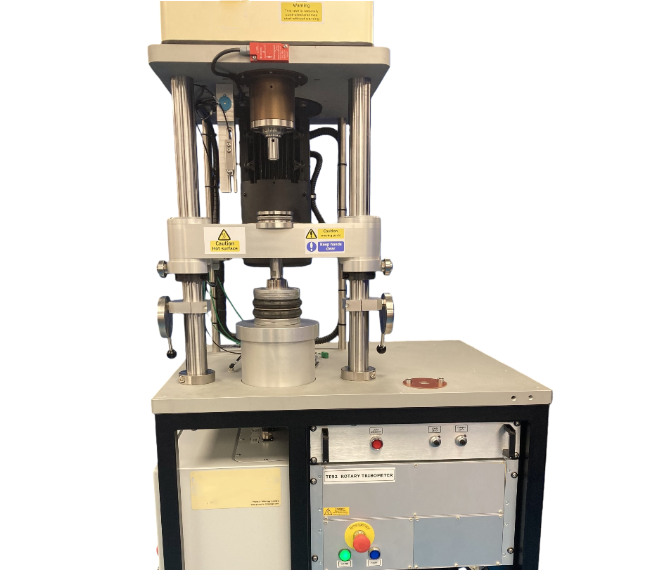
The Rotary Tribometer is a precision instrument specifically designed to investigate the tribological behavior of materials under rotational sliding contact. It has broad applications in key fields such as materials science and engineering, lubrication technology development, automotive and aerospace manufacturing, and energy equipment. Its main functions include:
Accurate Measurement of Friction Coefficients: Precisely measures and records frictional properties between paired materials under strictly controlled experimental conditions, including load, rotational speed, temperature, and environmental atmosphere.
Systematic Wear Performance Evaluation: Simulates the actual contact conditions of mechanical components such as bearings, gears, and sealing rings to quantitatively analyze and compare the wear resistance of bulk materials or surface coatings.
Comprehensive Lubricant Performance Testing: Evaluates the friction-reducing and wear-resistant performance of various lubricating oils, greases, and other lubrication media under rotational contact conditions, providing critical data for lubricant selection and optimization.
High-Fidelity Simulation of Real-World Conditions: Reproduces complex tribological scenarios such as rolling-sliding motion, boundary lubrication states, and extreme high-temperature or high-pressure environments, reflecting material behavior under actual operating conditions.
Support for New Material and Coating Development: Provides an essential experimental platform and data basis for developing advanced surface engineering materials with high wear resistance and low friction coefficients, such as ceramic coatings and diamond-like carbon (DLC) films, accelerating the research and development of new materials.
The Rotary Tribometer is suitable for tribological performance testing of various materials under different lubrication conditions. The applicable standards depend on the specific type of test, equipment configuration, and industry requirements.
ASTM D3702: Standard Test Method for Wear Rate of Self-Lubricating Materials under Sliding Contact; commonly used for rotary tribometers with thrust washer configurations.
GB/T 3075-2021: Axial Force-Controlled Fatigue Testing of Metallic Materials; primarily a fatigue test standard, but it provides reference methods for high-cycle fatigue tests of rotating components.
ASTM E466-15: Standard Test Method for Conducting Force-Controlled Constant-Amplitude Axial Fatigue Tests of Metallic Materials; applicable for fatigue evaluation of rotating machinery components.
ISO 1099:2017: International Standard for Axial Force-Controlled Fatigue Testing of Metallic Materials; applicable for fatigue analysis in rotating systems.
HB 5287-1996: Chinese Aviation Industry Standard specifying axial loading fatigue test methods for metallic materials; suitable for rotating aerospace components.
The Rotary Tribometer is an instrument designed to simulate and measure the friction and wear behavior of materials under rotational sliding contact conditions. Its core working principle relies on controlled rotational motion, precise load application, friction measurement, and environmental control to evaluate the tribological performance of materials, coatings, or lubricants.
Rotational Contact Pair: Standard contact geometries such as pin-on-disc, block-on-ring, or thrust washer configurations are typically used, where one specimen is fixed and the other rotates at a preset speed.
Normal Load Control: A pneumatic, hydraulic, or mechanical loading system applies a controlled normal force at the contact interface, simulating the pressure conditions experienced in real operating scenarios.
Friction Force Measurement: The friction torque on the rotating specimen is measured by high-precision sensors (e.g., strain gauges or torque transducers), from which the friction coefficient is calculated (μ=friction force/normal force\mu = \text{friction force} / \text{normal force}μ=friction force/normal force).
Motion Control: A servo motor drives the rotational system, allowing precise control of rotational speed, number of revolutions, acceleration, and operating time. The system supports steady-state, variable-speed, or programmed motion modes.
Environmental and Temperature Control: High-end models are equipped with temperature control systems (e.g., TE95 model with a range of –50°C to 1000°C) and optional chambers for vacuum, humidity, or controlled atmospheres to simulate real service conditions.
Data Acquisition and Analysis: Dedicated software (e.g., Phoenix Tribology COMPEND 2020) records friction coefficient, temperature, vibration, and other parameters in real time, and outputs key indicators such as wear rate and life curves.
General Operating Steps
1. Pre-start Preparation
Check that all equipment components are intact and confirm that the loading system, drive system, and sensors for force, torque, and temperature are functioning normally.
According to testing standards such as ASTM D3702 or ISO 7148. select the appropriate specimen fixtures: pin-on-disc, thrust washer, block-on-ring, etc.
Install the specimen and ensure proper alignment to avoid eccentric loading.
2. Environmental Setup (depending on model)
For high-pressure or vacuum models (e.g., TE58. TE91), seal the test chamber and either evacuate to vacuum or fill with specified gases (CO₂, H₂, etc.) to the set pressure.
For high/low temperature models (e.g., TE95), set the environmental temperature range from –50°C to +1000°C, and preheat or precool until a stable condition is reached.
3. Parameter Setting
Using control software such as COMPEND 2000. set the following parameters:
Load: typically 5 N – 5000 N
Speed: e.g., 6–1200 rpm
Test duration or sliding distance
Temperature (if applicable)
4. Start the Test
Activate the drive motor to rotate the specimen at the set speed.
Monitor and record friction coefficient (COF), temperature, and wear in real time.
5. Post-test Procedures
After stopping the machine, unload the specimen and clean the test chamber.
Analyze wear morphology and volume loss using a microscope or profilometer.
Export data via USB or software export functions.
6. Notes and Safety Considerations
Different models (TE92. TE93. TE94. etc.) have different functional focuses; refer to the specific device manual for operational details.
High-pressure, vacuum, and high-temperature tests must strictly follow safety protocols to prevent leaks or burns.
Multi-station equipment can run several specimens simultaneously, but ensure independent control and data acquisition for each test station.
Maintenance of the Rotary Tribometer primarily focuses on cleaning, lubrication, calibration, and safe operation.
1. Daily Cleaning and Inspection
After each use, clean components in contact with the specimen (rotor, disc, pin, etc.) to prevent residues from affecting subsequent test accuracy.
Clean the lenses of photoelectric sensors or other sensors using lens tissue or a dedicated cloth to prevent oil or dirt buildup.
Keep guide rails, support frames, and machine bed surfaces clean, and periodically apply anti-rust oil to prevent accumulation of iron filings or dust.
The electrical control box should be kept dry and vibration-free. For long-term storage, power on periodically for a few hours to preheat; do not turn panel knobs arbitrarily.
2. Lubrication Management
Regularly lubricate moving parts such as rollers, rotor contact surfaces, guide rails, and transmission components with a mechanically stable, high-adhesion grease or oil.
Wipe support blocks or rollers clean before each use and apply a small amount of lubricant.
For grease fittings, under single-shift usage, clean and replace grease at least once a year.
3. Calibration and Accuracy Assurance
Dynamic balancing-type rotary tribometers should be calibrated at least once per year to ensure measurement precision.
If the instrument is used for research or quality control, follow national metrology verification procedures for periodic checks, and conduct intermediate self-inspections if necessary.
4. Safety and Operational Protocols
Always disconnect power before moving or performing maintenance.
Never strike or hit the rotor on the roller frame. When moving the support frame, rotate the rotor or move the left and right support frames at the same speed to avoid scratching the journal or rollers.
Test safety systems (e.g., emergency stop buttons, protective covers) regularly to ensure proper operation in emergencies.
5. Environment and Storage
Place the instrument in a dry, dust-free, and temperature-stable environment.
For long-term storage, cover with a dust-proof cover and periodically power on to check the system.
The Rotary Tribometer is critically important because it can accurately simulate and study the friction and wear behavior of materials under rotational sliding conditions, making it widely used in research, industrial R&D, and quality control.
Versatility Across Applications:
The device can simulate real working conditions of various rotational contact components, including bearings, gears, tires, brake pads, and drill bits. It is suitable for a broad range of material systems, including metals, polymers, rubber, composites, and biomaterials.
High-Precision Control and Measurement:
Modern rotary tribometers (e.g., TE92. TE95 models) offer precise control over load, speed, and temperature, and integrate sensors for force/torque, temperature, and vibration. They can acquire key data in real time, such as friction coefficient and wear rate.
Support for Extreme Environmental Testing:
Some models operate under extreme conditions, including high temperatures (up to 1000°C), low temperatures (down to -50°C), high pressures (up to 15 MPa), or vacuum/special gas environments (e.g., hydrogen, CO₂), meeting the stringent testing needs of aerospace, energy, and deep-sea applications.
Facilitates Advanced Material Development:
In cutting-edge fields such as nanocomposites, biomedical materials, and tire rubber, the equipment is used to optimize material formulations, evaluate wear resistance, and reveal wear mechanisms (e.g., adhesive, abrasive, or fatigue wear).
Standardization and Reproducibility:
As a laboratory-grade instrument, it provides consistent testing conditions, avoiding the high cost and complexity of full-scale equipment tests. This enables reliable material comparisons, process validation, and standard development.
In summary, the Rotary Tribometer is an essential material testing device that plays an irreplaceable role in evaluating wear resistance, friction behavior, and durability. Its significance warrants close attention and in-depth research. We sincerely invite industry professionals, researchers, university scholars, and related organizations to engage, comment, or inquire for more detailed information.


