The Fully Automatic Falling Sand Abrasion Tester is a high-efficiency testing instrument specifically designed for laboratory environments to accurately evaluate the abrasion resistance of various organic coatings, paint films, or surface treatment layers. The device employs a fully automated control system that allows standard sand grains of specified size to fall freely from a predetermined height and impact inclined test panels in a controlled manner. This precisely simulates the mechanical wear and particle impact that coating surfaces may experience in real-world conditions. By measuring the weight or volume of sand required to wear the coating to a defined level under standard conditions, this instrument provides a scientific, quantitative assessment and comparison of different coatings’ wear resistance and durability, providing critical data for material research, quality control, and performance verification.
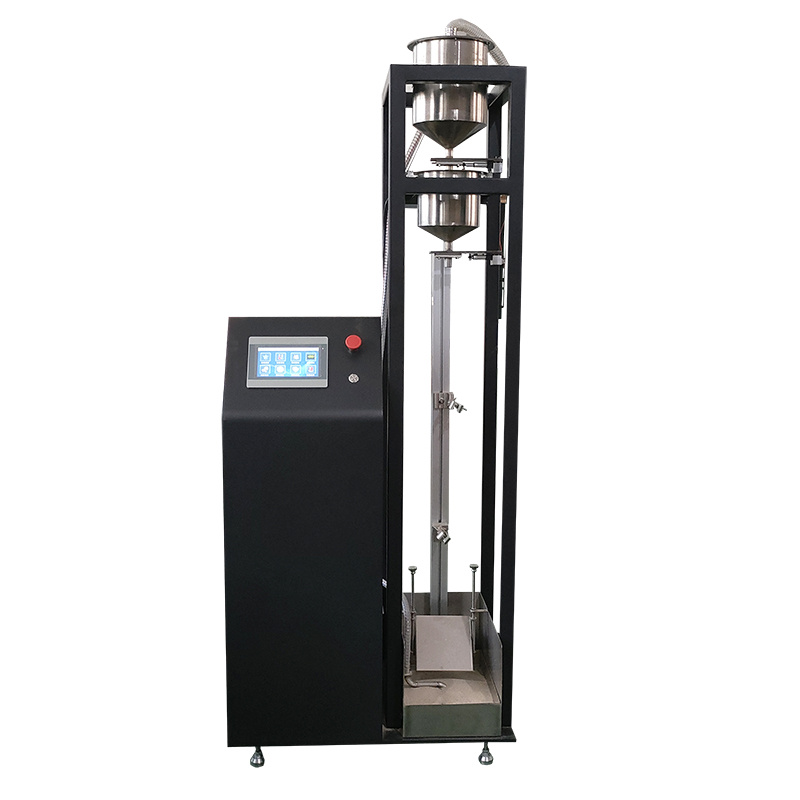
The development of the Fully Automatic Falling Sand Abrasion Tester is primarily driven by the industrial demand for standardized and automated evaluation of the wear resistance of coatings, platings, and surface-treated materials. Its background can be summarized as follows:
International standards such as ASTM D968 have, since the mid-20th century, specified the use of the falling sand method to evaluate coating wear resistance. These standards require quantitative control of sand flow parameters (e.g., flow rate, height, particle size) to simulate abrasion and use the time or amount of sand required to expose the substrate as the wear resistance metric.
Early falling sand tests relied on manual operation, which had several drawbacks:
High human error (e.g., unstable sand flow, subjective endpoint judgment)
Low testing efficiency (long duration per test, no continuous operation)
Poor repeatability (insufficient for high-precision R&D or quality control requirements).
With the development of sensors, motor control, and data acquisition technology, fully automatic testing systems have been realized:
Precise control of sand flow rate and total volume
Automatic detection of coating wear endpoints (e.g., via conductivity, optical, or weight changes)
Real-time data recording and report generation, greatly improving test reliability and efficiency.
This equipment is widely applied in automotive, electronics, aerospace, and construction industries, where rapid and reliable assessment of coating durability under simulated windblown sand or particle erosion is required. For example, in areas prone to sandstorms, concrete and metal structures must be tested for erosion resistance using the falling sand method.
In summary, the Fully Automatic Falling Sand Abrasion Tester is a modern materials testing instrument developed to overcome the limitations of manual testing and improve testing precision and efficiency, driven by standardization needs, technological advancement, and industrial applications.
The system uses precise programming to control key parameters such as falling sand height, sand flow rate, test duration, and sample platform movement. This full automation minimizes random errors introduced by manual operation, ensuring excellent repeatability and comparability between batches, providing reliable data for scientific research and product quality control.
Modern testers allow operators to adjust sand falling speed, select sand particle size, set specific impact angles, and even control chamber temperature and humidity. This high configurability enables realistic simulation of sand erosion, impact abrasion in material transport, and wear of protective coatings. It is suitable for evaluating metals, engineering plastics, coatings, composites, ceramics, and other advanced materials.
The instrument integrates high-precision mass sensors, displacement sensors, and optical monitoring modules to record real-time sample mass loss, micro-surface morphology changes, gloss decay, and other key indicators. Data is processed via dedicated software, which automatically generates standardized test reports with curves, charts, and conclusions. Compliance with ASTM, ISO, and other international standards is facilitated. High-end models may use non-destructive optical profilometry or laser scanning to measure wear volume or depth in 3D without damaging the sample surface, essential for high-value or fully assembled components and long-term R&D monitoring.
In automotive, aerospace, and electronic packaging industries, the tester allows systematic evaluation and optimization of coating, plating, and surface treatment processes. Accurate abrasion testing ensures components maintain expected performance and reliability under friction, impact, and harsh conditions, reducing early failures and maintenance costs.
For advanced materials such as wear-resistant alloys, high-performance ceramic coatings, or superhydrophobic self-cleaning materials, the device provides a standardized and quantifiable performance evaluation system. Researchers can quickly compare formulations and processes, speeding up development-to-production cycles.
In heavy industries such as tunnel boring, mining, and material transport, specialized falling sand testing methods simulate actual wear of critical components. The resulting data helps predict service life, plan preventive maintenance, and optimize equipment design.
The widespread use of fully automatic falling sand testers facilitates the implementation of standards such as ASTM D4060. ISO 9352. YS/T 1186-2017. enhancing comparability and mutual recognition of performance data worldwide, reducing technical trade barriers.
The Fully Automatic Falling Sand Abrasion Tester is a precision testing instrument designed for the accurate evaluation of the surface wear resistance of various materials. Its core principle is to control standard abrasive material to fall freely from a predetermined height under controlled conditions, continuously impacting the surface of the test sample at a specified angle. This simulates real-world wear processes, allowing the quantification of the material's abrasion resistance. The standard operating procedures are as follows:
Place the cut or prepared standard samples in a controlled environment with constant temperature and humidity (typically 23 ± 2°C and 50 ± 5% relative humidity) for at least 24 hours to stabilize the sample properties.
Before testing, carefully inspect and clean the sample surfaces to ensure they are free of oil, dust, fingerprints, or any contaminants that may affect results. Ensure the test area is clean and representative.
Accurately fill the sand hopper with the specified amount of standard abrasive (e.g., 2000 ± 10 mL of standard quartz sand).
Use the flow calibration device to verify the sand flow rate, ensuring the flow time meets relevant standards (commonly, the flow time for 2 liters of sand is controlled between 21 and 23.5 seconds).
Adjust the sand guide tube vertically and horizontally to ensure the central axis of the sand flow is precisely aligned with the center of the sample fixture.
Using auxiliary tools, verify the sand coverage area. Typically, 90%–93% of the falling sand should land within the designated test area to ensure uniformity and accuracy.
Secure the prepared sample in the dedicated fixture of the instrument. Ensure the sample surface forms a 45° angle with the vertical falling sand stream (this angle generally complies with ASTM D968 and ISO 1518).
Fine-tune the lateral and longitudinal positions of the fixture so that the pre-marked test area on the sample aligns precisely with the center of the sand outlet, ensuring accurate impact point alignment.
Start the instrument’s automatic control program and open the sand hopper valve. Standard sand falls at a constant flow rate, continuously impacting the sample surface.
The test continues until the coating on the sample surface is completely worn through, exposing the substrate beneath, and the wear spot reaches the standard specified diameter (typically 5/32 inch, approximately 4 mm).
Fully automatic models typically use built-in sensors to automatically determine the test endpoint and accurately record the total sand consumption (in liters) or total test duration from start to finish. This data serves as the primary metric for evaluating material wear resistance.
The abrasion resistance of the material is usually expressed as sand consumption per unit coating thickness, in units of μm/L. The calculation formula is:
A=VTA = \frac{V}{T}A=TV
Where:
A — Material abrasion resistance value (μm/L); higher values generally indicate better wear resistance.
V — Total volume of standard sand consumed to wear through the coating (L).
T — Average thickness of the coating on the sample (μm).
To obtain reliable and statistically significant results, it is recommended to perform at least three effective tests at different locations on the same sample or on multiple samples from the same batch. The arithmetic mean should be taken as the representative abrasion resistance value, helping reduce random errors and improve accuracy and repeatability.
To ensure long-term stability and accuracy of the test results, the instrument requires regular maintenance:
After approximately 25 tests, check the alignment of the sand guide tube and recalibrate if necessary.
After approximately 50 tests, replace or sieve the standard sand to remove fines or broken particles, ensuring particle size distribution meets standards and abrasive consistency is maintained.
Clean the internal parts of the instrument (especially the sand hopper, guide tube, and test chamber) after each test to prevent accumulation, compaction, or blockage of sand, which could affect test accuracy and instrument lifespan.
The Fully Automatic Falling Sand Abrasion Tester is a precision instrument used to evaluate the wear resistance of materials, widely applied in quality control for coatings, plastics, metals, textiles, and other industries. Considering its working principle and structural features, the key maintenance points are as follows:
After each use, remove any sand and residues from the sand delivery system, sample stage, and collection devices to prevent sand accumulation that could affect moving parts or cause wear.
Ensure that the sand guide tubes, nozzles, and valves are free of blockages and that sand flows smoothly. If necessary, use compressed air to clear any obstructions.
Regularly apply appropriate lubricating oil or grease to mechanical transmission components such as guide rails, lead screws, and bearings to reduce friction and wear.
Verify that load sensors, displacement sensors, photoelectric switches, and other signal transmission components are functioning correctly. Ensure cables are properly connected and free from looseness or damage.
Perform a comprehensive calibration at least once per year, including key parameters such as sand flow rate, applied load, and movement stroke, to ensure test results comply with relevant standards (e.g., ASTM D968. ISO 7784).
Use standard weights or reference samples with known wear rates to verify equipment accuracy.
Regularly sieve or replace abrasive materials (e.g., quartz sand) to prevent particle breakage, clumping, or moisture content changes that could affect test consistency. Keep sand dry, clean, and free from contaminants.
Check wear on the sand delivery mechanism, such as electromagnetic vibrators or pneumatic valves, and replace worn parts as needed. Inspect the sample fixture for looseness or deformation to ensure stable clamping.
Place the instrument in an environment with stable temperature (15–35°C) and humidity (<80% RH) to avoid extreme conditions affecting electronic components or mechanical precision. In humid areas, consider using a dehumidifier or protective enclosure to safeguard sensitive components.
In conclusion, the Fully Automatic Falling Sand Abrasion Tester is a critical precision instrument indispensable in numerous industrial and materials testing fields. Users should consider application scenarios, precision requirements, and budget to select the appropriate model, ensuring optimal testing results and value.


