The Multi-Functional Tribology Tester is a highly precise experimental analysis device specifically designed to study the complex friction-related behavior of various materials under relative motion at contact interfaces. It can accurately measure the coefficient of friction, systematically evaluate wear behavior, and analyze lubrication performance in detail.The system is capable of simulating a wide range of real working conditions, providing essential experimental data and theoretical support for studying the interaction mechanisms between material surfaces. Therefore, it is indispensable in high-tech and industrial fields such as mechanical engineering design optimization, new material research and testing, durability evaluation of automotive components, performance assessment of critical aerospace parts, and biocompatibility studies of biomedical implants.
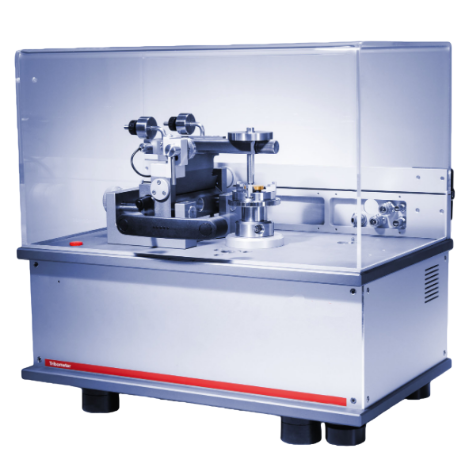
The Multi-Functional Tribology Tester is a key instrument for measuring friction and wear characteristics of various materials under complex conditions such as sliding, rolling, or contact loading. Its wide application range makes it an essential testing tool in the industry, mainly due to its advanced technical features and significant practical value, as outlined below:
Modern high-end equipment adopts a flexible and advanced modular architecture. Users can freely switch between multiple test modes on a single platform, including rotational, reciprocating, ring-on-block, and linear sliding tests. This significantly improves versatility and experimental efficiency, enabling multiple tribological experiments on one system.
The equipment offers a wide measurement range with extremely high precision:
Load range: from 1 mN up to 2000 N
Rotational speed: from 0.1 rpm to 5000 rpm
Motion displacement resolution: 0.25–0.5 μm
Such a wide range and high precision make it possible to study micro-tribological phenomena such as micro-motion wear and stick-slip behavior. Additionally, the high-sensitivity force sensors have extremely low noise (no more than 0.02% of full scale), ensuring excellent repeatability and reliability of test data.
To simulate various extreme or special service environments, modern tribology testers are equipped with comprehensive environmental simulation functions:
Temperature range: from -120°C to 1000°C
Optional configurations: humidity control (5%–85% RH), liquid circulation, electrochemical corrosion, vacuum environment
These capabilities allow material testing under conditions close to real working environments.
The level of intelligence continues to improve:
Equipped with the TriboID intelligent recognition system, which automatically identifies installed modules and loads calibration parameters, avoiding manual errors
Control and analysis software (e.g., TriboScript) uses icon-based programming, making it intuitive and easy to operate
Built-in test methods compliant with ASTM, DIN, ISO, JIS standards
Data acquisition speed up to 200 kHz, enabling capture of transient dynamic signals
Some models support simultaneous multi-sample testing, which is highly advantageous for large-scale material screening, formulation optimization, and quality control. It enables rapid acquisition of large amounts of comparable data.
Whether for advanced coatings, composite materials, high-performance lubricants, or biomedical materials, this equipment can precisely measure friction and wear properties. It is a key tool for formulation optimization, performance validation, and scaling from laboratory to production, helping significantly shorten the development cycle.
In industries with extremely high safety and reliability requirements—such as aerospace, nuclear power, and new energy vehicles—the equipment can simulate the actual working conditions of critical components (e.g., engine blades, bearings, seals), including high temperature, high load, electrical, and corrosive environments.
It is also used to test components such as brake pads, clutch plates, bearings, and gears, providing reliable data to improve overall system safety and service life.
This equipment is widely used in:
Lithium battery industry: testing electrode coatings and separator materials
Pharmaceutical industry: analysis of tablet pressing processes and packaging materials
Food processing industry: study of mechanical component wear
Metallurgical industry and many other fields
It helps optimize powder flowability, coating adhesion, and lubrication performance, while verifying consistency across production batches.
The equipment is highly versatile, eliminating the need for multiple dedicated instruments—thus saving both cost and laboratory space. Testing efficiency is also significantly improved. For example, powder flowability testing time can be reduced from two hours to less than 30 minutes, greatly shortening R&D and quality inspection cycles.
This equipment contributes to green manufacturing and sustainable development. Through precise laboratory simulation, it allows the prediction of friction and wear behavior during the product design stage, eliminating the need for numerous physical prototypes and time-consuming testing. This significantly reduces resource and energy consumption.
Some systems are also equipped with environmental control modules, enabling comprehensive evaluation of the environmental impact of materials or lubricants, supporting companies in transitioning toward low-carbon and environmentally friendly manufacturing.
When selecting a Multi-Functional Tribology Tester, it is necessary to conduct a systematic evaluation, considering application scenarios, testing standards, budget, and long-term requirements.
Testing purpose: R&D, quality control, or compliance with standards such as ASTM and ISO
Material type: Metals, coatings, polymers, lubricants, or biomedical materials (e.g., artificial joints)
Testing conditions: Whether extreme environments are required, such as high/low temperature, vacuum, corrosion, high speed, or high load
Supports multiple motion modes such as rotational friction, reciprocating sliding, ring-on-block, and four-ball testing
Integrated in-situ analysis capabilities such as real-time friction measurement, wear volume calculation, 3D surface morphology reconstruction, and even Raman spectroscopy
Load range should cover from micro-scale (e.g., as low as 1 mN) to several thousand newtons (e.g., up to 12.000 N)
Speed range should match application needs, from ultra-low speeds (e.g., 0.001 rpm) to high speeds (e.g., up to 10.000 rpm)
Prefer systems equipped with environmental chambers capable of:
Temperature range: from -120°C to 1200°C
Humidity control, vacuum, and salt spray environments
Modular design allows flexible upgrades (e.g., additional tribology modules or sensors)
Compatible with both standard test specimens and real engineering components
Must comply with international standards such as ASTM, DIN, and ISO
Verify certification and repeatability validation reports
Key indicators (e.g., measurement uncertainty) should be within acceptable limits (e.g., <10%)
Standards Group (Hong Kong) Co., Ltd.
Founded in 2003. the company focuses on promoting material testing standards and provides comprehensive laboratory solutions and world-class testing instruments for inspection agencies, enterprises, and research institutions.
Prioritize equipment with in-situ surface morphology analysis capabilities to obtain wear volume and surface roughness simultaneously
For industrial quality control, choose models with easy operation, PLC control, and USB data export (e.g., AMT multi-station systems)
Avoid the “parameter-first” mindset; instead, focus on long-term stability, after-sales support, and standard compatibility rather than only maximum load or speed
In the field of materials science and engineering, the Multi-Functional Tribology Tester plays a vital role. It simulates various complex working conditions and accurately measures the coefficient of friction, wear rate, and lubrication performance. The data obtained is crucial for product development, performance optimization, and reliability evaluation.However, not all models are suitable for every application. It is essential to thoroughly analyze testing requirements and comprehensively evaluate equipment in terms of precision, functionality, simulation capability, and cost-effectiveness in order to select the most appropriate model.In summary, understanding the importance of the equipment is fundamental, while making the correct selection based on specific application scenarios is the key to ensuring testing effectiveness and accurate research results.


