The Artificial Turf Abrasion Tester is a specialized testing instrument designed to accurately evaluate the abrasion resistance and friction characteristics of artificial turf surfaces.By realistically simulating actual usage conditions—such as rapid athlete sliding, high-speed ball rolling, and repeated foot traffic—the tester quantifies wear behavior and performance changes under continuous friction. This enables a scientific assessment of long-term durability and safety, providing critical data support for product quality control and performance optimization.
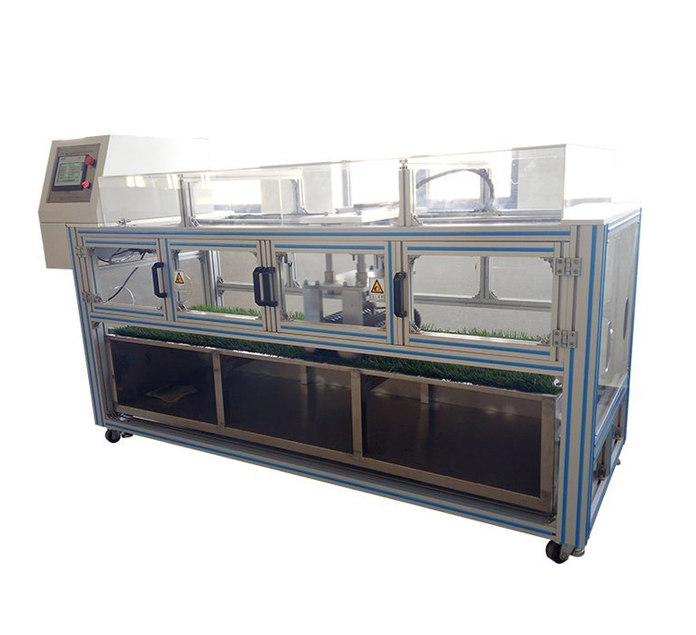
The development of artificial turf abrasion testers is driven by the widespread application of artificial turf in sports and landscaping, along with increasing demands for durability, safety, and performance stability. Key factors include:
Since the mid-to-late 20th century, artificial turf has been widely used in football fields, rugby fields, kindergartens, rooftop landscaping, and more. These applications involve long-term exposure to foot traffic, friction, and environmental conditions, necessitating scientific evaluation of abrasion resistance.
In sports applications, surface friction directly affects athlete performance and safety.
Excessive friction may cause skin injuries
Insufficient friction may reduce traction
Standardized testing equipment is therefore required to simulate real wear conditions.
International organizations such as FIFA, ASTM, and ISO have established clear testing requirements (e.g., FIFA Quality Programme). Manufacturers and testing institutions must use specialized abrasion testers to ensure compliance.
Artificial turf fibers (e.g., PE, PP, PA) degrade under combined effects of UV exposure and mechanical wear. Abrasion testing is often combined with aging tests to predict product lifespan.
Independent testing institutions provide objective performance verification, promoting standardization and wider adoption of abrasion testing equipment.
In summary, the Artificial Turf Abrasion Tester was developed to address real-world wear issues, meet international standards, ensure safety, and extend product lifespan. Its core principle is to simulate friction motion and quantify material mass loss and surface changes.
The Artificial Turf Abrasion Tester is a precision instrument used to evaluate the abrasion resistance of artificial turf. It is widely applied in sports facilities, running tracks, landscaping, and playgrounds.
Its standardized operation ensures reliable and comparable results.
Cut the artificial turf sample into standard shapes and sizes according to ISO, ASTM, or GB/T standards (e.g., circular samples with 108 mm diameter or square samples of 100 mm × 100 mm, typically around 3 mm thick).
Clean the sample surface to remove oil, dust, or contaminants.
Condition the samples in a controlled environment (e.g., 23 ±2°C, 50 ±5% RH) for at least 24 hours.
Select appropriate abrasion wheels based on material properties:
Rubber wheels (e.g., CS-10. CS-17) for elastic turf
Harder wheels (e.g., H-18. H-22) for rigid materials
Apply specified loads (e.g., 250g, 500g, 750g, or 1000g).
Set the turntable rotation speed (commonly 60 or 72 rpm).
Activate and check the dust extraction system before testing to remove debris and prevent secondary abrasion.
Secure the conditioned and pre-weighed sample on the rotating platform, ensuring a flat and stable surface.
Start the tester. The abrasion wheels apply constant load and friction until the preset number of cycles (e.g., 1000 or 5000 revolutions) is reached.
The system stops automatically after completion. Testing can be paused manually if necessary.
After testing, remove the sample and weigh it using a high-precision balance (accuracy 0.1 mg).
Calculate mass loss (mg).
Compute the Taber Wear Index (TWI):
[TWI = \frac{\text{Mass Loss (mg)}}{\text{Number of Cycles}} \times 1000]
Evaluate surface conditions, including:
fuzzing
color fading
fiber breakage
backing exposure
This provides a comprehensive assessment of durability.
After each use, clean the testing area with a soft cloth to remove dust, debris, and any rubber or plastic residues from components such as the abrasion wheels/brushes, loading platform, and sample holders.
Inspect the abrasion wheels or brushes for signs of wear, deformation, or looseness. Replace them when necessary to ensure the accuracy and reliability of test results.
Regularly (e.g., every 3–6 months) apply appropriate lubricant, such as lithium-based grease, to moving parts including guide rails, lead screws, and bearings.
Proper lubrication helps prevent dry friction, maintains measurement accuracy, and avoids mechanical jamming.
Periodically (recommended every 3–6 months), use standard samples or calibration blocks to verify the repeatability and accuracy of test results.
If the equipment is equipped with force sensors or displacement encoders, perform professional calibration according to the manufacturer’s specifications.
Avoid operating the equipment in environments with high humidity, excessive dust, or significant temperature fluctuations, as these conditions may accelerate electronic component aging or cause metal corrosion.
When the equipment is not in use for extended periods, cover it with a dust-proof cover and disconnect the power supply.
Establish a maintenance log to record equipment usage, servicing, calibration, faults, and repairs.
This ensures traceability and supports long-term equipment management and performance consistency.
Using standardized abrasion wheels (e.g., Taber wheels), the tester applies controlled pressure and rotational friction to accurately measure:
mass loss
surface morphology changes
fiber breakage
This ensures highly repeatable and reliable results.
Advanced models support temperature and humidity control, simulating outdoor weather exposure or intensive indoor use conditions, enabling comprehensive durability evaluation.
Modern systems feature:
automatic cycle counting
speed control
real-time parameter monitoring
fault alarms
This reduces human error and improves efficiency and data reliability.
Compatible with ISO, ASTM, DIN, and other standards, ensuring global comparability and facilitating international market access.
High-end systems can combine:
gloss measurement
3D surface analysis
This allows multi-dimensional evaluation of both functional performance and appearance retention.
Helps manufacturers optimize material formulations, including:
fiber selection
tuft density
UV resistance treatments
This extends product lifespan in high-wear environments.
Provides objective performance data for new turf types (e.g., short-pile, bi-color fibers, infill systems), accelerating product development and market introduction.
Enables companies to obtain internationally recognized test reports, improving competitiveness in export markets and large infrastructure projects.
Early-stage material screening helps eliminate low-durability options, reducing maintenance, repair, and replacement costs.
Standardized testing methods establish industry benchmarks, encourage fair competition, and drive continuous technological improvement.
In Conclusion,with the expanding application of artificial turf in sports, landscaping, and other fields, the Artificial Turf Abrasion Tester plays an increasingly critical role in ensuring product quality, driving material innovation, and supporting industry standards.It directly impacts product durability and safety while providing accurate and reliable data that promotes technological advancement and standardization across the entire industry chain.As a result, it has become an essential tool for the sustainable and healthy development of the artificial turf industry.


