A Nano Indenter is a high-precision analytical instrument used to characterize the mechanical properties of materials at the micro- and nanoscale. It operates by pressing a nanoscale indenter tip into the surface of a material and precisely measuring the relationship between applied load and displacement. From this, key mechanical parameters such as hardness, elastic modulus, fracture toughness, creep behavior, and friction coefficient can be obtained.The primary purpose of a Nano Indenter is to accurately characterize material mechanical properties at the nano- to microscale, including hardness, elastic modulus, creep behavior, and fracture toughness. By indenting the material surface with a nanoscale probe and recording real-time load–displacement responses, it enables detailed analysis of mechanical behavior within extremely small material volumes.
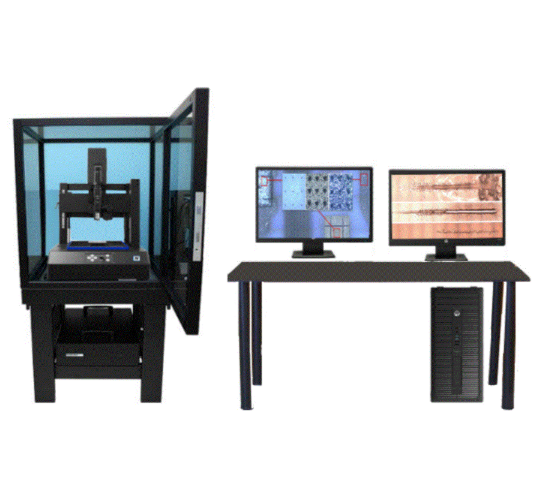
The working principle is based on applying a precisely controlled micro-load to the material surface and recording the displacement response using high-resolution sensors, allowing calculation of mechanical properties such as hardness and elastic modulus. The core principles and steps are as follows:
Basic Principles
Indentation Process:
A diamond indenter (such as a Berkovich tip) is pressed vertically into the material surface. The applied load typically ranges from nanonewtons (nN) to millinewtons (mN).
Load–Displacement Curve Acquisition:
During both loading and unloading, high-precision force and displacement sensors continuously record the load–depth curve, which forms the basis for analyzing material mechanical behavior.
Oliver–Pharr Method:
This widely used mathematical model derives contact stiffness, indentation hardness, and elastic modulus from the unloading curve.
A Nano Indenter is a highly sophisticated scientific instrument designed for in-depth characterization of material mechanical properties at micro- and nanoscale levels. It is widely used in materials science, semiconductor manufacturing, biomedical engineering, and thin-film/coating technologies.
Accurate Measurement of Hardness and Elastic Modulus:
With extremely high sensitivity and a wide measurement range, the instrument is suitable for nearly all solid materials—from ultra-soft materials (such as hydrogels) to ultra-hard materials (such as advanced ceramics and high-strength metals), providing quantitative mechanical data.
Comprehensive Analysis of Thin Films and Coatings:
It is particularly effective for evaluating ion-implanted layers, as well as thin films produced by chemical vapor deposition (CVD) or physical vapor deposition (PVD), including complex multilayer structures. It can measure adhesion strength, wear resistance, and residual stress, which are critical for process optimization.
Investigation of Soft Matter and Biomaterials:
For soft materials such as cells, biological tissues, and hydrogels, the Nano Indenter can detect subtle mechanical responses under conditions that simulate physiological environments. Specialized instruments, such as Piuma nanoindenters, are optimized to address limitations of traditional atomic force microscopy (AFM) or indentation methods, such as signal instability and complex sample preparation.
Evaluation of Fracture Toughness and Interfacial Adhesion:
By analyzing crack lengths generated after indentation or using dedicated scratch testing modes, the instrument enables quantitative assessment of brittle fracture behavior and interfacial adhesion strength between coatings and substrates.
Advanced Dynamic Mechanical Testing:
With modules such as Dynamic Mechanical Analysis (DMA) or Continuous Stiffness Measurement (CSM), the instrument can further evaluate viscoelastic properties across varying loading conditions.
High-Speed Testing and High-Throughput Screening:
Its rapid testing capability makes it well-suited for large-scale quality control and rapid process optimization in industries such as semiconductor manufacturing and coating production.
Exceptional Precision and Ultra-High Resolution:
Displacement resolution can reach as high as 0.01 nm.
Load application ranges from nanonewtons to newtons.
Advanced electromagnetic or electrostatic actuation minimizes lateral displacement, ensuring stable and reliable measurements.
Flexible Modular Design:
Supports multiple testing modes, including scratch testing, high-temperature indentation, DMA, and 3D surface imaging.
Optional modules (e.g., ultra-high precision modules or high-load modules up to 10 N) allow users to expand functionality according to specific needs.
Compliance with International Standards:
Fully compatible with ISO 14577 and other international standards, ensuring high comparability and reliability of test data across laboratories.
Powerful Software Support:
Equipped with professional software such as NanoSuite or InView, enabling real-time control, remote operation, customizable test protocols, and automated batch processing.
Broad Material Applicability:
Suitable for metals, ceramics, polymers, biological tissues, semiconductors, and composite materials.
Specialized systems (e.g., Piuma nanoindenters) are optimized for soft and biological samples.
High Reliability and Repeatability:
Automated testing procedures and advanced control algorithms minimize human error, ensuring highly repeatable results suitable for both research and industrial quality control.
When selecting a Nano Indenter, a comprehensive and systematic evaluation of multiple key factors is essential to ensure the chosen system meets specific research and testing requirements:
Evaluate the manufacturer’s industry experience and ability to provide full-cycle support—from basic operation training to advanced application development. Consider whether customized solutions are available for specialized testing needs.
The instrument’s modular architecture determines its long-term usability and investment value. Compatibility with different probes, modules, and software packages allows adaptation to diverse testing requirements, especially for complex materials such as soft or biological samples.
Carefully review warranty terms, response time, maintenance costs, spare parts availability, and long-term technical support. A clear service agreement reduces operational risks and unexpected costs.
For standard solid samples, surfaces must be well-polished, and sample diameter is typically recommended to be within 25 mm for stable testing.
For soft materials (e.g., biological tissues, hydrogels), proper fixation is required, such as mounting on rigid substrates (e.g., silicon wafers or glass slides) to prevent movement or deformation.
For thin films and coatings, prior knowledge of film thickness, substrate Poisson’s ratio, and elastic modulus is essential for accurate data interpretation.
In summary, the Nano Indenter has become an indispensable tool in modern materials science and micromechanics. Its technical sophistication and broad application value continue to grow.As scientific research and industrial development advance, Nano Indenters will play an increasingly important role in exploring material properties at the microscale, making them essential instruments for both research and industrial applications.Researchers, engineers, and professionals are welcome to visit our official website to obtain more detailed information on instrument principles, technical specifications, application cases, and the latest developments.


