A Nano Indenter is a high-precision scientific instrument specifically designed to characterize the mechanical properties of materials at the micrometer and nanometer scales. The instrument uses a high-precision diamond indenter tip to press into the surface of a test material in a controlled manner while continuously monitoring and recording the applied load and the corresponding indentation depth during both loading and unloading processes.Based on the obtained load–displacement curve, various mechanical models and algorithms can be applied to accurately determine key mechanical parameters such as hardness, elastic modulus, fracture toughness, creep behavior, and stress–strain relationships.
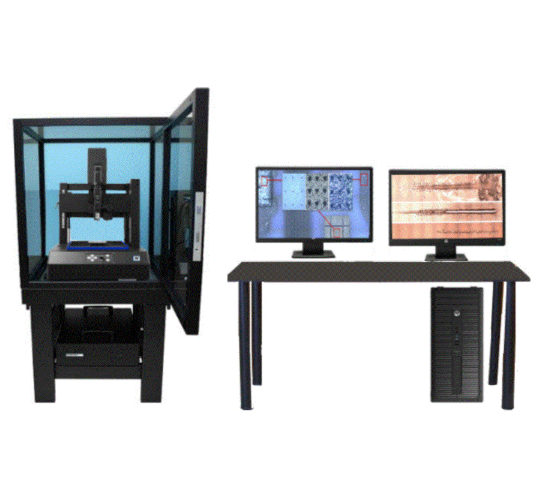
The development of nanoindentation technology was largely motivated by the limitations of traditional macroscopic mechanical testing methods when dealing with small-volume samples, thin films, surface-modified layers, and microelectronic components. Conventional techniques often lack the required resolution, sensitivity, and accuracy for such materials. Nanoindentation therefore enables reliable evaluation and analysis of material mechanical behavior at the micro- and nanoscale.
Before performing nanoindentation testing, the sample must be carefully prepared to ensure that the surface is smooth, flat, and clean, free from oil, dust, or any external contaminants.
If the sample surface exhibits significant roughness or unevenness, mechanical polishing or electrolytic polishing should be performed in advance. This prevents localized stress concentration during indentation, which could otherwise introduce significant deviations in the experimental data.
For thin films or coated samples, particular attention must be paid to the film thickness. The maximum indentation depth should typically not exceed one-tenth of the total film or coating thickness, in order to minimize the influence of the substrate material and ensure the accuracy and representativeness of the measured mechanical properties.
Before formal testing begins, the nanoindenter must undergo systematic calibration. A reference material with stable mechanical properties—commonly high-purity single-crystal silicon—is typically used as the calibration standard.
The calibration process mainly includes:
Calibration of the indenter area function
Verification of displacement sensor accuracy
These steps ensure that the applied load and indentation depth measurements remain accurate and reliable during subsequent experiments.
The prepared sample is placed steadily on the instrument stage and firmly secured using vacuum suction or specialized mechanical clamps.
Proper fixation prevents sample movement or vibration during indentation, which could otherwise affect the repeatability and accuracy of the experimental results.
Within the instrument control software, an appropriate testing mode should be selected according to the experimental requirements. Commonly used methods include:
Oliver–Pharr method
Continuous Stiffness Measurement (CSM) mode
The main parameters that must be configured include:
Maximum indentation load
Typically between 50 μN and 5000 μN, depending on the hardness of the tested material.
Maximum indentation depth
This should generally not exceed one-tenth of the sample thickness or coating thickness.
Other parameters such as:
Loading rate
Unloading rate
Holding (dwell) time
must also be properly configured based on the viscoelastic properties of the material and the experimental objectives.
Once the test program is started, the instrument automatically performs the full indentation cycle, which includes:
Loading phase
Holding phase
Unloading phase
During the process, the system continuously records load and displacement data, generating a complete load–displacement curve.
If multiple measurements are required, an indentation point array can be predefined within the software. The system will then automatically perform sequential indentation tests at each position, significantly improving testing efficiency.
After the test is completed, the system automatically calculates key mechanical parameters such as hardness and elastic modulus using the Oliver–Pharr model.
Users can generate a detailed test report, and export the data in commonly used formats such as Excel or PDF for further analysis and processing.
The core technological advantages of nanoindentation systems lie in their exceptional measurement precision, multifunctional capabilities, highly automated operation, and wide material applicability.
Nanoindenters can achieve a displacement resolution better than 0.01 nm and a load resolution as low as 50 nN, providing significant advantages for investigating material mechanical behavior at the nanoscale.
For example, the KLA G200/G200X series instruments can perform micro-load tests as low as 50 μN, with measurement repeatability deviations controlled within 2%, outperforming many competing instruments on the market.
Nanoindenters are capable of testing a broad range of materials, from ultra-hard thin films (such as diamond-like carbon coatings and multilayer composite films) to soft materials (such as polymer hydrogels and biological tissues).
For instance, the Piuma series nanoindenters are specifically designed for soft materials and can measure materials with Young’s modulus ranging from 5 Pa to 5 GPa, demonstrating remarkable versatility.
Nanoindentation systems support a wide range of mechanical testing functions, including:
Hardness and elastic modulus measurement
Creep and strain-rate sensitivity analysis
Fracture toughness evaluation based on crack propagation
Interfacial adhesion strength and friction coefficient testing using scratch modules
Viscoelastic and dynamic modulus characterization using Dynamic Mechanical Analysis (DMA) or Continuous Stiffness Measurement (CSM)
Modern nanoindenters feature fully automated positioning and calibration functions, providing one-click standardized testing procedures that significantly reduce human-induced errors.
Professional analysis software packages such as NanoSuite and InView can automatically generate testing reports compliant with ISO 14577 and GB/T 22458 standards. These systems also support one-click export of results in Excel or PDF formats, greatly improving data processing efficiency.
The G200 series includes an Express Test mode, capable of completing up to 100 test points within 100 seconds, significantly improving experimental efficiency.
Its modular design also allows users to flexibly add optional modules such as:
High-temperature testing
Scratch testing
Scanning Probe Microscopy (SPM) imaging
This enables continuous instrument upgrades and expanded functionality.
The future development of nanoindentation technology is mainly focused on higher precision, multifunctionality, intelligent operation, and domestic manufacturing advancement.
In terms of technical performance, instrument resolution continues to improve. Current systems have achieved:
Load resolution at the nanonewton level (≤3 nN)
Displacement resolution better than 0.002 nm
Thermal drift rates as low as ≤0.02 nm/s
These improvements allow for more stable and precise micro- and nanoscale mechanical testing.
At the same time, the testing range continues to expand, enabling reliable measurement of both:
Ultra-soft materials (e.g., hydrogels and biological tissues)
Ultra-hard materials (e.g., DLC coatings and ceramics)
In terms of applications, nanoindentation technology is increasingly used in:
Semiconductor device reliability evaluation
Biological soft material research
Extreme-environment materials for aerospace and nuclear engineering
Regarding system integration and intelligent operation, nanoindenters are gradually being integrated with instruments such as:
SEM (Scanning Electron Microscopy)
TEM (Transmission Electron Microscopy)
AFM (Atomic Force Microscopy)
Raman spectroscopy
High-speed testing and automated array measurements further improve experimental efficiency. Meanwhile, software platforms are introducing remote control and AI-based data analysis, and future developments may use machine learning to optimize testing parameters and predict results.
In addition, with the improvement of ISO and national standard systems, along with technological breakthroughs by domestic manufacturers, the localization of nanoindenter technology is accelerating.
Overall, nanoindenters will continue to evolve toward higher precision, stronger integration, and greater intelligence, becoming an increasingly important tool in materials science and micromechanics research.


