In the textile and apparel industry, material durability and appearance stability are key indicators for evaluating fabric quality. In daily life, consumers not only care about comfort and color vibrancy, but also pay close attention to how garments wear over time and whether they are prone to pilling. As a result, abrasion resistance testing and pilling resistance testing have become standard evaluation items in textile testing.
Although both abrasion testing and pilling testing involve friction, their purposes, principles, test methods, and result interpretations are fundamentally different. This article explains these differences from multiple perspectives to help readers gain a comprehensive understanding of the two tests and their roles in textile testing and quality control.
Textile quality testing typically includes a wide range of performance evaluations, such as tensile strength, tear strength, breaking strength, color fastness, and air permeability. Among these, abrasion resistance and pilling resistance fall under surface performance evaluation and directly reflect how materials change when subjected to friction during use.
Consumer concern about abrasion and pilling mainly comes from real-life usage experiences. Areas such as the knees of sportswear, upholstery fabrics on armrests, carpets, and shoe linings are all prone to quality issues caused by repeated friction. Therefore, abrasion testing and pilling testing are indispensable indicators in material evaluation.
Definition and Nature
Abrasion testing is used to evaluate a fabric’s ability to resist wear and damage under frictional or abrasive conditions. Simply put, it simulates the gradual surface wear that occurs when a material repeatedly rubs against other objects during everyday use.
Abrasion resistance does not merely refer to pilling. Instead, it focuses on the loss of fibers and yarns, breakage, thinning, or structural damage to the material. It reflects the overall durability of the fabric. During testing, if repeated friction causes yarn breakage or holes to appear, the fabric is considered to have poor abrasion resistance.
Depending on the mode and location of friction, abrasion can be categorized into flat abrasion, edge abrasion, and flex abrasion.
Purpose of Abrasion Testing
The primary objectives of abrasion testing are to:
Evaluate a fabric’s ability to withstand friction during actual wear or use
Predict the service life of materials
Quantify wear resistance through abrasion cycle counts to support material selection
Assist material improvement, such as choosing higher-strength fibers or optimizing yarn structures
Abrasion test results are widely used to guide material selection for clothing, upholstery, and industrial textiles, and they play a critical role in determining long-term durability.
Typical Methods and Equipment
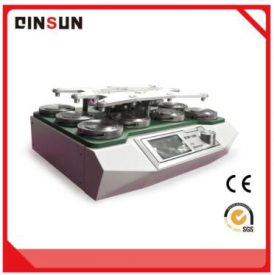
One of the most commonly used methods for abrasion testing is the Martindale abrasion test. This method uses a specialized tester to rub the specimen against a standard abrasive surface under a specified pressure for a set number of cycles, simulating long-term friction during use.
The Martindale abrasion tester produces a Lissajous motion pattern. The number of cycles at which visible wear, yarn breakage, or holes appear is recorded. A higher number of cycles indicates better abrasion resistance.
During testing, the specimen is usually rubbed against a rough standard fabric along a defined motion path until a specified damage level is reached. Test parameters such as speed, pressure, and motion pattern can be adjusted according to material characteristics and relevant standards to suit different textile applications.
Definition and Nature
Pilling refers to a surface phenomenon in which fibers loosen, entangle, and form small ball-like structures due to friction. Unlike abrasion damage, pilling is a surface appearance issue rather than a direct loss of material integrity. It is often caused by short fibers in yarns and repeated friction during wear or laundering.
Pilling commonly occurs on areas subject to frequent rubbing, such as shoulders, backs, side seams, cuffs, or during washing processes where mechanical action is intense.
Purpose of Pilling Testing
Pilling testing is mainly intended to:
Evaluate a fabric’s resistance to pilling
Predict appearance retention during actual wear and use
Assess the bonding strength and compactness between fibers and yarns
Serve as a key indicator of garment appearance durability
Although pilling does not necessarily mean structural failure, visible pills significantly affect appearance and consumer perception. Therefore, pilling resistance is a critical quality indicator for textiles.
Methods and Standards for Pilling Testing
Common pilling test methods include the Martindale pilling test and random tumble pilling tests. In the Martindale pilling test, specimens are rubbed against each other or against a standard soft fabric for a fixed number of cycles. The surface is then visually assessed and graded using standard photographic references.
Compared with abrasion testing, pilling testing differs in friction media and testing mode:
Abrasion testing uses rough standard surfaces to simulate long-term wear
Pilling testing typically uses soft fabrics or identical materials to encourage fiber protrusion and entanglement
Results are usually rated on a scale from 1 to 5. where Grade 5 indicates almost no pilling and Grade 1 indicates severe pilling.
Pilling testing considers not only the fabric itself but also factors such as fiber length, yarn structure, and finishing processes, rather than simply measuring surface material loss.
Different Testing Objectives
Abrasion testing focuses on a fabric’s ability to resist fiber loss, breakage, and holes under sustained friction, reflecting structural durability.
Pilling testing focuses on whether friction causes the formation of small fiber balls on the surface, reflecting appearance durability and fiber entanglement behavior.
Although both involve friction, abrasion testing evaluates material damage, while pilling testing evaluates surface appearance change.
Different Principles and Friction Conditions
Abrasion testing usually involves long-duration friction against rough or standardized abrasive surfaces to observe damage progression and failure points. Pilling testing, on the other hand, uses softer surfaces or fabric-to-fabric contact to simulate fiber migration, protrusion, and entanglement during actual wear.
Abrasion testing generally requires higher friction forces and longer cycle counts, while pilling testing emphasizes localized friction over shorter periods.
Differences in Equipment Configuration
Although both tests often use Martindale abrasion and pilling testers, the test modes and configurations differ. The same machine can be configured with different motion settings, friction heads, and abrasive materials.
In abrasion mode, longer travel distances and rough abrasives are used to measure destructive wear. In pilling mode, shorter motions and softer materials are used to promote pill formation.
Different Evaluation Metrics
Abrasion resistance is typically expressed in terms of the number of cycles endured before holes appear or a specified wear level is reached.
Pilling resistance is evaluated using grade ratings, usually on a 1–5 scale.
It is possible for a fabric to show excellent abrasion resistance while still being prone to pilling, due to loose surface fibers.
Different Application of Test Results
Abrasion test results are commonly used to assess suitability for high-friction, long-term applications such as workwear, denim, upholstery fabrics, and carpets. A high abrasion rating indicates longer structural durability.
Pilling test results are more relevant to appearance-focused products such as sportswear, knitwear, and fashion fabrics, where short-term surface appearance is a major consumer concern.
To fully understand the differences between these two tests, material properties must also be considered:
Fiber Type and Length
Short fibers are more likely to break and protrude during friction, increasing pilling risk, while longer fibers generally improve abrasion resistance.
Yarn Structure and Fabric Construction
Fabrics with higher density and tighter yarn structures typically show better abrasion resistance and reduced fiber looseness, helping to minimize pilling.
Fiber-to-Fiber Bonding Strength
Stronger bonding between fibers improves resistance to both abrasion and pilling.
Finishing Processes and Anti-Pilling Treatments
Some fabrics undergo anti-pilling finishes that improve pilling resistance, but these treatments do not necessarily enhance abrasion resistance, as the mechanisms differ.
Overall, abrasion testing and pilling testing are two fundamentally different performance evaluations in textile testing. Although both involve friction, they differ significantly in purpose, method, principle, equipment configuration, and evaluation criteria.
Abrasion testing focuses on a material’s ability to resist damage and structural failure under friction.
Pilling testing focuses on the tendency of surface fibers to form small balls under friction.
In product design, material selection, and quality control, both indicators play important roles. Abrasion resistance determines product durability, while pilling resistance affects long-term appearance. Understanding the differences between these two tests is valuable not only for manufacturers, but also for consumers seeking to better evaluate textile quality.


