Abrasion resistance is a key physical property that measures a material’s ability to resist surface wear under friction and abrasive conditions. In engineering applications, material development, quality control, and safety evaluation, abrasion resistance testing reflects a material’s performance and lifespan under real-world conditions. Whether for plastics, rubber, coatings, concrete, or textiles, testing abrasion resistance is an essential part of assessing durability. This article provides a systematic overview of the principles, methods, standards, and result interpretation of abrasion resistance testing.
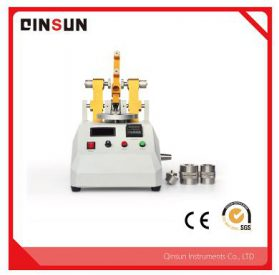
Abrasion resistance refers to a material’s ability to withstand mechanical wear and frictional damage. When a material contacts another surface during use, frictional and shear forces may cause surface wear, particle loss, or changes in morphology. Testing abrasion resistance can reveal the material’s durability and suitability under frictional conditions.
The main purposes of abrasion resistance testing are:
Evaluate how well a material withstands friction and wear.
Compare wear performance between different materials.
Support material development and formulation optimization.
Serve as a basis for product quality control and industry standard compliance.
Abrasion resistance is commonly quantified using parameters such as wear volume, mass loss, depth of wear, or coefficient of friction. High abrasion resistance indicates that a material is less likely to wear or fail during its service life.
The core principle of abrasion resistance testing is to simulate actual wear under controlled friction conditions. The test involves moving the sample relative to a standard abrasive, grinding wheel, sandpaper, or other friction surface. Wear indicators are measured under specific cycles or loads, and material performance is assessed based on the amount of wear.
Common testing approaches include:
Fixed sample, moving abrasive.
Fixed abrasive, moving sample.
Opposing movement of sample and abrasive under a specified pressure.
Tests can be conducted under dry or lubricated conditions depending on the material type and testing standard.
Testing methods vary depending on the material, application, and standard requirements. The most widely used methods include:
Taber Abrasion Test
Principle: Uses a Taber abrasion tester equipped with two pairs of abrasive wheels. Constant pressure and rotational speed are applied as the wheels rotate over the sample surface, simulating wear during use. Mass loss or surface change is measured after the test.
Applications: Plastics, coatings, textiles, leather, rubber, and other flat materials. Results typically include worn area, mass loss, or abrasion classification.
Advantages: Controlled conditions, reproducible results, suitable for comparing different materials.
Rotating Cutter Method
Principle: Used for concrete or mortar testing. A rotating cutter continuously abrades the surface, and wear depth or weight loss is measured. Commonly applied in evaluating concrete durability for pavements and flooring.
Plastic Material Abrasion Tests
Standards such as ASTM D1242 recommend methods including:
Olsen Abrader: Loose abrasive (e.g., aluminum oxide sand) on a rotating disk abrades the sample.
Continuous Belt Abrasion: Sample moves under sandpaper at constant speed to simulate wear.
These methods assess plastic sheets or plates for durability under friction.
Rubber Abrasion Tests
Rubber products are often tested using rotating drum abrasers (e.g., ASTM D5963). Rubber samples are mounted on a rotating drum covered with abrasive cloth, and wear resistance is evaluated based on volume loss or abrasion index.
Organic Coating Abrasion Tests
For paints and coatings, common methods include:
Taber Abrasion (ASTM D4060): Evaluates coating wear using rotating wheels.
Falling Abrasive (ASTM D968): Abrasive particles fall from a height onto the sample, and wear is measured.
Metal Abrasion Tests
Methods such as ASTM G65 use dry sand/rubber wheel abrasion. An abrasive is pressed against a metal sample by a rotating rubber wheel, and wear is measured by mass or volume loss. Suitable for heavy-duty parts like mining or construction machinery.
Textile Abrasion Tests
Textile durability is evaluated using Martindale (ISO) or Wyzenbeek (ASTM D4157) methods. Fabric is rubbed repeatedly against an abrasive surface under a specified pressure, and the number of cycles to reach a defined wear endpoint is recorded as the abrasion index.
Although specific steps vary, the typical workflow includes:
Sample Preparation: Cut samples to specified dimensions, ensure flat, defect-free surfaces, and mount in fixtures as required.
Equipment Setup: Install the sample in the testing machine, adjust wheels, sandpaper, or abrasive containers, and set parameters such as load, speed, and cycles according to standards.
Conduct Test: Run the machine, ensuring relative motion between sample and abrasive. Instruments may record cycles, speed, or wear depth continuously.
Record Wear Data: Measure mass loss, wear depth/area, or calculate volume loss. Friction coefficient may also be recorded for multi-cycle tests.
Analysis and Evaluation: Compare results to standard limits. For example, in Taber testing, wear amount determines durability grade; in ASTM G65. mass loss indicates metal part wear resistance ranking.
Common metrics for abrasion resistance include:
Mass Loss: Difference in sample weight before and after testing.
Volume Loss: Calculated from cross-sectional measurements or geometry.
Wear Depth or Area: Measured using optical or mechanical instruments.
Abrasion Cycles: Number of cycles required to reach a defined wear endpoint (commonly for textiles).
Higher abrasion resistance corresponds to lower mass/volume loss, shallower wear depth, or higher cycle count.
Soft materials (rubber, textiles, coatings): Taber abrasion, drum abrasion, or fabric rubbing tests.
Hard materials (metals, concrete): Dry sand/rubber wheel or rotating cutter methods.
Plastics and composites: Rotating disk or sandpaper abrasion methods.
Factors affecting test results include:
Consistency of test parameters: Load, speed, and cycles must be controlled.
Sample preparation: Surface defects or roughness affect wear.
Abrasive type and particle size: Hardness and size influence wear.
Environmental conditions: Humidity and temperature may impact results.
Strict adherence to standard procedures and proper calibration is essential.
Abrasion resistance testing is a fundamental method to evaluate material durability. Best practices include:
Clarifying applicable standards and requirements.
Selecting methods suited to material type and application.
Controlling test parameters and environmental conditions.
Analyzing results scientifically to guide material selection or optimization.
With ongoing advances in materials science and testing technologies, international organizations like ASTM and ISO continue to refine abrasion testing standards, providing reliable support for engineering, product design, and quality control.
.


