Abrasion testing is a critical performance evaluation method in materials science and engineering, used to assess a material’s durability, wear resistance, and service life under conditions of friction, rubbing, impact, or erosion. Across industries such as textiles, coatings, rubber, plastics, metals, and construction materials, various abrasion tests provide essential data for material selection, product development, quality control, and compliance verification.
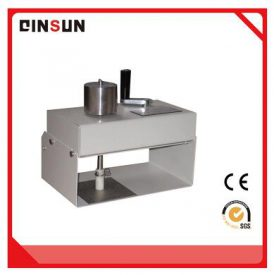
Understanding the types, principles, and appropriate applications of abrasion tests helps engineers and laboratory technicians select the most suitable testing method to ensure material reliability under real-world conditions.
Abrasion refers to the gradual loss, deformation, or failure of a material’s surface due to mechanical action. Abrasion testing simulates the wear conditions a material experiences in real use, using standardized and reproducible experimental methods to measure wear resistance and failure behavior under specified conditions. This allows for comparison between different materials or between the same material under different treatments.
The importance of abrasion testing includes:
Quality control and compliance: Ensuring materials and products meet industry-defined wear resistance standards.
Material design and optimization: Evaluating new or modified material formulations for performance under wear conditions.
Product life prediction: Using experimental data to estimate service life under actual operating conditions.
Engineering safety and reliability assessment: Preventing performance failure or safety hazards in high-durability applications, such as transportation infrastructure, heavy machinery, or flooring materials.
Before exploring specific testing methods, it is important to understand common forms of wear:
Sliding wear: Occurs when two surfaces slide against each other, gradually removing material from the contact area.
Rolling wear: Occurs in rolling contact surfaces, such as wheels, shafts, or bearings.
Impact wear: Material breaks or detaches due to particle or solid impacts.
Corrosive wear: Wear occurs simultaneously with chemical corrosion.
Different wear mechanisms require different testing approaches. For example, testing for continuous sliding friction differs significantly from testing under abrasive particle impingement.
Taber Abrasion Test
Principle: The Taber abrasion test uses a dual-wheel abrader to rotate against a sample surface. The wheels repeatedly apply friction to simulate cyclic wear conditions.
Process:
The sample is mounted on a rotating platform.
Two abrasive wheels apply controlled pressure at a set speed.
After a set number of rotations, material loss is measured by weight change or surface damage observation.
Applicable materials: Plastics, coatings, paints, wood, textiles, leather, and more.
Characteristics: Provides standardized, quantitative data on weight or thickness loss, enabling comparison of wear resistance.
Dry Sand/Rubber Wheel Abrasion Test (ASTM G65)
Principle: A rubber wheel rotates against a sample with dry sand as an abrasive, simulating three-body wear conditions.
Process:
The sample is mounted on a platform.
A measured amount of sand is introduced between the rubber wheel and the sample.
The wheel rotates, causing abrasion between the sample, wheel, and sand.
Weight or volume loss is measured to assess wear resistance.
Applicable materials: Metals, hard alloys, wear-resistant coatings, and heavy-duty components.
Characteristics: Simulates three-body wear, widely used in mining, machinery, and agricultural equipment.
Martindale Abrasion Test
Principle: Evaluates textiles under repeated friction along multi-directional paths to simulate wear in daily use.
Process:
Fabric samples are mounted and subjected to repeated rubbing until noticeable wear occurs.
Results are expressed as the number of abrasion cycles or broken yarns; higher numbers indicate better wear resistance.
Applicable materials: Apparel fabrics, upholstery, carpets, home textiles.
Characteristics: Multi-directional motion closely replicates real-world textile wear conditions.
Falling Sand Abrasion Test
Principle: Assesses surface material or organic coating durability by dropping abrasive particles (e.g., sand or silicon carbide) from a specific height to impact the sample surface, simulating natural particle erosion.
Process:
Samples are weighed or measured for thickness/depth before and after exposure to falling particles.
Standard methods include sand or silicon carbide as the abrasive medium.
Applicable materials: Organic coatings, paints, exterior wall materials.
Characteristics: Simulates particle impact and erosion in environments such as windblown sand exposure.
Reciprocating Linear Abrasion Test
Principle: The sample is subjected to repeated linear motion against an abrasive head, simulating wear in straight-line friction applications (e.g., rails, guides, sliding blocks).
Applicable materials: Metal components, plastics, mechanical sliding surfaces.
Characteristics: Better replicates real linear wear conditions compared to rotational abrasion methods.
Sand/Slurry Abrasion Test
Principle: Evaluates material resistance to impact and erosion from high-velocity abrasive particle flow, often in wet or slurry conditions.
Applicable materials: Road surfaces, pipelines, mining equipment.
Metals and Hard Alloys:
Dry Sand/Rubber Wheel (ASTM G65)
Los Angeles (LA) Abrasion Test for aggregates
Reciprocating and impact wear tests
Coatings and Surface Materials:
Taber Abrasion Test
Falling Sand Abrasion Test (ASTM D968)
Reciprocating linear wear tests
Textiles and Flexible Materials:
Martindale Test
Wyzenbeek Test (reciprocating textile abrasion)
Rubber and Elastomers:
Rotary Drum Abrader (ASTM D5963)
Pico Abrasion Test
Material weight loss: Difference in sample weight before and after testing; smaller loss indicates higher wear resistance.
Number of wear cycles: Common in textiles and flexible materials to quantify durability.
Surface damage assessment: Visual evaluation of surface wear, cracking, fuzzing, or other defects, often graded using standardized scales.
Abrasion testing methods vary according to material type and wear conditions, providing standardized data to evaluate material performance under friction, impact, or particle erosion. Common methods include:
Taber Abrasion Test
Dry Sand/Rubber Wheel Test
Martindale Textile Abrasion Test
Falling Sand Abrasion Test
Reciprocating Linear Abrasion Test
Sand/Slurry Abrasion Test
Rubber/Elastomer Specific Tests
Selecting an appropriate wear test based on material type, operating conditions, and industry standards is crucial for material development, product quality control, and performance evaluation.


