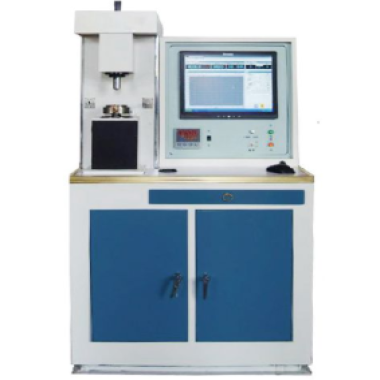
Within the massive structures of industrial machinery, thrust bearings function like hardworking “joints,” specifically designed to withstand substantial axial loads. Whether supporting the enormous blades of a wind turbine or operating inside a high-speed aircraft engine, a thrust bearing can cause anything from equipment downtime to serious safety accidents if it becomes worn or fails.To ensure that these critical components are sufficiently durable, engineers use specialized equipment known as a Thrust Bearing Rolling Friction and Wear Testing Machine. It acts like a “comprehensive health check” for bearings, allowing various extreme operating conditions to be simulated in the laboratory and potential problems to be identified before they occur in actual service.
Many people assume that a bearing will be less likely to fail as long as it has sufficiently high hardness. In reality, this is not necessarily the case. Wear is a complex physical and chemical process that can occur in several forms, mainly including the following:
1. Fatigue Wear
Just as repeatedly bending a metal wire can eventually cause it to break, bearings subjected to cyclic loads may develop microscopic cracks on their surfaces. These cracks can gradually propagate and ultimately cause material to flake off, resulting in pitting and spalling.
2. Abrasive Wear
If dust, metal particles, or other hard contaminants enter the bearing, they can act like sandpaper, continuously scratching and removing material from the contact surfaces.
3. Adhesive Wear
When lubrication is insufficient or the applied load is excessive, metal surfaces may come into direct contact and locally bond together. As the surfaces move relative to each other, these bonded areas can be torn apart, causing material transfer and surface damage.
Through testing with a Thrust Bearing Rolling Friction and Wear Testing Machine, engineers can quantitatively evaluate the extent and characteristics of wear. The resulting data can be used to optimize material formulations, improve lubrication methods, and ultimately extend bearing service life.
The core principle of the Thrust Bearing Rolling Friction and Wear Testing Machine is “realistic simulation.” The machine mainly consists of the following systems:
1. Loading System
The loading system simulates the axial thrust that a bearing actually experiences during operation. Hydraulic or pneumatic mechanisms are used to apply a precisely controlled normal load, which can range from several newtons to tens of thousands of newtons, depending on the equipment configuration and test requirements.
2. Drive System
The drive system generates relative motion between the bearing and the test specimen. Depending on the test requirements, the motion can be either rotational or reciprocating linear motion, thereby simulating the rolling friction conditions encountered during actual operation.
3. Sensing and Data Acquisition System
This system serves as the “eyes and brain” of the testing machine. High-precision sensors continuously monitor parameters such as friction force, temperature, and vibration in real time, while the data acquisition system processes the measured signals and calculates key performance indicators such as the coefficient of friction and wear rate.
4. Environmental Control System (Optional)
Advanced models can also simulate special operating environments, such as high temperature, vacuum, humidity, or corrosive gases, enabling the performance and durability of bearings to be evaluated under extreme conditions.
Test Procedure
Step 1: Install the Specimen
Mount the thrust bearing or simulated friction pair securely onto the appropriate fixture.
Step 2: Set the Test Parameters
Set the required load, rotational speed, test duration, temperature, and other relevant parameters according to the test method.
Step 3: Start the Test
Start the machine and allow the test system to operate under the specified conditions, simulating the actual working process of the bearing or friction pair.
Step 4: Analyze the Test Data
After the test is completed, evaluate the wear resistance of the bearing by analyzing parameters such as mass loss, changes in surface morphology, friction coefficient, and wear rate. The results can be used to assess the material’s wear performance and provide a basis for improving bearing materials, lubrication methods, and service life.
Based on extensive data collected through testing, several factors have been found to have a particularly significant impact on the wear of thrust bearings. These factors interact with one another and collectively determine the service performance and operating life of a bearing under actual working conditions.
1. Material Properties
Higher hardness does not necessarily mean better performance. Hardness and toughness must be properly balanced. Excessively hard materials are often more brittle and may be prone to spalling or fracture under impact loads, while materials that are too soft may have insufficient resistance to plastic deformation.
Surface roughness also needs to be appropriately controlled. A surface that is excessively smooth may have difficulty retaining lubricant and forming an effective lubricating film, whereas an excessively rough surface generates greater frictional resistance. Frequent contact between surface asperities can accelerate the wear process.
2. Lubrication Conditions
A properly formed lubricating film can completely separate the metal surfaces, creating a fluid friction condition. Under such conditions, the coefficient of friction is extremely low and wear is minimal.
Once the lubricating film breaks down and the contact enters a boundary lubrication or dry friction regime, direct contact between metal surfaces occurs. The wear rate can then increase sharply and may even lead to scuffing or adhesive seizure.
3. Load and Speed
Excessive load can cause stress concentrations at the contact surfaces, resulting in fatigue cracks in the material’s surface layer. As these cracks gradually propagate, fatigue wear is accelerated.
Excessive speed, on the other hand, can lead to the accumulation of frictional heat and a rapid increase in temperature. This may reduce the viscosity of the lubricant and cause the lubricating film to become thinner, ultimately resulting in lubrication failure.
4. Cleanliness
Contamination caused by inadequate sealing is one of the major causes of abrasive wear. When hard particles enter the friction pair, they act as abrasives between the contacting surfaces, scratching the surfaces and damaging the lubricating film. This can significantly accelerate the wear process and shorten the service life of the bearing.
This type of testing machine is used not only for quality inspection of finished bearings, but also plays an important role in various technical processes. It is an indispensable testing method throughout the R&D, evaluation, and quality assurance lifecycle of bearings.
1. New Material Development
The machine can be used to evaluate the wear resistance of new materials, including ceramics, composite materials, and surface coatings such as diamond-like carbon (DLC) coatings. By simulating actual friction and wear conditions, engineers can assess the wear performance of new materials under specific loads, speeds, and lubrication conditions, providing reliable data to support their engineering application and commercialization.
2. Lubricant Selection
The testing machine can be used to compare the protective performance of lubricants with different brands and viscosities. Under identical operating conditions, parameters such as wear amount, coefficient of friction, and lubricant film condition can be measured to systematically evaluate the friction-reducing and anti-wear performance of different lubricants. This helps identify the most suitable lubrication solution for a specific application.
3. Failure Analysis
When abnormal bearing wear occurs during actual operation, the testing machine can help identify the underlying cause by reproducing the relevant operating conditions. Actual operating parameters can be replicated on the test machine, allowing engineers to observe the evolution of wear morphology and determine whether the failure was caused by insufficient lubrication, overloading, contamination, material defects, or other factors. The findings can then provide a basis for subsequent product and process improvements.
The Thrust Bearing Rolling Friction and Wear Testing Machine serves as a bridge between theoretical design and engineering practice. By replacing empirical assumptions with scientific test data, it enables engineers to identify and address potential wear-related problems before a product enters the market.With the continued development of smart manufacturing, future testing machines are expected to become increasingly intelligent, with capabilities such as real-time condition monitoring and remaining useful life prediction. These advances will provide even stronger support for the safe and reliable operation of industrial equipment.


