The Metal Ring-and-Block Friction and Wear Tester is a laboratory testing machine designed to evaluate the friction and wear performance of metallic materials. It simulates sliding contact between a ring and a block under controlled loads, speeds, and conditions, measuring parameters such as friction force, coefficient of friction, wear volume, and torque. The machine is widely used in materials research, quality control, and tribology studies to assess material durability and surface behavior.
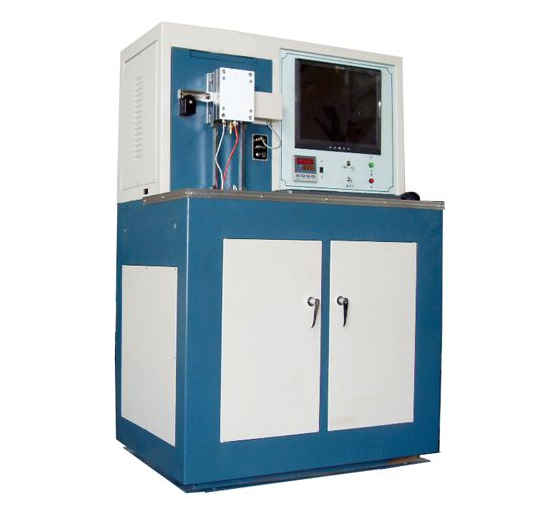
This friction and wear tester is designed and manufactured in accordance with the national standard GB/T 12444-2006 “Test Method for Sliding Wear of Metal Materials – Ring-and-Block Test Method” and fully complies with this standard.
Applications
Material Evaluation: Determine friction coefficients and wear rates of metals and alloys.
Lubricant Testing: Assess performance of oils, greases, and solid lubricants under sliding conditions.
Surface Treatment Assessment: Evaluate coatings, plating, and surface-hardened layers for durability.
Mechanical Component Testing: Simulate real-world contact conditions for bearings, gears, and other metal parts.
Research and Development: Support tribology studies, material optimization, and failure analysis.
Quality Control: Ensure consistency and reliability of metal products in manufacturing.
High-Temperature and Extreme Conditions: Test performance under controlled temperature, humidity, or corrosive environments.
The Ring-and-Block Friction and Wear Tester mainly consists of the following components:
Machine base and frame
Drive spindle with AC servo drive system
Friction pair and specimen clamping device
Test force loading device
Electronic measurement systems for various test parameters
Computer with data acquisition board and dedicated control software
| Parameter | Specification |
|---|---|
| Normal force load range | 20–2000 N, steplessly adjustable |
| Test force accuracy | better than ±1% |
| Long-term automatic force holding relative error | ≤±1% FN |
| Test force zeroing error | ≤±1% FN |
| Loading system | automatic |
| Spindle speed range | 5–3000 r/min, steplessly adjustable |
| Speed control accuracy | ≤±2 r/min |
| Test cycle (revolutions) range | 1–10⁹, freely settable |
| Test time range | 1–9999 s (min) |
| Temperature control range | ambient to 300°C |
| Additional features | Automatic force loading, stepless force adjustment, spindle speed controlled via AC servo motor, real-time display of force, friction, speed, revolutions, time, and plotting of curves |
| Test conditions | dry friction or lubricated (oil) conditions available |
| Force control | computer-controlled, automatic loading |
| Data processing | Dedicated control system with computer for full control and real-time display of all parameters, automatic plotting and recording of friction force–time, coefficient of friction–time, temperature–time curves, and report generation; operators can set all parameters via computer interface |
| Friction pair | ring-and-block |
| Power supply | 220 V, 50 Hz |
| Ring dimensions | Outer diameter 49.22±0.5 mm, thickness 13.06 mm, width 10 mm; coaxiality deviation of outer to inner surface <0.01 mm; surface roughness Ra ≤0.4 (or customized to user samples) |
| Block specimen size | 19.05 × 12.32 × 12.32 mm (or according to user sample) |
| Software | free debugging, lifetime free upgrades |
| Friction force load sensor | max 300 N |
| Maximum measured friction torque | 5 N·m |
| Tester dimensions | 780 × 980 × 1610 mm |
| Tester weight | approximately 400 kg |
(1)Test Rings and Blocks: Standardized metal specimens for friction and wear measurements.
(2)Load Weights or Springs: Apply precise normal forces on the contact surfaces.
(3)Lubricant and Sample Holders: For testing under lubricated conditions or securing samples.
(4)Torque Sensor/Force Transducer: Measures frictional force accurately.
(5)Data Acquisition System: Collects and records friction coefficient and wear data.
(6)Cooling or Heating Units: Maintain desired test temperatures for high- or low-temperature studies.
(7)Software: Configures test parameters and analyzes results.


