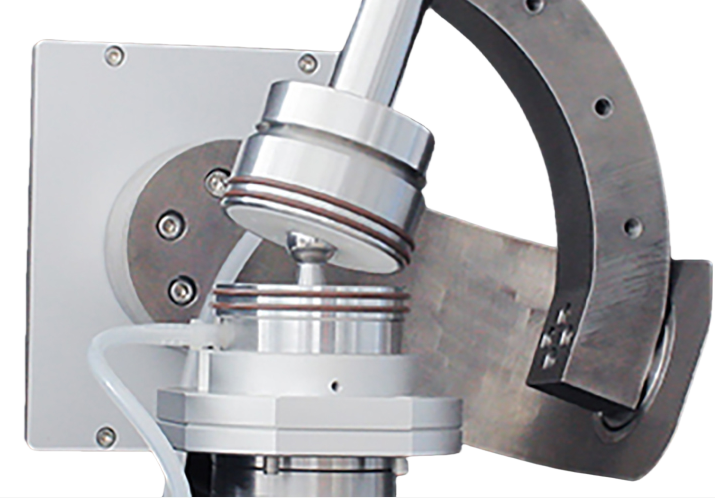
The Total Hip Prosthesis Wear Testing Machine is a specialized laboratory device used to simulate the mechanical motions and loading conditions of the human hip joint. It evaluates the wear resistance, durability, and longevity of total hip replacement implants under repetitive movement cycles, helping assess the implant’s performance and predict its lifespan in vivo.
(1)YY/T 0651.1
(2)ISO 14242-1
These standards specify the relative angular motion between joint components, test loading patterns, test speed and duration, specimen assembly, and test environment requirements for wear testing of total hip prostheses.
The Total Hip Prosthesis Wear Testing Machine is designed to simulate the in vivo mechanical conditions of hip implants and evaluate their wear performance over time. Key applications include:
Implant durability testing: Assess wear resistance and friction behavior of femoral heads, acetabular cups, and total hip components.
Material comparison: Evaluate different materials and coatings for reduced wear and improved longevity.
Quality control: Ensure hip prostheses meet mechanical and wear standards before clinical use.
Research and development: Optimize implant design, articulation geometry, and lubrication strategies.
Standards compliance: Perform tests according to ISO 14242. ASTM F1714. and other relevant international standards.
This machine helps predict implant lifespan and supports the development of safer, longer-lasting hip prostheses.
| Parameter | Specification |
|---|---|
| Maximum load peak | 4400 N |
| Dynamic load peak | 3000 N |
| Static load peak | 2100 N |
| Machine grade | 0.5 |
| Load measurement range | 0.4%–100% F.S. |
| Load measurement accuracy | Better than ±0.2% of indicated value (within measurement range) |
| Maximum fatigue loading frequency | 100 Hz |
| Axial stroke | 30 mm |
| Displacement resolution | 0.1 μm |
| Testing space (vertical clamp distance) | 0–950 mm |
| Net weight | Approximately 900 kg |
| Overall dimensions | Approximately 1000 × 700 × 1800 mm |
| Optional Environmental Accessories | Water bath environment, high-temperature environment, low-temperature environment, humidity environment, etc. |
| Applications | Testing fatigue, fracture, and static performance of metals, polymers, composites, and other materials; static and dynamic testing of surgical implants (e.g., trauma, joint, spinal, dental implants); tensile fatigue testing of polymers; crack propagation testing in rubber materials |
| Optional Fixtures and Accessories | Mechanical tensile grips, compression grips, bending grips, femoral stem-specific fixtures, four-point bending fixtures, spinal rod/screw fixtures, tibial plateau-specific fixtures, vertebral resection model compression/tensile fixtures, dental implant fixtures, and other specialized testing attachments |
(1)Load application fixtures for femoral head and acetabular cup.
(2)Lubrication system (fluid reservoir, pump, tubing).
(3)Temperature control bath or chamber.
(4)Data acquisition sensors (force, displacement, rotation).
Mount hip prosthesis components in the simulator.
Apply cyclic loads and motions to replicate walking or gait patterns.
Circulate lubricant to mimic synovial fluid conditions.
Record wear data, friction torque, and displacement over testing cycles.
Clean fixtures and lubrication system after each test.
Calibrate force, displacement, and rotation sensors regularly.
Inspect mechanical parts for wear or misalignment.
Ensure proper storage of components and fluids to prevent contamination.
1. What is the main purpose of this machine?
It evaluates the wear resistance, friction behavior, and durability of total hip prostheses under simulated in vivo conditions.
2. Which components can be tested?
Femoral heads, acetabular cups, and complete hip implant assemblies.
3. How does the testing process work?
Cyclic loads and motions replicate walking or gait patterns while lubricant simulates synovial fluid, and wear is measured over time.
4. Which standards does it comply with?
ISO 14242. ASTM F1714. and other international standards for hip implant wear testing.
5. How is the machine maintained?
Regular cleaning of fixtures and lubrication system, calibration of sensors, inspection of mechanical parts, and proper storage of components and fluids.


