AKRON wear testing machine is used with the balance, specially testing the wear resistance of rubber products such as soles, tires, car tracks, etc. The counters are electronic automatic, which can set the wear revolution, and automatically stop when the set revolution is reached.
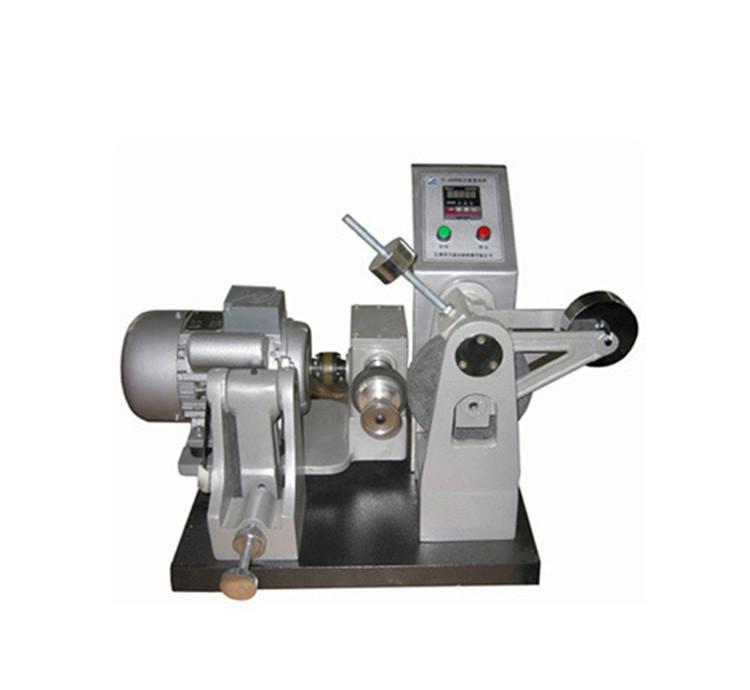
The AKRON abrasion testing machine/rubber Akron abrasion tester is used to determine the abrasion resistance of rubber products or vulcanized rubber, such as shoe soles, tires, and vehicle tracks, in order to evaluate the performance of the tested product.
(1)GB/T 1689 : Rubber vulcanized—Determination of abrasion resistance (Akron machine)
(2)ISO:4661-1:1993: Rubber, vulcanized or thermoplastic - Preparation of samples and test pieces - Part 1: Physical tests
(3)ISO 2481:1988: Rubber, vulcanized—Determination of density
(4)ISO 471:1983: Rubber—Standard temperatures, humidities and times for the conditioning and testing of test pieces
(5)ISO 1826:1981: Rubber, vulcanized—Time-interval between vulcanization and testing—Specification
(1)High-precision measurement: Utilizing advanced sensor technology and precise mechanical structures, the machine can achieve accurate measurement of material wear, providing reliable data support.
(2)Diverse testing modes: Supports multiple testing modes, including dry abrasion, wet abrasion, and grinding wheel abrasion, to meet the testing needs of different materials and application scenarios.
(3)Automated operation: Modern wear testing machines are typically equipped with an automated control system, which can automatically complete the testing process, reducing human error and improving testing efficiency.
(4)User-friendly interface: The equipment features an intuitive digital control panel or computer software, allowing users to easily set test parameters, monitor the testing process, and obtain test results.
(5)Wide range of applications: Wear testing machines are suitable for testing the wear resistance of various metal materials, non-metallic materials, and composite materials, and are widely used in materials science, mechanical engineering, aerospace, and other fields.
(1)Grinding wheel
(2)Rubber wheel
(3)Weights/Loading device
(4)Counter
(5)Sample holder
(6)Angle adjustment device
(7)Power cord and power switch
| Description | Details |
|---|---|
| Grinding wheel diameter | Φ150mm, 40mm(w), particle size 36# |
| Grinding wheel speed | 34±1r/min |
| Incline range of test material | Adjustable from 0 to 35° |
| Test shaft speed (GB) | 76±2r/min |
| Load | 26.7N±0.2 |
| Counter | LED, 0——99.999.999 |
| Volume (W×D×H) | 60 × 50 × 45cm |
| Weight (approx) | 60 kg |
| Power | 1 #, AC220V, 50Hz (depending on country or designation) |
Outer diameter 2 ", inner diameter 1/2 ", thickness 1/2 ", circumference 220mm, hardness 60——70
1. Prepare the core of the specimen according to the conditions of obtaining the specimen. And record its exact weight.
2. Fix the specimen core on the core shaft seat, and then adjust the Angle of the specimen. (Usually set to 15∘)
3. Different test methods are divided into high standards and low standards according to material requirements.
High standard requirements:
a. Angle (the Angle between the test piece and the grinding wheel)15∘
b. Load :6 pounds
c. Pre-grinding revolutions :300 revolutions
d. Remove the specimen core, brush with a clean brush to remove the powder, then weigh the exact weight with a precision balance, and record the weight of the sample before the test
e. Install the specimen core and set the wheel rotation times :3000 revolutions
f. After the wear is completed, remove the specimen, brush with a clean brush to remove the powder, and then weigh the accurate weight with a precision balance, which is the weight of the sample after the test
g. Substitute the formula to calculate the grinding amount
Low standard requirements:
a. Angle (the Angle between the test piece and the grinding wheel)15∘
b. Load :2 pounds
c. Pre-grinding revolutions :200 revolutions
d. Remove the specimen core, brush with a clean brush to remove the powder, then weigh the exact weight with a precision balance, and record the weight of the sample before the test
e. Load back the specimen core and set the wheel rotation times :2000 revolutions
f. After wearing, remove the specimen, brush with a clean brush to remove the powder, and then weigh the exact weight with a precision balance
This is the test weight after the test
g. Substitute the formula to calculate the grinding amount
4. After all specimens have been tested, remove the weight and store it, and remove the debris on the machine.
Wear value calculation method:
Wear (volume m1)== Weight before test - weight after test
Specific gravity algorithm:
a. If the test material is heavier than water
Specific gravity = Weight in air ÷(weight in air - weight of sample in water)
b. If the test material is lighter than water
Specific gravity = weight in air ÷ volume
1. What is the primary purpose of the AKRON Abrasion Testing Machine?
It measures the abrasion resistance of vulcanized rubber by rubbing a specimen against a calibrated abrasive wheel under controlled load and tilt angle, determining the material loss over a specified distance.
2. Which types of materials can be tested using this machine?
The tester is suitable for vulcanized rubber and other elastomeric materials used in tires, hoses, seals, and industrial rubber components.
3. How does the machine operate?
The specimen rotates against an abrasive wheel at a set tilt angle and load. The machine digitally counts abrasion cycles and stops automatically when the test reaches the preset distance.
4. Which standards does this tester comply with?
It meets international and national standards, including GB/T 1689. BS 903. CNS 734. and JIS K6264.
5. Who typically uses this equipment?
Rubber manufacturers, quality control laboratories, and R&D teams use it to evaluate material durability, improve formulations, and ensure product performance under abrasion.


