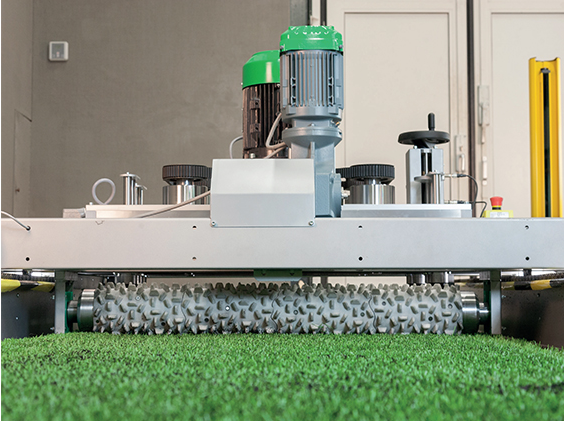
An artificial turf wear tester is a device specifically designed to evaluate the wear resistance of artificial turf. It tests the wear performance of artificial turf by simulating friction conditions encountered during actual use.
(1)FIFA Quality Programme: Exceeds 2015/2016 handbook requirements for artificial turf abrasion resistance testing
(2)EN 15330-1: European standard for shock absorption and deformation recovery in synthetic sports surfaces
(1)Abrasion System:
Rubber-Coated Discs: 200mm diameter with 60 Shore A hardness.
Particle Rollers: Interchangeable grit inserts (40/60/80 mesh).
(2)Control Panel:
10” HMI touchscreen with pre-loaded FIFA test protocols.
USB/Ethernet ports for PC connectivity and remote diagnostics.
(3)Safety Systems:
Emergency stop with E-Stop loop monitoring.
Overload protection at 110% of rated capacity.
Software Suite:
(4)TurfDur Pro™: Auto-calculates abrasion resistance (FIFA stars) and fiber loss.
Cloud Sport: Remote monitoring for global R&D teams.
(5)Illumination:
Adjustable LED array (3.000–6.500K color temperature).
Anti-glare diffusers for operator comfort.
1. Assessing Wear Resistance
The artificial turf wear tester simulates real-world friction conditions to test the wear resistance of artificial turf. This helps understand the turf's wear performance under different conditions, providing data support for its performance in practical applications.
2. Quality Control and Inspection
During the production process, this equipment can be used to test whether the artificial turf meets the predetermined wear resistance requirements. This helps ensure the consistency and stability of product quality, reducing return and repair costs caused by quality issues.
3. Product Development and Optimization
Testing with the artificial turf wear tester provides data support for product development and optimization. For example, when developing new materials or processes, this equipment can be used to evaluate the impact of different solutions on wear resistance, thus selecting the best solution.
4. Standard Setting and Verification
This equipment can also be used to develop and verify wear resistance standards for artificial turf. Through the accumulation and analysis of a large amount of test data, more scientific and reasonable wear resistance standards can be established, providing a basis for quality control and inspection in the industry.
| Specification | Details |
|---|---|
| Test Area | 12m² (1m × 12m) |
| Speed Range | 0.1–1.0 m/s (adjustable in 0.01 m/s steps) |
| Cycle Capacity | 1–10.000 cycles (pre-settable intervals) |
| Power Supply | 380V/32A/50Hz (3-phase) |
| Dimensions (W×D×H) | 6.500mm × 2.000mm × 1.800mm (folded) |
| Expanded Footprint | 8.000mm × 3.000mm × 2.200mm (operational) |
| Weight | 1.500 kg (net) |
(1)Standard Kit:
2 × Abrasion discs with rubber coating.
4 × Particle roller inserts (40/60/80 mesh).
Quick-release sample clamps.
(2)Software Add-Ons:
Batch Processor: Queue 24/7 unattended testing.
API Integration: Connect to MATLAB/Python for custom analytics.
(3)Calibration Services:
Annual recalibration with NIST-traceable certificate.
(4)Custom Upgrades:
Climate chamber integration (-20°C to +60°C).
Automated fiber loss measurement system.
(5)Consumables:
10L Replacement abrasive particles.
1L Silicone lubricant for high-cycle testing.
1. The equipment features an electrophoretic aluminum alloy frame structure, and all components have undergone chrome plating or anodic anti-rust and anti-corrosion treatment, ensuring a beautiful appearance and durability.
2. The test roller loading is achieved using a servo motor and ball screw drive, accurately controlling displacement and time. High-precision pressure and displacement sensors are included for accurate measurement, and a lifting mechanism facilitates sample installation and removal.
3. The entire machine is controlled by a PLC and operated via a microcomputer, making it simple and convenient.
4. System structure
1) Transverse motion system: This system includes two rollers, linear guides, sprockets and chains, gears and racks, a motor, limit switches, a variable frequency drive, and a counter;
2) Longitudinal motion system: This system includes a tray, linear guides, a motor, and a variable frequency drive.
(1)Regularly clean the testing surfaces, brushes, rollers, and sample holders to remove debris and turf fibers.
(2)Inspect and lubricate moving parts, bearings, and mechanical components to ensure smooth operation.
(3)Check sensors, motors, and electrical connections periodically for proper function and accuracy.
(4)Calibrate the machine as recommended to maintain consistent wear testing results.
(5)Replace worn or damaged components, such as brushes, rollers, or clamps, promptly to ensure accurate testing.
(6)Update software or firmware according to manufacturer guidelines for proper operation and data recording.
(7)Keep detailed maintenance records to track inspections, calibrations, and repairs for consistent performance.
1. What is an Artificial Turf Wear Tester used for?
It evaluates the wear resistance and durability of artificial turf under simulated foot traffic or mechanical abrasion.
2. How does the tester operate?
The instrument uses brushes, rollers, or mechanical arms to repeatedly rub or compress the turf while monitoring wear over time.
3. What types of materials can be tested?
Artificial grass fibers, infill materials, and complete turf systems for sports fields, playgrounds, or landscaping.
4. How is test data recorded and analyzed?
Wear depth, fiber loss, and other parameters are recorded digitally, displayed on the interface, and can be exported for analysis.
5. What maintenance is required for the tester?
Routine cleaning, lubrication of moving parts, sensor checks, calibration, and timely replacement of worn brushes, rollers, or mechanical components.


