The Automotive Wire Scratch Resistance Tester is designed to evaluate the abrasion resistance and durability of automotive wire insulation under mechanical wear conditions. You can use this device to simulate long-term friction, vibration, and contact stress, ensuring that wire coatings maintain integrity and prevent conductor exposure during service life.
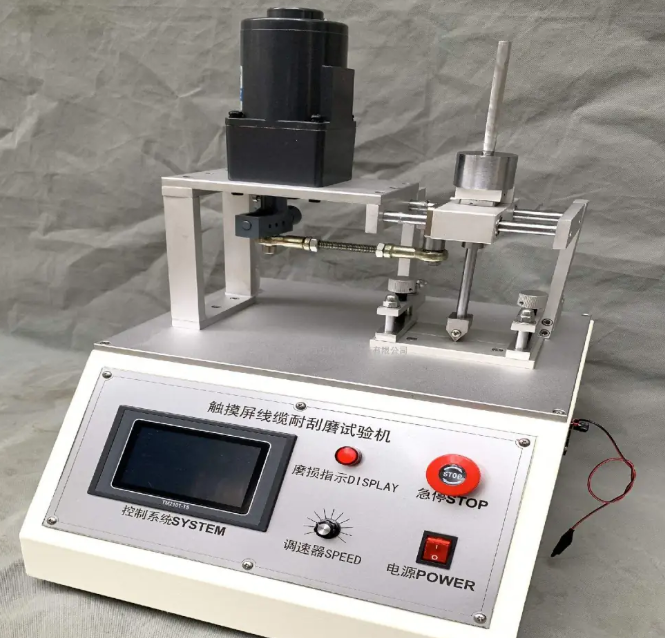
This tester is suitable for:
(1) Abrasion resistance testing of automotive wires and cables.
(2) Evaluation of insulation durability in wire harness systems.
(3) Quality control of cable coatings and insulation materials.
(4) R&D validation of wiring systems for automotive, aerospace, and electronics applications.
The tester adheres to global standards for material abrasion testing, including:
ISO 6722-1 (Road vehicles – Electrical cables – Test methods for abrasion resistance)
SAE J2394 (Standard test for electrical resistance of automotive wire insulation under abrasion)
LV 112 (Volkswagen standard for automotive cable durability)
GB/T 5023 (China’s national standard for electric cables – Abrasion tests)
UL 758 (Appliance Wiring Material standard for insulation integrity)
These standards ensure consistent evaluation of wire insulation durability, coating adhesion, and resistance to mechanical wear.
The tester operates by controlled mechanical abrasion:
Sample Mounting: Automotive wires or cables are clamped between two moving jaws.
Abrasion Cycle: A weighted abrasive head (e.g., tungsten carbide) moves back and forth across the wire surface at a preset load (e.g., 20 N) and speed (e.g., 30 cycles/min).
Cycle Execution: The test runs until insulation breach or a predefined cycle count (e.g., 10.000 cycles) is reached.
Performance Assessment: Post-test, samples are evaluated for insulation damage, conductor exposure, or coating wear using microscopy or electrical continuity tests.
Abrasion Resistance Testing (ISO 6722-1/SAE J2394):
Wires are subjected to 5.000–20.000 cycles to simulate years of vibration and friction.
Pass/fail criteria: No conductor exposure or insulation breach (e.g., <0.1 mm wear depth).
| Parameter | Specification |
|---|---|
| Load Range | 1–50 N (adjustable for light to heavy abrasion) |
| Abrasion Head | Tungsten carbide tip (1 mm diameter) or steel wool (customizable) |
| Stroke Length | 10–100 mm (programmable) |
| Test Speed | 10–60 cycles/min (adjustable) |
| Sample Dimensions | Up to 5 meters (cable length); 1–10 mm diameter |
| Control System | PLC-based with 7-inch touchscreen (multilingual interface) |
| Power Supply | 220V/50Hz, 200W |
| Dimensions | 600 × 450 × 1200 mm (L × W × H) |
Automotive: Validating engine bay wiring, door harnesses, and battery cables.
Aerospace: Testing in-flight entertainment system cables.
Consumer Electronics: Assessing USB-C and HDMI cable durability.
The Automotive Wire Scratch Resistance Testing Machine is essential for manufacturers developing robust wiring systems, ensuring compliance with safety standards and minimizing field failures. Its precision and adaptability make it a cornerstone of automotive component testing laboratories.
(1) What is this product?
It is a testing machine used to evaluate the scratch and abrasion resistance of wire insulation.
(2) What is this product used for?
You can simulate long-term wear conditions to assess insulation durability and prevent conductor exposure.
(3) What is the working principle of this product?
The tester applies a controlled load through an abrasive head moving repeatedly across the wire surface to simulate mechanical wear.
(4) Why is this product important?
It ensures wiring systems maintain insulation integrity, improving safety and reducing failure risks.
(5) Which industries is this product suitable for?
It is suitable for automotive, aerospace, cable manufacturing, and electronics industries.


