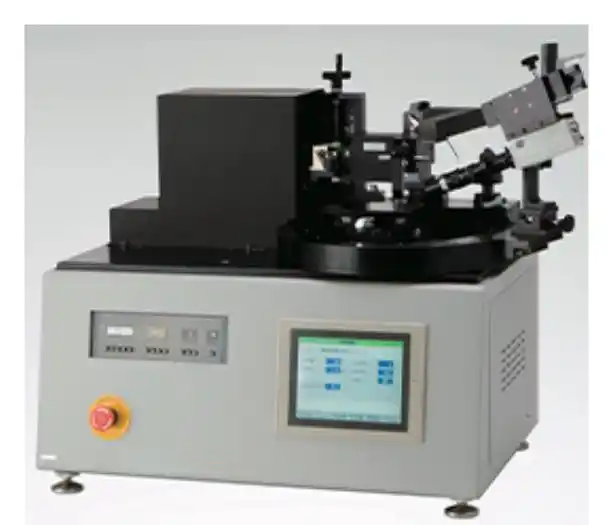
The Variable Load Friction and Wear Test System is designed to simulate real operating conditions by applying controlled friction motion under variable vertical loads. Driven by a servo motor with a gear-and-rack mechanism, the system enables simultaneous measurement of friction force and wear volume, supports three-dimensional wear pattern analysis, and accurately identifies critical load points associated with wear transitions. It offers flexible test modes, high operational safety, and compliance with multiple international testing standards.
Friction and wear performance evaluation of metallic materials
Wear resistance testing of plastics, polymer films, and sheets
Tribological characterization of rubber and elastomer products
Scratch and abrasion testing of ceramics and surface coatings
Friction coefficient measurement under variable load conditions
Typical test samples include:
Metals and metal surface treatments
Plastic films, sheets, and molded components
Rubber and elastomer materials
Technical ceramics and coated surfaces
Polymer and composite materials
GB/T 6040-2008 Test Method for Wear Resistance of Metal Surfaces
ASTM D1894 Test Method for Static and Kinetic Coefficients of Friction of Plastic Film and Sheeting
JIS K 7317:2022 Plastics — Film and Sheeting — Determination of Coefficient of Friction
ISO 4649 Rubber and Elastomers — Determination of Abrasion Resistance
ISO 12137-2 Coated Fabrics — Determination of Abrasion Resistance (Martindale Method)
ISO 20502 Fine Ceramics and Coatings — Scratch and Wear Testing
ASTM G99 Test Method for Wear Testing with a Ball-on-Disk Apparatus
ASTM D3702 Test Method for Wear Rate of Materials Using a Rotating Drum Apparatus
| Parameter | Specification |
|---|---|
| Sliding speed | 0.1 – 50 mm/s |
| Vertical load range | 10 – 1000 g / 1 – 50 g / 100 – 10.000 g |
| Load sensor capacity | 19.61 N / 0.98 N / 196.1 N |
| Worktable size | 120 × 200 mm |
| Main unit dimensions (Type 1) | W 710 × D 490 × H 710 mm |
| Main unit dimensions (Type 2) | W 1000 × D 520 × H 900 mm |
Servo motor–driven gear and rack system for stable and precise motion control
Simultaneous measurement of friction force and wear displacement in a single test
Three-dimensional wear pattern generation for comprehensive tribological analysis
Multiple test modes, including constant load and continuously variable load
Touch panel interface for intuitive parameter setting and mode switching
High safety design with overload protection and advanced noise suppression circuitry
High signal stability with CMRR ≥130 dB (AC/DC) and NMRR ≥50 dB (AC)
(2) Scratch needles
(2) Ball indenters
(1) Vertical gauge
(1) Load variation unit
(1) Set of calibration weights
(1) Power cable
(1) Tool set
(1) Parts box
(1) Operating manual
(1) Tribosoft software package
(1) Friction analysis software
(1) Notebook computer
Optional: Tribo CCD system, heating unit, cooling unit
Mount the test specimen securely on the worktable.
Select the appropriate contact geometry, such as scratch needle or ball indenter.
Configure test parameters including speed, load range, and test mode via the control interface.
Start the test to apply friction motion under variable or constant vertical load.
Record real-time friction force and displacement data during operation.
Generate three-dimensional wear maps showing the relationship between load, friction force, wear depth, and wear cycles.
Identify critical load values corresponding to wear transitions based on test results.
Keep the gear and rack drive system clean to ensure smooth motion
Inspect load sensors and displacement sensors regularly for accuracy
Replace scratch needles or ball indenters when wear affects measurement reliability
Verify electrical connections and safety protection devices periodically
Store software, accessories, and calibration weights in a clean, dry environment
1. What is the core advantage of this product?
The system combines variable load control, friction force measurement, and wear displacement analysis to accurately determine critical wear behavior under realistic conditions.
2. Are the test results reliable?
Yes. Servo-driven motion, high-precision sensors, and advanced noise suppression ensure stable, repeatable, and accurate measurements.
3. Which international or industry standards does it comply with?
It supports GB, ISO, ASTM, and JIS standards covering friction, wear, abrasion, and coefficient of friction testing.
4. Why is this product important?
Understanding friction and wear mechanisms is essential for material selection, durability evaluation, and performance optimization in engineering applications.
5. Which fields is this product suitable for?
It is suitable for materials research laboratories, industrial R&D centers, quality inspection organizations, and manufacturers of metals, polymers, rubber, ceramics, and coatings.


